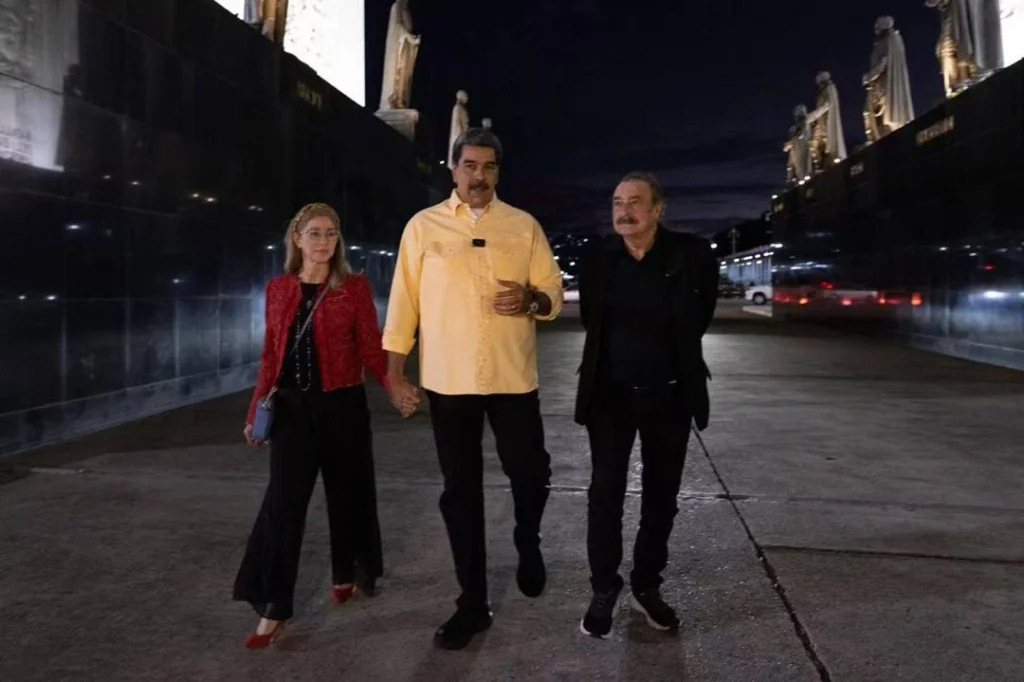
For the tenth consecutive time, Venezuelan President Nicolás Maduro agreed to grant us a “New Year’s interview.” We recorded it in Caracas in the late afternoon of December 31, as night began to fall over the country’s beautiful capital and 2025 came to a close. This time, President Maduro proposed that we conduct a “traveling interview.”
In other words, we had our conversation aboard his private vehicle, which he was driving himself, as we traveled through the lively city streets. In the back seats were Cilia Flores, the president’s wife and First Lady, and Freddy Ñáñez, the young and brilliant Vice President for Culture and Communication. No visible bodyguards, no armed men.
This time, President Maduro’s statements are of particular interest because, for more than five months, his country has been under pressure from a powerful U.S. navy stationed off its coast. Also, because the President of the United States has not stopped issuing threats against Venezuela’s sovereignty. And because this tense situation places President Nicolás Maduro at the very heart of international affairs.
Ignacio Ramonet: First, Mr. President, I am very grateful that you have granted me, for the tenth consecutive time, this “New Year’s interview.” I know you have a very busy schedule, especially under the current circumstances… I’d like to begin by addressing an economic issue: a report has just been published by ECLAC—the Economic Commission for Latin America and the Caribbean—which states that Venezuela will have the highest economic growth in Latin America in 2025, estimated at 9%. My question is: how, under the circumstances of a country under blockade, a country subjected to so many unilateral and illegal coercive measures, a country currently under serious military threat from the United States, does it achieve this “economic miracle”?
President Nicolás Maduro: That’s a good question, you know? First, I want to greet our guests, Cilia Flores, my wife, a special guest; and the philosopher and poet, Alfred Nazaret Ñáñez, is here, keeping a close eye on everything. Look, this is the second consecutive year that Venezuela has led the growth of the real economy in Latin America and the Caribbean. We’ve had twenty consecutive quarters of growth since we took off in 2021.
I remember that when I presented the economic plan to you for the interview you published on January 1, 2022, which you can review, we were talking about how we had designed a plan of economic engines, so that each engine could start running on its own. These economic engines were truly Venezuelan in origin, inherent to our reality; they weren’t things we invented. And the development of each engine, in its capacity for real growth and in the coordination of all the engines, was already beginning to yield results.
In 2021, we had the first two quarters of miraculous growth, right in the middle of the Covid-19 pandemic. I devised the method that became known as the 7×7 Method, which allowed us to begin that growth. From a spiritual perspective, it’s called a “miracle,” but from the perspective of Venezuelan identity, I would say that the growth of this new economy—now with 14 sectors—is the result of the entrepreneurial spirit and the way in which the entire society rebuilt itself, reinvented itself. Venezuelan families, men, women, entrepreneurs, business owners, workers—all reinvented themselves. From the simplest businesses: selling coffee, selling arepas… People rebuilt themselves, the countryside rebuilt itself, and production began… when it had always been said to be impossible. To produce food in Venezuela: meat, milk, chicken, corn, rice, and so on. Everything that was previously bought with oil money. The oil boom distorted everything.
We didn’t choose to have a rentier model dependent on oil. When I was born in 1962, the oil-dependent rentier capitalist model had already been imposed. We were a US oil colony. What we did choose was to begin building the foundations to break free from oil dependency, to build our own model. Commander Chávez laid out the guidelines for us in the “Plan de la Patria” (Homeland Plan), and we tested them at the worst possible moment, in the midst of the blockade imposed on us, when they took away 99% of our oil revenues.
At that time, nothing was being produced in Venezuela. And, without resources, we could no longer import anything… It was then that we said: let’s move forward, let’s rise to the challenge in this situation. And that’s what happened: Venezuela grew, from a spiritual standpoint, from a doctrinal standpoint of economic policy. We designed an absolutely correct policy, that of a real economy, with real values, which gradually became a new productive force. And what is it that is growing? In 2024 we had 9% growth, and in 2025 it will be around 9% as well, perhaps more. What is growing? The real economy is growing, the economy that produces goods and services, that generates wealth at an advanced stage, which is truly astonishing. Because, I repeat, the real economy is growing; every sector of the 14 engines is growing. And the great challenge now—as I have been saying—is for those 14 engines to implement a strategy that will reduce, almost radically eliminate, all imports. We must do everything in Venezuela.
Second: we must have an export sector that is not oil. New sources of foreign currency. And third: supply the market. But I would say that the best formula is to radically replace all imports, all of them. Until we reach zero imports. And produce everything to continue supplying 100% of the national market.
IR: …In food.
Nicolás Maduro: No, in everything, in everything. We’re talking about public services, goods… All the country’s needs: clothing, shoes, everything… Producing everything.
IR: Vehicles?
Nicolás Maduro: Yes, vehicles, of course. And thirdly: continuing to grow in the great engine of non-oil exports. Continuing to grow in the export of seafood; organic produce from the land… Continuing to export our coffee, the best in the world; exporting chocolate, cocoa, etc. We’ve already paved the way; we’re exporting more and more. So our economy has great challenges to continue developing. Because no one can declare victory yet. This is still being done, still being built. And the 14 sectors have demonstrated great vitality. The good news is that, for the second year in a row, we, from a besieged and threatened Venezuela, are leading economic growth throughout Latin America and the Caribbean. That’s great news.
Ignacio Ramonet: Mr. President, this economic success doesn’t preclude another rise in inflation. I ask you, in this very difficult geopolitical context, what strategies does your government have to control inflation, stabilize the currency, and improve the purchasing power of pensioners, workers, and wage earners?
Nicolás Maduro: First of all, we’ve had an absolutely correct strategy: indexation. This isn’t talked about in the world… It’s a formula we tested… Indexation, along with entrepreneurship, family businesses, and worker cooperatives, has allowed Venezuela to have one of the most powerful domestic markets, and what I’ve been calling, since September 2024, an “internal overheating of trade.” Right now, in December 2025, trade in sales and consumption grew by 34%, meaning there’s a very significant overheating. But domestic products already cover 90% of all product demand in the national market. And trade is growing again this year at 34%… Which means there is real purchasing power; real consumption capacity within Venezuelan families. And Venezuelan families know this. But this needs to be consolidated as a model.
The other issue has to do with the constant speculative attack on our currency, the bolívar. It’s something we’ve managed to overcome in stages. Because this has also become what we could call the central objective of the extreme right and the campaigns of economic threats and blockades imposed by the empire.
One of their objectives now, with this whole issue of attacks on oil tankers and the sale of Venezuelan oil, is to once again disrupt monetary life and the balances we have already achieved and consolidated in previous stages. It’s a disruption we know how to confront, and that we will confront. And when we do our interview in a year’s time, you’ll see that we’ve already overcome it.
Ignacio Ramonet: Mr. President, I want to address another topic that isn’t discussed much. And that is the originality of the Venezuelan political model. In 2025, you strongly promoted the Communal State, and I ask you, in this current context of so many threats against Venezuela, why have you decided to deepen popular self-management instead of centralizing control? Is the commune the Bolivarian political response to the dominant liberal democratic model in the West? Is there a specific new model of Venezuelan democracy that you are considering?
Nicolás Maduro: I believe that this model was born with The Blue Book, from 1990, by Commander Chávez, when he was already speaking of “Bolivarian democracy,” popular democracy. Without a doubt, Western democracy, the classical democracy they call liberal, has reached a point of terminal exhaustion. It no longer represents the people. These are democracies without the people; they are manipulated, easily manipulated democracies; they are democracies for minorities, and increasingly, they are democracies that operate based on the interests of billionaires and large corporations. They are democracies subjected to the manipulation of social media, to the emotional manipulation of social media. Therefore, the community, the citizen, has no power in these democracies. Fundamentally. This is not to say that there aren’t positive experiences in what they call “Western democracy.” Of course there are.
But from the beginning, we had our own original project, inspired by Bolívar, Simón Rodríguez, and Ezequiel Zamora. Commander Chávez, in The Blue Book, proposed remaking democracy through a popular constituent process. And remaking the formula of democracy to build an everyday democracy. A permanent democracy. A democracy with the people. Where complete power is given to the people. And what is power? First and foremost, power is politics. Deciding. Deciding public policies. Secondly, there is economic power. The power to decide the budgets. To decide the national budget. And thirdly, there is the power of culture. The power of education. So that is what we are building. Commander Chávez founded the Communal Councils, he founded the Council of Communes. And you undoubtedly remember how Chávez entrusted it to me, but he entrusted it to all of us. He told me, grabbing my shoulder: “Nicolás, I entrust the communes to you as I would entrust my life to you.”
When he said that, I felt the weight of centuries on my shoulder, right next to him… But, fortunately, our people took that weight on, and now it doesn’t weigh me down. Look, my shoulders are free, because our people are now exercising direct democracy.
This year we had four national consultations. Oh, of course, for AP, EFE, CNN, UPI, AFP, for the Western media, direct democracy doesn’t exist. For them, what exists is the constant attack against Bolivarian Venezuela. But here I challenge anyone who wants to debate, anyone, whatever their name, whatever their position, I challenge them to debate in any neighborhood of Caracas, to go and debate with our people; not with me, but with the people. So they can see how a new democracy is being built.
We don’t pretend to be a model for anyone, but we are proud of what we are building. So the people are empowering themselves, forging themselves, forming themselves. There have been four consultations, one per quarter, and this year we also approved 33,000 community projects that were funded and built. These include public works, health centers, community health clinics (CDIs), schools, high schools, roads, highways, infrastructure, senior citizen centers, youth centers, and much more. Problem-solving.
Where do these projects come from? From the neighborhood assembly. And how are the projects approved? They aren’t approved by a mayor, a minister, or a president. I don’t approve something for this community; I don’t say, “Look, do this for us,” no. The people approve it with their vote. 33,000 projects… More than 330 million dollars were invested. Where did that 330 million dollars come from? Its equivalent in Bolivars came from the 14 engines, from the taxes collected, from exports, from oil, from those oil tankers that leave… All of that is then transformed into community projects; it becomes solutions to needs.
So I believe we are building a vigorous democracy, a permanent, participatory democracy, where the people have the power and only the people decide. That’s why I embrace Chávez’s expression when he said: “It’s not a man, it’s a people.” It’s not Maduro, it’s a Republic, it’s a people. What Maduro does is interpret a power that is the power of the people.
IR: How many communes are there currently in the country?
Nicolás Maduro: There are 49,000 communal councils. And there are 4,100 communes. But we are organized for quarterly consultations in 5,336 communal circuits. How is this? Well, where there are communes, the commune coordinates the communal councils and forms a communal circuit. But where there aren’t communes yet, communal circuits are organized so that people can vote and decide. So it’s our own model. We didn’t copy it from anyone.
IR: And is that true both in the city and in the countryside? Both in the capital and in the states?
Nicolás Maduro: Yes. From north to south, from east to west. You go to the most remote mountain, to the hamlet, to the countryside, to any neighborhood you want to go to right now, and there’s a communal council, a commune. There’s a voice, leadership. Seventy percent of the leadership is women. So 2025 has been the big bang of democratic power in Venezuela.
Ignacio Ramonet: Mr. President, you have criticized and denounced—you just did so—the existence of a media and cognitive war against Venezuela, against the Bolivarian process. How is your government fighting to ensure that the truth about what is happening here reaches international public opinion? Especially at a time like this, when communication is dominated by social media.
Nicolás Maduro: We have created a national system that is already beginning to have an international impact, and what I call in a book I published, a sort of manual: From the streets to social media, from social media to the media, from the media to the walls. And the “Radio Bemba,” which in other places is called “Word of Mouth.”
So, we have been building this system. There is still much to be done, but I am truly very happy with how millions of men and women here in Venezuela and around the world are defending the truth about Venezuela.
The war is cognitive because the war is for the brain; the brain manages emotions and concepts. And to counter this cognitive warfare, we must build a force of conscience, a force of values, a spiritual force, and fight the battle with the truth. Our greatest weapon is not a nuclear missile; our greatest weapon is the truth about Venezuela, which is irrefutable, devastating, and when they create an opening for us to speak our truth, the lights come on for the good of our country. We defend our right to peace, we defend our right to national sovereignty, to international law that guarantees the self-determination of peoples. We defend the right to a future and to development.
These are fundamental rights guaranteed by the United Nations and all international treaties. The right to the development of peoples, the right to a future, the right to peace. We also defend a glorious history, the history of the liberators of America. So I believe that this system of streets, networks, media, and walls will gain strength and substance, and will allow us, in 2026 and in the years to come, for Venezuela to be known for its truths and not for so much manipulation and so many dirty attacks.
Ignacio Ramonet: Mr. President, precisely in that sense, recent independent polls show that there is currently a broad consensus among the Venezuelan population to reject the current US military threats. How do you interpret this popular support, and what strategies are you implementing to keep the Venezuelan people united?
Nicolás Maduro: I believe that people, especially around the world—I would say, because I speak from the heart of a man who grew up as a simple person. I am not a magnate, I don’t want to be one, I want to remain a simple man of the people, who governs from the people and with the people. Now, the world has to understand, American public opinion has to understand, that our peoples in the Global South have the right to exist, to live… That it is not possible to try to impose, with the Monroe Doctrine, or with any doctrine, a new colonial model, a new hegemonic model, a new interventionist model, a model where countries would have to resign themselves to being colonies of a power, and we, the people, slaves of new masters… That is unfeasible. In the 21st century, it is completely unfeasible. And they have to understand these numbers that the polls give. I imagine that at the highest levels of government decision-making in the United States, in the government in general, in all institutions, they must have reliable data on how citizens behave, because there’s something now called big data, and they do it with artificial intelligence, and you can have the public opinion of all countries. I’m going to tell you a secret, can I tell you?
Ignacio Ramonet: That’s what we’re here for, this is a confessional…
Nicolás Maduro: [laughs] We have advanced artificial intelligence and big data, and artificial intelligence from many countries. It’s not complicated to understand. We have the technology; it’s not only one of our ways of measuring public events, but also those of other countries… So those world powers also have it, and they have to know that the immune reaction of Venezuelan society to the assault and theft of its oil has been 95% rejection. The current US government needs to know that in Venezuela and Latin America—but I’m speaking specifically about Venezuela; I won’t give you data for Latin America, we can discuss that another day, in another conversation sometime in January—they need to know that 95% of citizens reject what the current US government is doing when it militarily threatens Venezuela. It’s the immune response of all Venezuelan society. They need to know that the person they’ve installed as the right-wing leader is very isolated and widely rejected in Venezuela.
Right now, we could say that the United States doesn’t have any political allies in Venezuela, because this woman named María Machado—in Venezuela they call her “La Sayona”—has an 85% rejection rate, a total repudiation of Venezuelan society. Neither she nor what she represents would ever have the capacity to govern this country.
I know they know it. They know it in the North, and the world in general knows it. And you need to know that we, the patriotic forces of the country, President Maduro, and far beyond the PSUV, far beyond the Great Patriotic Pole, currently enjoy over 70% support in the fight I am waging for the defense of national sovereignty and for peace. Over 70%.
We have never had numbers like these before. And there has certainly been support for Commander Chávez throughout all his phases, and we have certainly gained support at different times, as we have demonstrated in electoral processes.
So these are very compelling numbers that tell you the state of national public opinion and how Venezuela has achieved a level of consensus, of national unity, never before seen. Never before seen! I call it the perfect popular-military-police union, but we could even call it the broadest union of all sectors, the national unity we have ever had.
That is the natural immune response of Venezuelan society to the illegal, disproportionate, threatening, and warmongering aggression we have suffered for 28 continuous weeks.
Ignacio Ramonet: Let’s talk, then, about the U.S. military threat. Venezuela has been facing this naval military threat off its coast for more than five months. And the question many people are asking is, how do you interpret the United States’ intentions? What is Washington seeking? Do they want to pressure us to break the national cohesion we just discussed, the unity of the Bolivarian Revolution, the unity of the Bolivarian National Armed Forces? Or are they trying to launch a real attack to proceed with what is called a “regime change”? How do you interpret this threat?
Nicolás Maduro: I think there is an open debate in American society, and here in Venezuela as well. What is the current U.S. government seeking with all these threats? Unusual, illegal, and extravagant threats, too.
And what is their goal? What are they seeking? It is clear they seek to impose their will through threats, intimidation, and force. All of this violates international peace law, established after World War II with the founding of the United Nations in 1945. In fact, the 80th anniversary of the founding of the United Nations was recently commemorated. And international law, the UN Charter, which is the backbone of all international law since the post-war period, expressly prohibits and condemns any country threatening another with the use of force. It prohibits it, condemns it, and establishes it as an international crime. And it condemns and prohibits the use of force by one state against another.
This has significant legal implications. They are blatantly violating international law. And, furthermore, it has a significant ethical and moral component. Because the people of the United States must ask themselves if they elected their current administration to initiate military interventions in Latin America once again. To the American public, to the media, but above all to ordinary people, to the youth of the United States, to the Christian community, my Christian brothers and sisters in the Christian churches—I am a member of a church—I ask if it is ethical, if it is moral, and if it is Christian to do what your government is doing.
If you elected your government to initiate military interventions again in Latin America and the Caribbean; to seek regime change by force in Latin America and the Caribbean; to stage coups, to promote coups in Latin America and the Caribbean. To begin preparations for a great war, one of those “eternal” wars. Because I have said it in my speeches and in my song as well: “Not war, not crazy war.” Right? “Not crazy war. Yes, peace.” I have said it, I even said it—and then it became a song. I have said “no” to another Vietnam War. Or are they proud in the United States of what happened in Vietnam? I don’t think so.
If you conduct a poll, 80% of the American population doesn’t want another Vietnam War. They don’t want another war in Afghanistan. Or are they proud of Afghanistan? Oh, they’re going to bring a Vietnam War, an Afghan War, an Iraq War, a Libyan War here to the Caribbean, to South America. These are just thoughts. These are just thoughts. So, the current U.S. government’s policy is contrary to what American society and humanity aspire to.
Because what humanity aspires to is dialogue, diplomacy, peace, respect between states, respect between peoples. We are acting within our law. I, as president, am acting within my law. We are acting within our law, international law, the Constitution. We are defending what is most sacred to us: our land, our natural resources. Because, what is the goal? What is the goal of the current U.S. government? They’ve already stated it. They’ve already said it. Right? To seize all of Venezuela’s oil. They’ve already said it. The gold. The rare earth elements. Venezuela’s riches.
So there’s an expression in Spanish that goes: “Not like this! Not like this!” We want peace. We want respect for international law. And let’s wait for the weeks and months to come, and hope that American society, global society, can develop solutions to dispel and end this entire threat.
Ignacio Ramonet: The most reputable American media outlets have already stated that some of the arguments put forward by the US administration in this pressure campaign against Venezuela—for example, that Venezuela is a “cocaine-producing country”—are untrue. This isn’t the Venezuelan government’s claim; it’s the US media themselves. It makes no sense. It doesn’t correspond to the reality demonstrated by anyone familiar with the issue. And regarding the oil issue, the US president’s statement that he disagrees with the “nationalization of oil” that took place in 1976, that is, long before Chavismo, also makes no sense. So, it’s not clear what the specific argument is for this military pressure.
Nicolás Maduro: Look, regarding the drugs, I can tell you. Venezuela has, I would say, a perfect model for combating drug trafficking. Today we managed to destroy the fortieth foreign drug trafficking plane belonging to Colombia. Who? The Venezuelan Sukhoi fighter jets. My congratulations to the pilots. Today, in a battle in the Venezuelan plains, the last operational leader of the Tren del Llano gang, in Guárico state, and four of his criminal accomplices were neutralized. He was the last remaining member of the Tren del Llano. We have a perfect model for combating drug trafficking and criminal gangs. So, all the cocaine that moves through this region is produced in Colombia. All of it. All the cocaine. We are victims of Colombian drug trafficking.
Not just today, but for decades. And we have managed, with our model, to control the impact that Colombian drug trafficking had on Venezuela in the past.
So, we have a tremendous battle on the border. We dedicate billions of dollars to having police, soldiers, and operations because the Colombian border is completely devoid of military and police protection. We have created three peace zones along the 2,200 kilometers of border with Colombia. But there is no cooperation whatsoever from the Colombian side. So, we have to do all the work ourselves.
And these forty aircraft shot down, all forty came from Colombia… With the law on our side, the interdiction law, they were warned in advance, everything that needed to be done was done, and then, bang bang bang, the Sukhoi rockets.
Today we have reached 431 foreign and Colombian drug trafficking aircraft shot down… With the law on our side. So we have an exemplary and very effective model.
Everything else, look, is part of a narrative that even in the United States they don’t believe, not for any reason. And simply put, since they can’t accuse me, since they can’t accuse Venezuela of having weapons of mass destruction, since they can’t accuse us of having nuclear missiles, of preparing a nuclear weapon, of having chemical weapons, then they invented an accusation that the United States knows is as false as that accusation about weapons of mass destruction, which led them into an endless war.
In the United States, they know that’s false. So, I think all of that needs to be put aside, and we need to start a serious conversation, with facts in hand. And the United States government knows this, because we’ve told many of its spokespeople, that if they want to seriously discuss an agreement to combat drug trafficking, we’re ready. If they want Venezuelan oil, Venezuela is ready for US investment, like with Chevron, whenever, wherever and however they want.
In the United States, they need to know that if they want comprehensive economic development agreements, here in Venezuela too—and I’ve said this a thousand times—look at what happened with the migrant issue. I have to tell you this because we reached an agreement on January 31, 2024, with envoy Rick Grenell. It was working perfectly, and three weeks ago, the U.S. government authorities stopped sending migrants to Venezuela, and they simply stopped sending any more migrants… So they talk about migration, but they’re the ones who suspended the migration agreement, among other things. If there were ever any rationality and diplomacy, these issues could be discussed, and we have the maturity and the stature. Besides, we are people of our word, Ramonet. We are people of our word, serious people. And someday this could be discussed, with the current government or with whoever comes next.
Ignacio Ramonet: A very important question, Mr. President. Among the recent statements in Washington, they say there has been a kind of “ground attack” in Venezuela, allegedly against a drug production facility. Your government has neither confirmed nor denied this information. What can you tell us about this?
Nicolás Maduro: Look, that’s a topic we might discuss in a few days, in a second version of this podcast, right? We could certainly talk about it in a few days. What I can tell you is that our national defense system, which combines popular, military, and police forces, has guaranteed and continues to guarantee territorial integrity, the peace of the country, and the use and enjoyment of all our territories. And our people are safe and at peace.
Ignacio Ramonet: You had a direct conversation with President Donald Trump, didn’t you? And lately, it’s been said that there was a second conversation. Can you confirm if this second conversation with President Trump took place?
Nicolás Maduro: I’ve been seeing speculation about a second conversation. We’ve only had one conversation, Ramonet. He called me last Friday, November 21st, from the White House, and I was at Miraflores Palace. We spoke for 10 minutes. It was a conversation, as I’ve said, respectful, very respectful, cordial.
Ignacio Ramonet: What did President Trump say to you?
Nicolás Maduro: The first thing he said to me was, “Mr. President Maduro.” And I said, “Mr. President Donald Trump.” And I think that conversation was even pleasant. But the events following the conversation haven’t been pleasant.
Let’s wait and see. I entrust everything to God. Almighty God. Creator of heaven and earth. Especially on a day like today, December 31st. With a marvelous, majestic sky, with that color as the afternoon fades, in this peaceful and beautiful Caracas. I entrust everything to God; God knows what He’s doing. Let us act with ethics, with morality, with patriotism, with love for our country.
By 2026, which is the year I have called the “Year of the Admirable Challenge,” we will overcome disturbances and problems, and we will be able to continue consolidating a country like Venezuela, a country at peace. And to the people of the United States, I say what I have been saying: here in Venezuela, you have a brother nation. To the people of the United States, I even say: here you have a friendly government. I know the United States well; I have driven quite a bit in New York, Boston, Baltimore, Philadelphia, New Jersey, Queens, Manhattan, Washington… I have driven quite a bit.
I told the President of the United States that. I know Constitution Avenue quite well; it’s beautiful. Pennsylvania Avenue, where the statue honoring Bolívar stands. The Lincoln Memorial, which is magnificent. And I’ve driven there quite a bit. And the people of the United States should know that they have a friendly, peaceful people here, and a friendly government as well. They should know that. And that our motto is very clear: No war, yes peace.
Ignacio Ramonet: Last question, Mr. President, precisely on this. We’ve seen you these past few weeks, in these circumstances of undeniable pressure, very active in public and very well supported by the masses. In other words, you’re not in a bunker, protecting yourself from this threat. You’re surrounded by people, and some of your speeches have gone around the world. Precisely this slogan, “No war, yes peace,” in the various songs that have been made. I think social media has expressed great sympathy toward you. And I want us to conclude with a personal reflection from you. How are you experiencing this situation personally, psychologically, spiritually, in the face of the threat of an attack by the world’s leading military power?
Nicolás Maduro: I have an infallible refuge: Almighty God. I entrusted Venezuela to Our Lord Jesus Christ. He is the King of Kings. The King here, of our homeland. I entrust myself to Him every day. I entrust our homeland to Him. Always, not just now, always. And furthermore, the people are our greatest shield, our greatest inspiration, our greatest energy. Because it is through these people that we have received everything we are.
And it is for these people that we give everything we are. I am simply not myself. I represent a historical project of 500 years of struggle. I could tell you, I am Guaicaipuro, I am Zamora, I am Chávez, because I am the people. And to embrace the people, to give power to the people, is the reason for being, and the essence of our historical project, and on that path we will always prosper, always, under any circumstances. Our absolute decision is to be loyal to the oath to lead our homeland to greatness. But for Venezuela to be great, we must not harm anyone. Right? Just like the United States, which wants to be great again. Well, let them be great through effort, through work, through a pacifist vocation. And not through threats, nor through war. Enough is enough, no more war. These are convictions. We are driven by convictions, commitments, oaths, and a divine, sacred force that transcends all understanding. Because God is with us, and as our people say: “If God is with us, who can be against us?” So victory, under any circumstances, will always belong to us. That is why we have tranquility, serenity, and the confidence that we are defending the most just cause that has ever been defended. And that the victory of peace belongs to us.
Ignacio Ramonet: Thank you, Mr. President, and Happy New Year.
(This interview was recorded on video for television. Its total duration is 1 hour and 4 minutes. This written version is shorter. I have edited it myself, removing less central aspects and retaining the most essential parts, those most closely related to current international affairs. IR.)
IMAGE CREDIT: President Nicolás Maduro and First Lady Cilia Flores, with journalist Ignacio Ramonet in Caracas / Photo: teleSUR.
[ SOURCE: teleSUR ]

1 comment
Very Interesting!
Excellent interview article! It really should be reproduced in the New York Times so that it will get attention in the US. The only “news” (propaganda) that we get here in the US is that Maduro is a narco-terrorist, that Trump is retaliating with boat strikes, and that Trump plans to take Venezuela’s oil. The US population has heard nothing about the Columbia factor. The lack of information in the US “news” media, and its simple parroting of the Trump administration’s propaganda, is why this US citizen listens to RHC, and reads articles on the RHC website. Best of luck to President Maduro and Venezuela!