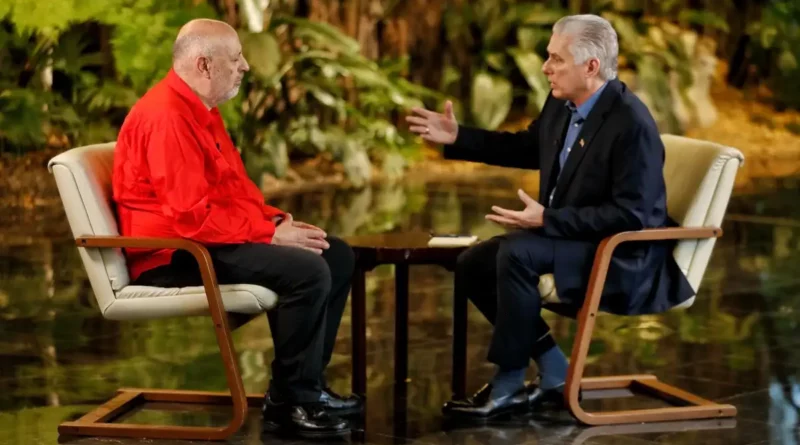
In an interview with the Mexican newspaper La Jornada, Cuban President Miguel Díaz-Canel stated that the greatest failure of the U.S. government in 67 years of revolution is its inability to seize the island. The president explained that this situation has provoked anger, manifesting itself in a tightened blockade since 2019, with more than 240 measures implemented during the first phase of the Trump administration.
Díaz-Canel denounced that Cuba’s inclusion on the list of state sponsors of terrorism has cut off its funding channels, compounded by a recent executive order threatening tariffs on goods from countries that supply oil to the island. This has resulted in the country receiving no fuel for almost four months.
“On January 29, an executive order was issued, considering Cuba an unusual and extraordinary threat to the security of the United States. It is another slander, another completely fabricated claim,” the president stated in an interview.
According to the head of state, the energy blockade is, above all, a flagrant violation of the human rights of the Cuban people and a violation of international law. “It even goes against the logic of capitalism.” “They, who talk so much about free trade, about the free market, impose on us an energy blockade that is criminal.”
The son of a teacher and a worker, Díaz-Canel defines himself as a product of the revolutionary process and emphasized that 80 percent of the Cuban population was born under the blockade. “Therefore, 80 percent have lived their entire lives under the dictates of the blockade. My children, our children, have lived under the blockade. Our grandchildren were born under the blockade.”
Faced with the energy crisis, the engineer by profession detailed a strategy that includes the transition to renewable sources such as photovoltaics, biomass, and biogas, in addition to incentivizing the production of domestic crude oil and associated gas.
“To that end, we are pursuing a strategy of increasing oil well prospecting, exploration, and also improving our extraction processes. In the first two months of the year, we have been able to halt the decline we had been experiencing in the production of domestic crude oil and associated gas,” he explained.
He mentioned that scientific solutions have been found to treat the country’s heavy crude oil, “which is heavy and has a high sulfur content.” He added that “in any case, we will still have a dependence on hydrocarbon imports, which will decrease as we move forward.”
To this end, the president reported that they are seeking to build energy cooperation alliances with sister nations. Furthermore, they are exploring commercial projects that will allow Cuba to diversify and expand its fuel suppliers, “with countries that respect Cuba’s sovereignty and are willing to face the challenges of this energy blockade.”
Regarding the updating of the economic model, the president noted that Cuba exchanges experiences with China and Vietnam, but applies solutions with Cuban characteristics, rejecting the copying of external models.
In the president’s words, it is a Cuban system, but one that shares elements of the Chinese and Vietnamese models. The plan seeks a strong state, an agile public administration without bureaucracy, and harmony between centralized planning and the market.
This combination of elements should allow us to achieve sustainable, socially just, inclusive, and equitable development. We must be able to achieve food sovereignty, strengthen science and innovation, and develop digital transformation and artificial intelligence processes in our society. We must continue to strengthen universal public social services. We must continue to guarantee the rights to education, health, sports, and culture, and boost our economy in all sectors, while maintaining international cooperation. That is the direction we are heading,” he emphasized.
The Cuban presdient also confirmed the willingness to allow investments by Cubans residing abroad under legal regulations that prevent capital being subservient to subversive interests, while maintaining control over the sovereignty of the sociopolitical system. “We must have oversight and control.”
Díaz-Canel stated that with the unity of the Cuban people, “with ideological clarity and the defense of the country’s legality, and also with the understanding of those who come with a commitment to participate in the development of their nation, this entire process can be feasible and beneficial.”
Regarding dialogue with Washington, the president reiterated that talks have taken place between officials from both countries, facilitated by international factors. Along the same lines, he reaffirmed that Cuba is open to understanding as long as there is respect for sovereignty and reciprocity, clarifying that its political system is non-negotiable.
The president rejected the thesis of a “failed state,” calling it a hypocritical construct of those who impose the blockade, and defended the legitimacy of Cuban institutions against attempts at media manipulation aimed at “assassination of the reputation” of its collective leadership.
On the other hand, Miguel Díaz-Canel acknowledged the reality of the Cuban people, with blackouts lasting more than 40 hours and impacts on health and food security, but he highlighted their creative resilience, noting that “every Cuban kitchen has become a wood-burning or charcoal-burning stove. It’s very difficult to have that in apartment buildings.”
Nevertheless, communal kitchens have emerged. “Everyone respects each other, everyone collaborates. But look at the hardships we face. I would ask, how many people could endure a situation like this? Only a people like ours, who deserve a monument.”
Miguel Diaz-Canel proposed perfecting the system of people’s power with greater community participation and popular control in municipal assemblies. Finally, he expressed his deep gratitude to Mexico and President Claudia Sheinbaum for their courage, quoting José Martí’s poem “Love is repaid with love” as the epitome of a close relationship that remained steadfast even when the rest of the world turned its back on the island.
“Mexico is the sister nation that has always stood by Cuba, in good times and bad. The one that has always accompanied us, the one that has never wavered. Let us remember the 1960s, when the whole world turned its back on us due to pressure from the United States, yet Mexico stood firm.
For Cubans, Mexico holds a very special place in our hearts,” the Cuban leader affirmed, concluding: “Thank you, Mexico! A thousand times thank you for always being by Cuba’s side in our nation’s most difficult moments.”
IMAGE CREDIT: According to the head of state, the energy blockade is, above all, a flagrant violation of the human rights of the Cuban people and a violation of international law. Photo: @PresidenciaCuba
[ SOURCE: teleSUR ]