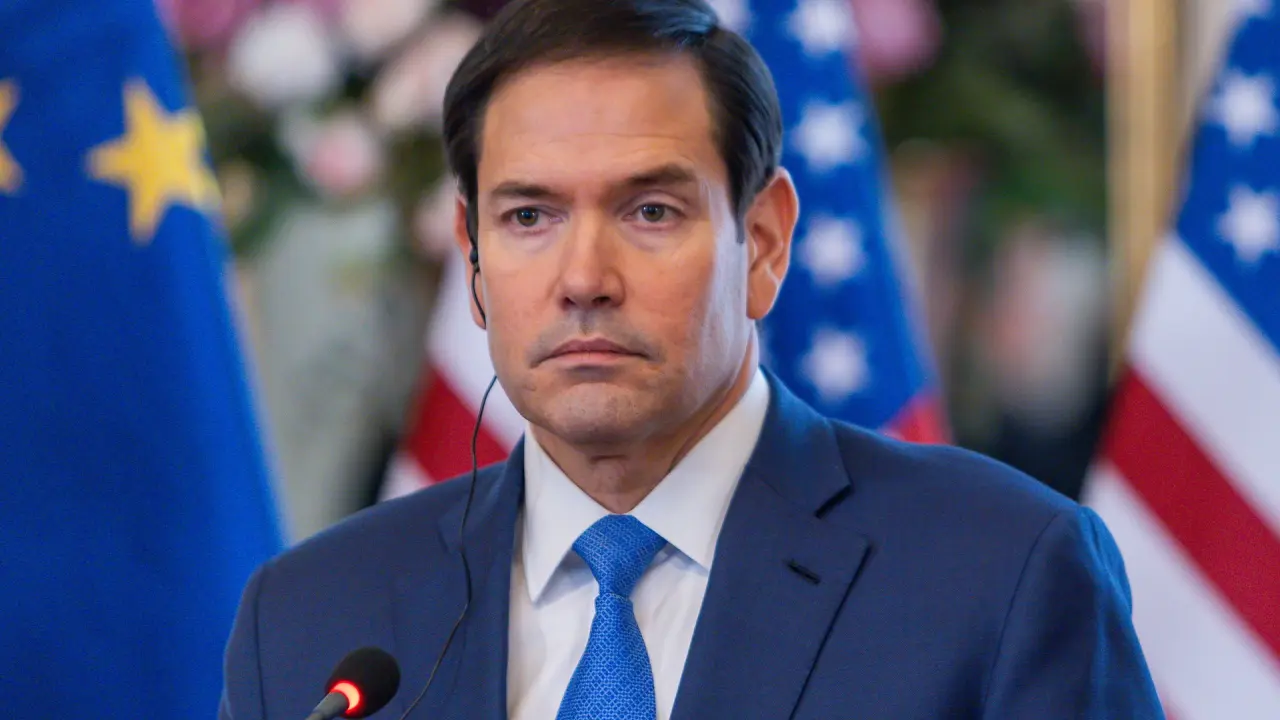
Marco Rubio, U.S. Secretary of State under the Trump administration, delivered a speech at the Munich Security Conference that draws a dividing line in the international order. For him, the West appears as a “victim” of its own decline — a historical setback—that the United States and its allies must now prevent.
“For five centuries before 1945, the West dominated globally with missionaries, soldiers, and explorers. But everything changed,” he stated. His narrative painted decolonization as a “communist plot” that supposedly destroyed five centuries of hegemony, while ignoring histories that predate Columbus himself. This earned him applause from Europeans.
Although figures like Chris Van Hollen, US Senator from Maryland, warned that the standing ovation for Rubio revealed the “weakness” of European leadership, the reaction was unexpectedly complacent. Van Hollen denounced the speech as a call for a “Trumpian lobotomy” that abandons universalist values for “blood and soil” nationalism.
Nick Paton Walsh, analyzing for CNN, noted ironically: Europe seems trapped in “couples therapy” with the United States after a declining political marriage. The Munich organizers themselves had previously warned that the continent was being sidelined from global decision-making.
European leaders showed little resistance. Friedrich Merz, the German Chancellor, criticized only the “culture wars” of MAGA but did not question the imperialist vision. Emmanuel Macron equated territorial sovereignty with France’s right to control its own disinformation.
China Warns of Catastrophic Consequences
Wang Yi, China’s Foreign Minister, responded directly to the speech with a clear message: “Some people (in the United States) continue to try by all means to contain and suppress China.” Beijing identified Rubio as a real threat to its development.
“Washington’s style treats China as an enemy, not as a partner,” the Chinese minister warned. His diagnosis offered two scenarios: cooperation or confrontation. “The rational option—diplomacy and partnership—benefits both China and the world. The irrational one—economic decoupling, fragmentation of supply chains, separation of Taiwan—endangers peace.”
China diagnosed the problem not as institutional failures but as powers placing themselves above the rest. “The reason the international system is failing is not the UN, but rather that some countries exaggerate differences and revive Cold War mentalities,” Wang Yi stated firmly.
Rubio’s views on Taiwan generated particular concern. “Separating the island would cross a red line that would likely lead to conflict,” China warned directly. Beijing sees the American rhetoric as a real danger to regional stability. “Why insist on destructive competition when you can build together?” asked Wang Yi.
A rhetoric that revives the past. Glenn Diesen, an expert on Russian geopolitics, saw in the speech “an outright ideological war against multipolarity,” after Rubio invited Europe to restore an imperial order. “This is not diplomacy—it is a declaration of war against sovereign equality,” argued Diesen, noting that the language revives 19th-century mentalities in a 21st-century world.
But it was Kanwal Sibal, former Indian Secretary-General now at Jawaharlal Nehru University (JNU), who gave the speech its most forceful interpretation: “This is effectively an ideological attack against the rest of the world,” he stated bluntly. “Rubio is building a new kind of empire where Washington would be the absolute master of the international order.” His diagnosis reveals a dangerous strategy: “Washington wants the world to accept its one and only version of the story, completely ignoring other perspectives.”
Analysts agree on the essential point: Rubio isn’t talking about cooperation—he’s talking about domination. Instead of proposing a multilateral order, he presents a narrative where the United States would be the sole global arbiter.
What happened in Munich marked a point of no return. Rubio didn’t offer collaboration; he offered submission by another name. By constructing a narrative where Washington would be the sole guardian of the international order, he transformed the Atlantic Alliance into a matter of submission or independence.
The historical tension is returning between old powers and new structures, modernized imperialisms versus alternative systems. Europe is forced to choose between continuity with an imperialist past or a break with the very roots of the Western order.
As The Guardian points out: “To save itself and the transatlantic alliance, Europe must not only change its policies—it must regain its autonomy before it loses its soul.”
Kaja Kallas completed the circle by declaring her loyalty to the established system. “Let’s not waste time talking about new things when we should be strengthening our militaries, doing it together in our European way,” accepting the imposed terms.
Europe does not want its own army to challenge Washington and has instead chosen to strengthen the “European pillar” within a structure where the United States remains at the helm. The very admission—rejecting a common army in favor of a military power coordinated by Atlantis—turned its intervention in Munich into a ratification, not a proposal.
IMAGE CREDIT: Analysts agree on the essential point: Rubio doesn’t speak of cooperation; he speaks of domination. Instead of proposing a multilateral order, he presents a narrative where the United States would be the sole global arbiter. Photo: EFE
[ SOURCE: teleSUR ]