Sometimes medicine seems like a dream. Not out of naiveté, but out of wonder. Wonder at the precision, coordination and ethics that come into play when a life — especially a child’s — cannot wait.
A few hours ago, in Havana, that wonder had a name: an 11-year-old boy, brought from Las Tunas, diagnosed with an invasive tumor of the sellar region, extending to the base of the skull, with involvement of the sphenoid sinus and clivus. A complex tumor.
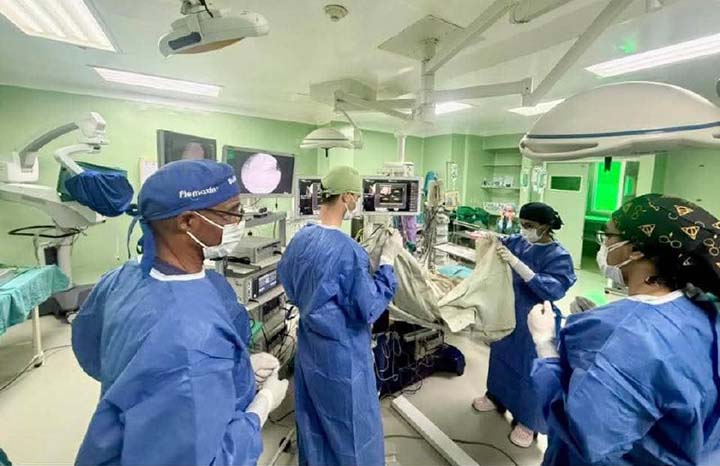
The stage was perfectly set: the operating room of the Institute of Neurology and Neurosurgery, with professionals from this institution and the Juan Manuel Márquez Children’s Hospital.
The decision was clear: an extended endoscopic endonasal approach to the skull base, minimally invasive, with neuronavigation, neuromonitoring, and intraoperative pathology. In the operating room, time seemed to stand still.
As a matter of ritual and responsibility, the patient safety protocol was activated at the start of the surgery. The beginning was signaled by the voice of Dr. Orestes, director of the Institute of Neurology and Neurosurgery:
“Let’s begin. What time is it? Tell me the patient’s name and the diagnosis.”
The most complex cases in the country are operated on there: adults and children with complex pathologies of the Central Nervous System, with good outcomes so far, not only for skull base surgeries, but also for the most difficult and complex surgery a neurosurgeon performs: tumors of the pineal region. All of this is possible thanks to the installed technology.
The anesthesiologists Dr. Misiel, head of the Surgical Unit, Dr. Lisbeth, and Dr. Meiver participated in this procedure; as did the neurosurgeons Dr. Lismary, head of the service at the INN (National Institute of Neurology), and Dr. Miriela, head of the Neurosurgery service at the Juan Manuel Márquez Hospital; along with Dr. Carlos Urbina, a Nicaraguan neurosurgeon completing a fellowship in minimally invasive surgery.
And nurses, technicians, support staff: a human chain that rarely appears in photos, but without which nothing happens. It was the result of the efforts of many people doing what they know how to do, even under increasingly difficult circumstances, such as the lack of transportation, which forces them to get up very early to go and save a life.
At the end, the essential thing happened: the child left the operating room extubated. The pediatric intensivist was waiting for him in the operating room itself. The National SIUM ambulance arrived as planned. Immediate transfer to the intensive care unit at Juan Manuel Márquez Hospital. Everything worked.
The child also had visual impairments, and yesterday he reported that he could see better.
Cuban medicine doesn’t deny the shortages: it confronts them, prioritizes them, and makes decisions. That’s why, when it seemed like a dream, it wasn’t escapism. It was a stark contrast. In contrast to those who reduce Cuba to scarcity, a family saw their son leave after six real, intense, exhausting hours of skull base surgery.
It wasn’t an operating room epic. It was work. It was rigor.
Not to “bring it back to life”, but to defend it from a scientific perspective.
IMAGE CREDIT: Mylenys Torres | Photo: Courtesy of the Ministry of Public
[ SOURCE: AGENCIA CUBANA DE NOTICIAS ]