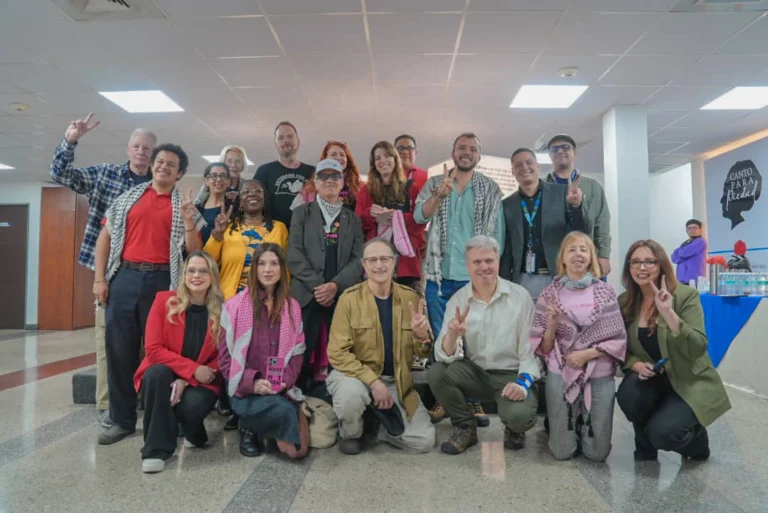
The multiplatform news network of the Global South, teleSUR, opened its doors to a delegation from the International Brigade for Peace and Solidarity with Venezuela, made up of activists from the United States, Brazil, and Colombia, and members of the feminist organization Code Pink.
This visit is part of a solidarity cooperation exchange aimed at strengthening ties between media outlets and social movements across the continent.
The initiative was organized in conjunction with the Simón Bolívar Institute for Peace and Solidarity, an organization that promotes dialogue between social and international actors. During the visit, the delegates toured teleSUR’s audiovisual production facilities, newsroom, and programming departments, observing firsthand the workings of its multiplatform structure, which broadcasts content in Spanish and English to a global audience.
During the tour, the visitors exchanged experiences with the channel’s journalists about the role of the media in covering social and political processes in Latin America. The organizers emphasized that these types of meetings reinforce teleSUR’s commitment to building communication bridges to audiences and movements historically marginalized from mainstream media.


Community Meetings in Caracas
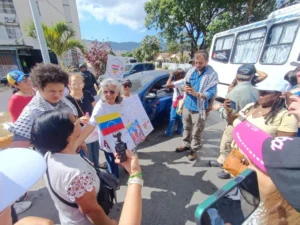
As part of its agenda, the Internationalist Brigade for Peace and Solidarity with Venezuela visited working-class neighborhoods in Caracas, including the El Panal sector in the 23 de Enero district, where they met with families, community leaders, and cultural groups. The activities included assemblies, artistic performances, and meetings with grassroots committees, all focused on raising awareness of the country’s socioeconomic situation and denouncing the unilateral coercive measures imposed against Venezuela.
During a community assembly, Medea Benjamin, co-founder of the feminist organization Code Pink, expressed the brigade’s rejection of Washington’s imperialist siege. The activist also called for the release of President Nicolás Maduro and his wife, Cilia Flores, following the military attack on January 3, which left more than one hundred victims, according to local sources.
Members of the U.S. delegation, including war veterans, offered public apologies for the aggressive policies pursued in recent years. At El Panal, the visitors also participated in traditional dances and a theatrical performance about the Monroe Doctrine, a symbol of resistance against foreign intervention in the region.
Impact of Sanctions and International Solidarity
According to data shared at the meetings, Venezuela faces 1,087 unilateral coercive sanctions, 107 of them imposed in 2025 and 7 additional ones in 2026, including attacks on commercial vessels and the bombing on January 3. Activists acknowledged firsthand accounts from affected families, demonstrating the daily impact of the blockade on access to services, food, and transportation.
“Seeing firsthand how these sanctions affect people’s daily lives completely changes one’s perception,” stated a U.S. participant. Another Brazilian delegate emphasized that the visit represents “a concrete show of solidarity, not a tourist trip.”
The activities also extended to the Ezequiel Zamora housing complex in Ciudad Tiuna, one of the areas affected by the January attacks, where the visitors learned about forms of grassroots organization and community resilience mechanisms. A community leader from El Panal stated: “The Venezuelan people are not alone; every day we strengthen our resistance networks.”

teleSUR strengthens international dialogue
With this visit, teleSUR reaffirms its commitment to international cooperation, justice, and highlighting the experiences of the peoples of the Global South, promoting independent, solidarity-based journalism committed to the truth. The visit represents a new step in the collaboration between alternative media and social movements fighting for peace, sovereignty, and self-determination.
IMAGE CREDIT: International activists tour the teleSUR facilities in Caracas. Photo: teleSUR
[ SOURCE: teleSUR ]