By René Tamayo León
Presidency of Cuba
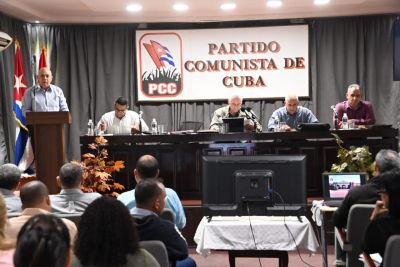
Extraordinary plenary sessions of the provincial committees of the Communist Party of Cuba were held in Matanzas and Mayabeque. They were chaired by the First Secretary of the Central Committee of the Party and President of the Republic, Miguel Díaz-Canel Bermúdez, and the member of the Political Bureau and Secretary of Organization of the Central Committee, Roberto Morales Ojeda.
The country’s core tasks in these complex times, marked by increasing threats from imperialism against the Cuban nation—such as the defense of the homeland, the stability of the national electrical system, food production (including the sugarcane and sugar program), the quality of services to the population, and the fight against indiscipline, corruption, and illegal activities—continued to be the focus of the extraordinary plenary sessions of the provincial committees of the Communist Party of Cuba, which have been taking place throughout January.
Led by the First Secretary of the Central Committee of the Party and President of the Republic, Miguel Díaz-Canel Bermúdez, the meetings continued this Friday. The morning session was held in Matanzas and the afternoon session in Mayabeque, and included the participation of Roberto Morales Ojeda, member of the Political Bureau and Secretary of Organization of the Central Committee, among other leaders.
Members of provincial committees, local leaders, and grassroots activists evaluated the implementation in their territories of the agreements reached at the recently held 11th Plenum of the Central Committee of the Communist Party of Cuba (CC-PCC), the results of the organization’s and the territories’ work in 2025, and the commitments for progress in 2026.
Morales Ojeda emphasized in both meetings the imperative of fulfilling the resolutions of the 11th Plenum. “It is urgent,” he stated, “to comply with these agreements as a guarantee of the Revolution’s survival.” He urged reflection on the role of local groups and the rank and file, starting with an unavoidable question we must all ask ourselves: “What have we done, what are we going to do, and how are we going to do it?”
The party leader emphasized that these could not be just another meeting, but rather a catalyst for changing the way of thinking and adopting a different approach. He called for a review of what needs to be done differently, based on First Secretary Díaz-Canel Bermúdez’s concept of promoting robust discussions while marching together.
MATANCES FULFILLS ITS COMMITMENTS
In presenting the implementation of the agreements from the 11th Plenum of the Party’s Central Committee, the results for 2025, and the commitments for progress in 2026, Comrade Mario Sabines Lorenzo, First Secretary of the Party’s Provincial Committee in Matanzas, highlighted indicators such as membership growth and increased political and ideological work at the grassroots level regarding the organization’s internal dynamics.
Regarding the implementation of the Government Program to correct distortions and revitalize the economy, it was reported that, in budgetary terms, Matanzas was a surplus province in 2025, a trend also observed at the municipal level.
In food production, planting campaigns were completed, and plans for rustic crops such as cassava, plantains, and sweet potatoes, which require less technological input, were fulfilled. Rice production reached 100.4 percent of the planned output, and corn production reached 118 percent, although the food supply to the population is still far from meeting needs.
In the social sphere, Matanzas saw an increase in childcare capacity, higher enrollment in pre-university science programs, and maintained 100 percent medical and nursing coverage in the province’s medical clinics.
Exports and foreign exchange earnings did not fare as well, as agreements were not honored. The housing plan was not completed; freight and passenger transportation fell short of projections; and the plans for beans, tobacco, and pork, among other items, were also not met.
By 2026, the province set commitments aimed at consolidating the Party’s work, with an emphasis on the grassroots; as well as increasing economic and social indicators and the well-being and quality of life of the population, according to the priorities established by the country’s leadership.
To this end, Sabines Lorenzo explained, “work is underway to prepare and train political and administrative cadres on essential topics for fulfilling their missions and tasks,” while the communication strategy is being updated and refined to achieve more active public participation and better citizen oversight.
THE PROVINCE WAS BORN IN THE MUNICIPALITY
During the exchange, several first secretaries of municipal Party committees in Matanzas explained the experiences they are developing in their jurisdictions, which prompted President Díaz-Canel Bermúdez to address the strengthening of local production systems and the municipalization of the economy.
Among other ideas, he reiterated the importance of generalizing the positive experiences that already exist in some territories and advocated for granting municipalities increasing powers to strengthen their management. However, he clarified that this greater autonomy and decision-making capacity requires that municipal officials be properly prepared to assume responsibility.
The goal — he noted, reiterating concepts shared in meetings in other provinces — is a business transformation of the municipalities, where most structures are subordinated to this level, and also achieving a general restructuring that avoids an excess of people in leadership positions in a small country.
Díaz-Canel emphasized the need to conceive of and integrate the non-state sector into the economic and social life of the municipality. He reiterated — as he has done in other provinces — the urgency of establishing appropriate relationships between the state and non-state sectors in order to maximize the productive capacity already installed in state entities. He reflected that, to achieve this, a permanent dialogue with this important sector is fundamental, incorporating it into economic plans and local development strategies.
Addressing two of the main issues shaping daily life in Cuba today—energy and food production—the First Secretary of the Central Committee of the Communist Party of Cuba (PCC) reiterated the principle that new projects and investments in the country must be based on renewable energy sources.
Regarding food production, he called for a review of the directives issued by the Commander-in-Chief during the Special Period, when, he recalled, creative solutions were found and production was maintained. He also emphasized that the increase in local production must have a direct impact on the population, lowering prices and becoming the basis of the regulated family food basket.
The President stressed, however, that no transformation will be possible without popular participation, and within that, the essential role of young people. “All projects must be conceived and executed with the active participation of the people,” he reiterated.
MAYABEQUE IS CHANGING FOR THE BETTER
Also marked by the exchange of experiences in Party work and economic and social activity, the extraordinary plenary session of the provincial committee of the Party in Mayabeque confirmed the changes taking place in the territory in all areas, although the results still do not meet current demands.
In his remarks at the meeting, Comrade Edelso Antonio Ramos Linares, first secretary of the provincial Party committee, insisted that the prevailing work method today is for each leader of the organization to embrace the concepts of the 11th Plenum of the Central Committee; incorporating these into the work system and the individual planning of the cadres.
The party leader addressed two fundamental dimensions of the Party’s work: the political-ideological strategy and the economic-social strategy. This strategy focuses on strengthening unity, refining ideological work, and ensuring the implementation of the Government Program to confront distortions and revitalize the economy.
Regarding the economic sphere, he reported that the province achieved a surplus in the last four months of the year, although this result was only obtained in five of its eleven municipalities.
Plans were met for rural crops, as well as for the production of basic rice, beans, and corn. The current winter planting season is progressing satisfactorily, with a four percent overfulfillment. The province also fulfilled its food delivery agreement with the capital.
However, indicators such as retail sales and selected physical production targets were not met, and the planned production of eight products under state mandates was not achieved. Production targets for eggs, milk, meat, and sugar, among other items, were also not met.
During the Mayabeque plenary session, the negative results in some social indicators, such as infant mortality, the occupancy rate of maternity homes, and teenage pregnancy, which remains high, were critically addressed.
For 2026, the province has set commitments in the party, economic, and social spheres. These commitments include assigned responsibilities, indicators, goals, and deadlines, and will be closely monitored by the provincial leadership. However, it was acknowledged that their success depends on active public participation.
As in the ten plenary sessions held up to this Thursday, on Friday, the First Secretary of the Central Committee of the Party and President of the Republic, Miguel Díaz-Canel Bermúdez, shared key reflections on the party’s work at this time.
Among other points, he also reiterated the call to strengthen unity and avoid complacency, and asked that we not attribute all the difficulties we are facing to the blockade, because—he pointed out—there are also internal causes, stemming from our own actions. He asserted that there are successful examples in the country that, under the same conditions of the blockade and scarcity, manage to move forward. Therefore, the essential question remains: if they can, why can’t others?
IMAGE CREDIT: Foto > Estudios Revolución
[ SOURCE: cubainformacion.tv ]