By Hedelberto López Blanch* / Special Collaboration for Resumen Latinoamericano.
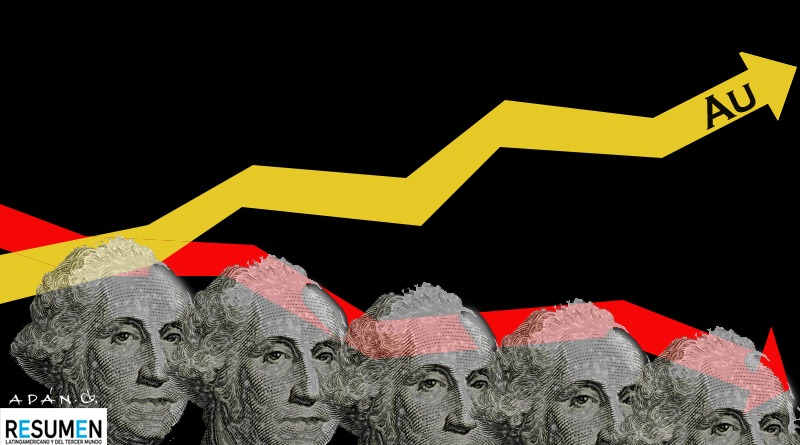
Not like a saw, but more like a hacksaw, the dollar has been losing ground in recent years, and the percentage of reserves held in that currency has decreased by 18 percentage points in a decade, the lowest level in 20 years.
The information provided by the financial analysis bulletin The Kobeissi Letter also indicated that, conversely, gold increased its weight by 12 points in these 10 years, reaching 28%, the highest since the beginning of the 1990s.
This trend is occurring while central banks continue to diversify their assets away from the dollar and accumulate gold, explains The Kobeissi Letter.
The publication notes that in this context, the price of gold rose 65% in 2025, its largest annual gain since 1979, while the dollar index fell 9.4%, its worst annual performance in eight years.
Similar analyses are made by several banks and financial institutions, such as Bloomberg, which reaffirms that the dollar’s share of central bank reserves has decreased significantly over the last 20 years. While in 2001 the US currency represented 72.7% of global reserves, by 2025 this percentage had fallen to 56.3%.
One of the factors contributing to this weakening has been President Donald Trump’s tariff policy, which has caused investors to massively abandon US assets, simultaneously driving down the value of bonds, stocks, and the dollar itself.
The United States is the most indebted country in the world, with an astronomical $38 trillion in debt, and major creditors and buyers of Treasury bonds, such as China, Saudi Arabia, and Japan, have begun to limit their purchases.
Washington sustains the debt by selling these bonds, but given this situation, the Treasury Department will have to deal with it directly.
The weakening of the dollar has also been aided by Saudi Arabia’s termination of the petrodollar agreement and the push by BRICS members to conduct their transactions in national currencies.
In June, Saudi Arabia decided not to renew the petrodollar agreement, which had been in place for 50 years and under which the country’s oil exports were paid for exclusively in US dollars. Now, hydrocarbons can be purchased in yuan, yen, euros, or bitcoin.
As is well known, Washington, in order to maintain its global hegemony and military power, relied on control over the financial system after the dollar was established as the international reserve currency at the end of World War II, following the Bretton Woods Conference in July 1944.
The measure stipulated that foreign currencies could be exchanged for dollars at fixed rates and that, in turn, it was guaranteed that greenbacks could be converted into gold at a rate of $35 per ounce of the precious metal.
When oil prices rose in 1973 due to the Arab-Israeli War, Washington, already heavily indebted, imposed a system of seigniorage on the dollar through Saudi oil profits.
It persuaded the Saudi Arabian nation to sell its hydrocarbons in dollars and invest the profits in Treasury bonds and bills, while guaranteeing arms sales and security in the event of war.
Now, Saudi Arabia’s decision, prompted by China to sell it crude oil in yuan, has jeopardized the dollar’s status as the world’s reserve currency.
Another major blow has been the position of the 10 BRICS nations, which have chosen to conduct most of their transactions in their national currencies.
The Russian Ministry of Finance announced plans to launch BRICS Bridge, a platform that enables cross-border payments between member states. The idea is to use digital financial assets (DFAs) issued by the central banks of the BRICS members, whose assets would be pegged to the national currencies of the member states. This would allow the group to make payments almost instantly at minimal cost, independent of third-party restrictions.
In a short period, bad news for the hegemony of the dollar and the American financial empire has been mounting. As a result, President Donald Trump is attempting to preserve the greenback’s financial dominance through military aggression and tariffs against various governments, which so far have not been successful.
IMAGE CREDIT: Adán Iglesias Toledo.
(*) Cuban journalist. He writes for the newspaper Juventud Rebelde and the weekly Opciones. He is the author of “Cuban Emigration to the United States,” “Secret Stories of Cuban Doctors in Africa,” and “Miami, Dirty Money,” among others.
Special thanks to the author, Hedelberto López Blanch, for his valuable contribution