Statement from The Interreligious Foundation for Community Organization (IFCO/Pastors for Peace)
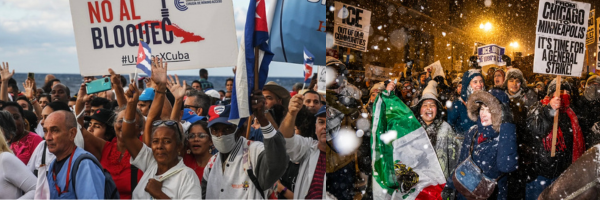
On the eve of a historic, nationwide shutdown organized by the people of the United States—a powerful response to escalating attacks on immigrant communities, workers’ rights, and democratic freedoms—we received with disgust, yet not surprised, the news from Washington. Donald Trump’s latest executive order, dated January 29, 2026 declares Cuba a “national threat” and triggers an unprecedented escalation punishing any nation on earth that dares to sell or give oil to the island. This is not a new policy, but the intensification of a sixty-seven-year campaign of economic aggression. It is no coincidence that as people across the U.S. mobilize to defend their communities, the people of Cuba gather in the streets of Havana to denounce this very act of cruelty. Our struggles, separated only by 90 miles, are bound by a common adversary and a shared fate.
The executive order weaponizes the full force of the U.S. financial and tariff system in a blatant act of extraterritorial bullying. Its stated goal, framed in the hollow language of “solidarity” and “necessary measures,” is a lie. The true intent is clear: to provoke a level of misery so profound that leads to civil unrest and the toppling of the Cuban government. It is Washington’s plan through their engineered blackouts, frozen transportation, and lack of access to the most basic and necessary material that the Cuban people act against their interests and sovereignty. This is state-sanctioned economic terrorism, a cold calculation that treats millions of Cuban civilians as acceptable collateral in a relentless, bipartisan project of regime change.
This resurrection of maximum pressure prompts a critical examination not of Cuba’s government, but of the profound moral bankruptcy of the United States. How can a government claim any moral high ground or legitimacy in its actions abroad when it systematically works to deprive its own people of health, housing, education, economic development and peace?
The U.S. administration, facing domestic dissent and eroding legitimacy, seeks a familiar scapegoat. It revives the tired specter of a “national threat” 90 miles away to distract from the crises it fuels at home: the militarization of our communities, the hollowing out of public services, and the consolidation of power in the hands of a wealthy few. The cruelty is not a bug in the system; it is the system’s core feature, applied both domestically and globally.
The connection between our fights is material, not metaphorical. The same ideology that justifies brutal sanctions against Cuban families, claiming it will “free” them, justifies the dismantling of social safety nets for poor and working-class families in the U.S., claiming it will “liberate” them and keep them “safe.” The same logic that views Cuba’s sovereignty as an affront to U.S. hegemony views immigrant communities, Black and Brown neighborhoods, and organized labor as internal threats to be controlled and broken. The struggle against imperialism is not an overseas concern alone; it is the fight against the very power structures that terrorize the people in Minnesota, that threaten the right to unionize in Southern states, and separate families at the US – Mexico border. The empire wages war abroad and wages war on the poor at home, with the same playbook of division, deprivation, and fear.
For decades, the U.S. blockade has been the primary architect of Cuba’s economic hardship, a fact overwhelmingly condemned by the world community year after year. Yet, Cuba’s resistance is a lesson in dignity. Despite the immense cost, the island has built a society that prioritizes doctors over bombs, universal literacy over corporate greed, and international medical solidarity over military intervention. They share all they have, sending doctors to the world’s frontlines while U.S. policy seeks to leave them in the dark. This is not to romanticize Cuba’s challenges, but to recognize that its people defend a principle: the right to self-determination against the most powerful aggressor in modern history.
Therefore, our solidarity must move beyond statements of support. It must become an active, mobilized, and integral part of our domestic struggle. In every rally for migrant rights, for healthcare, for justice, we draw the direct line to U.S. imperialism abroad. The fight to stop ICE is the fight to stop the blockade. Both are battles against a machinery of dehumanization. We must continue to defy the blockade and intensify our solidarity. Organize delegations of activists, trade unionists, artists, and students to see Cuba for themselves, to break the blockade of information, and to bring back the truth of Cuban resilience and creativity.
The Cuban people have resisted for over six decades. Their resilience is a testament to the human spirit. Our task, as people living inside the belly of the beast, is to dismantle the machinery from within. The nationwide shutdown proves our collective power. Let that power now be turned unequivocally toward ending this unjust war on Cuba. Let our chants for justice here echo with demands to lift the blockade there. Our liberation from the boot of billionaires and U.S imperialists is inextricably linked. Their fight is our fight. Our victory, their victory. We must act like we believe it. As the Trump administration intensifies war, we, the people of the U.S., must intensify our solidarity!
Claudia De la Cruz
Interreligious Foundation for Community Organization (IFCO/Pastors for Peace)
IMAGE CREDIT: Statement from The Interreligious Foundation for Community Organization (IFCO/Pastors for Peace)