The Government of the Bolivarian Republic of Venezuela has strongly rejected the decision of a U.S. court that upholds the forced sale of CITGO Petroleum, calling it a “vulgar and barbaric plundering” of a strategic asset of the Venezuelan people.
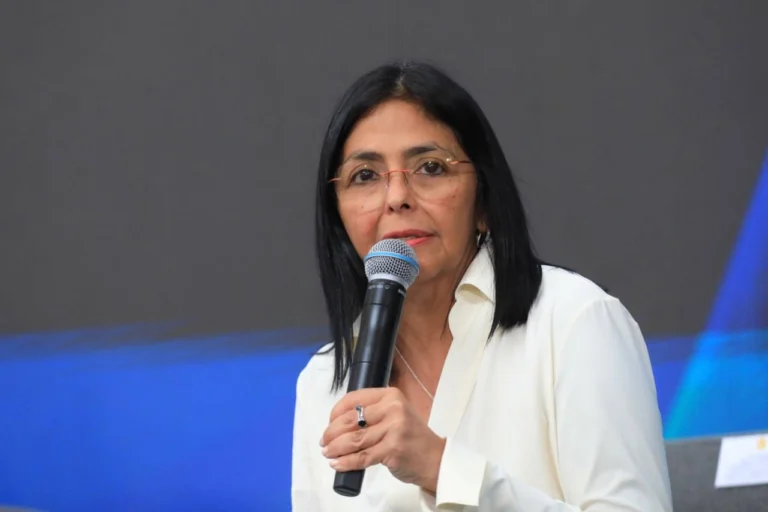
In a statement read by Venezuelan Executive Vice President Delcy Rodríguez, it was denounced that this act constitutes a “fraudulent process” and a “new episode of the multifaceted aggression being carried out by the United States against Venezuela.” The official asserted that PDVSA and the Venezuelan State “were intentionally and illegally excluded from the process,” denied the right to a defense under the “crude excuse” of not recognizing the legitimate government.
The official statement indicates that this dispossession was carried out “in complicity” with figures from the radical opposition such as María Corina Machado, Edmundo González Urrutia, Juan Guaidó, Julio Borges, Carlos Vecchio, and José Ignacio Hernández. It identifies these individuals as part of an “organized crime group” that, since the self-proclaimed National Assembly of 2015, attempted to usurp the country’s representation, leaving it defenseless against this “blatant theft.”
“Venezuela reiterates that it does not recognize and will not recognize the forced sale of CITGO,” stated Rodríguez, carried out in “flagrant disregard” for legal and economic guarantees. The government reaffirmed that it will adopt “all measures at its disposal” to bring to justice, including international prosecution, all those who promoted and carried out this plunder.
“This case will go down in history as blatant and pathetic evidence that foreign investments are neither respected nor guaranteed in the United States of America,” the statement concluded, asserting that the Venezuelan people will teach a “historic lesson” to those who have betrayed the nation.
The Fraudulent Authorization of the Sale of CITGO
In an act that consolidates one of the largest expropriations of the modern era, a U.S. federal judge approved the forced sale of CITGO Petroleum, the main international subsidiary of Petróleos de Venezuela (PDVSA). This ruling, issued by Judge Leonard P. Stark in Delaware, represents the culmination of a long, politically charged legal process aimed at depriving the Venezuelan state of a strategic asset valued at billions of dollars.
The transaction, approved for $5.9 billion in favor of Amber Energy, constitutes a veritable “robbery,” according to expert analysis, given that the company’s real value is between $11 billion and $13 billion. Professor and analyst Werther Sandoval describes it bluntly: “The collusion, the coven, the legal-political alliance of the US judiciary with the puppet government and the vulture creditors… will steal CITGO from PDVSA under the guise of collecting a debt that doesn’t belong to PDVSA, but to the Bolivarian Republic of Venezuela.”
The mechanism for this dispossession was set in motion after the Trump administration’s illegitimate recognition of a parallel government in Venezuela in 2019. Sandoval explains that it was then that “the sham [Guaidó’s government] ballooned [the debt] to $23.6 billion to make it unpayable and thereby exacerbate the creditors’ financial woes in order to sue and seize Citgo.” This strategy violated the capitalist legal principle of the alter ego or corporate veil, which protects a subsidiary from the debts of its parent company.
As the analysis details, “prior to Guaidó’s usurpation, CITGO was never over-indebted… Venezuela, even up until 2019, before the self-proclamation, fully complied with its payment obligations.” The illegal takeover of the board of directors by figures aligned with the opposition, such as Luisa Palacios and Carlos Jordá, paved the way for vulture creditors to file massive lawsuits in U.S. courts.
The Dual Objective
The ambition for CITGO is not new. Sandoval recalls that historical warnings, such as those from former President Carlos Andrés Pérez, cautioned that owning a refinery 100% in the US made it “vulnerable and susceptible to protectionist measures.” The dual objective was, on the one hand, to strangle a vital source of foreign currency for the Bolivarian nation and, on the other, to seize a profitable industrial complex that for decades has disproportionately benefited the US economy.
“Citgo was acquired to ship Venezuelan oil at below-market prices, at a discount, which results in the delivery of large sums in taxes to the US Treasury, at the expense of lower dividends and almost no tax payments to the Venezuelan state,” Sandoval points out. Its total control was a key element in the multidimensional economic war against Venezuela.
This ruling, which the Bolivarian Government has vehemently denounced as a daylight robbery, will have serious repercussions. Sandoval warns that “any relationship and agreement between the US and Venezuela will be tainted by the precedent of the theft of CITGO, a criminal act that will always be present… generating distrust and raising the costs of any bilateral negotiation.”
The Venezuelan state has made it clear that it will exhaust all legal avenues at the international level to recover what legitimately belongs to it. The sale, which still requires regulatory approvals and would not be finalized until 2026, stands as a monument to the double standards and lawfare employed by the empire and its local collaborators.
IMAGE CREDIT: Venezuelan Executive Vice President Delcy Rodríguez stated: “There will be international accountability for those governments that lent themselves to this blatant theft and plunder of a valuable asset like CITGO.” Photo: Venezuelan Vice Presidency
[ SOURCE: teleSUR ]