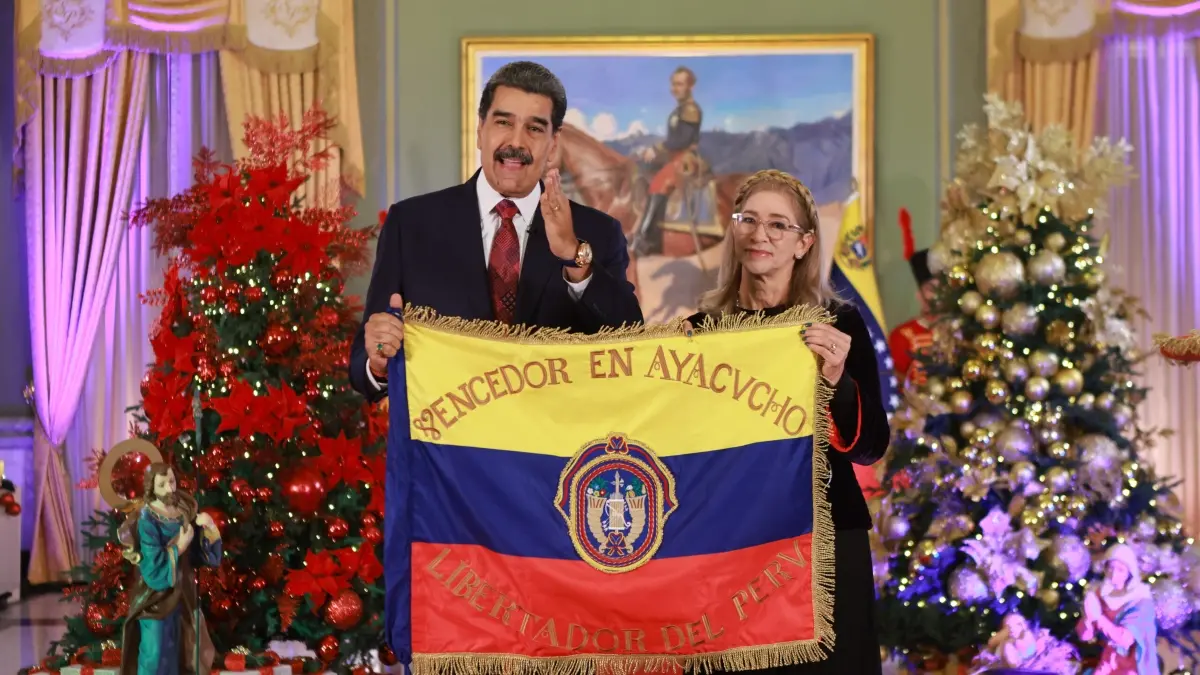
The President of the Bolivarian Republic of Venezuela, Nicolás Maduro, delivered his traditional New Year’s message this Wednesday from the Peru Room at Miraflores Palace, where he described 2025 as a period of “victorious resistance and historic consensus.”
In his speech, the president highlighted the strategic advances in sovereignty, direct democracy, science, and national power, within the framework of the Seven Transformations Plan (7T).
“A year of intense work, significant challenges, resilience, and collective unity. Resilience that has astonished the world. We bid farewell to 2025 and close it on a positive note,” declared the Head of State, underscoring the Venezuelan people’s spirit of perseverance.
During his address, Maduro emphasized that the greatest achievement of 2025 was the strategic coordination among the country’s various sectors, which allowed for the consolidation of governance based on community participation and institutional strengthening.
“The list of efforts, processes, achievements, and goals accomplished is long. It couldn’t be otherwise for a country that perseveres, works hard, and believes,” he affirmed, highlighting the Venezuelan people’s capacity to maintain their faith and enthusiasm in the face of challenges.
The president noted that “2025 has been the year of the broadest and firmest consensus ever reached in our republican history,” which he defined as “a national consensus for life, for peace, and for guaranteeing the future.”
This social agreement, he explained, was made possible thanks to the implementation of the Seven Transformations Plan (7T), a method that emerged from a popular consultation, became an Organic Law of the Republic, and has allowed victorious, communal resistance to become a daily practice.
“This year, we demonstrated who we are, what we Venezuelans are made of. We fully embraced a beautiful revolutionary premise: when a people decide to walk together, nothing and no one can stop them,” Maduro declared. He highlighted the accelerated implementation of the Plan de la Patria (Homeland Plan) and the Simón Bolívar National Project 2025-2031, whose pillars align harmoniously with the 7Ts (Seven Transformations).
Among the most significant advances, the Venezuelan president mentioned the fusion of military power with popular power, described as “two pillars that allow us to solidify and accelerate the sovereign march toward 2030.” He also noted the integration of economic power with scientific and technological power, as well as the strengthening of the spiritual, identity-based, and cultural power of Venezuelan identity, which, he said, “includes each and every one of us as the path that gives order and meaning to everything else.”
“In one year, we consolidated Venezuela’s national power, both as a concept and a tangible reality on the ground, politically and militarily,” he said, emphasizing that the country has advanced toward building a “strong, profoundly democratic, and sovereign state.” In this context, he stressed that direct democracy has ceased to be “a postulate, a discourse, or a utopia” and has become a daily practice in planning, project execution, and conflict resolution.
Maduro also highlighted the progress in science, technology, and culture, fundamental pillars for the country’s cognitive and spiritual sovereignty. “The nation’s new independence is cognitive in nature,” he affirmed, while noting that science and technology must be “at the service of life, social well-being, and the defense of sovereignty.” In his view, technological development, coupled with cultural strengthening, is the main support of the national consciousness that protects the future of the next generations.
The president’s address was marked by a message of unity, resilience, and strategic vision for 2030, in which the Plan of the Seven Transformations stands as the guiding principle of the new model of the State. “Thanks to this plan, we have managed to unite vital forces above any national differences,” he emphasized, reiterating his confidence in the capacity of the Venezuelan people to build a sovereign and prosperous future.
IMAGE CREDIT: The Venezuelan president emphasized that direct democracy has ceased to be “a postulate, a discourse, or a utopia” and has become a daily practice. Photo: Presidential Press Office.
[ SOURCE: teleSUR ]