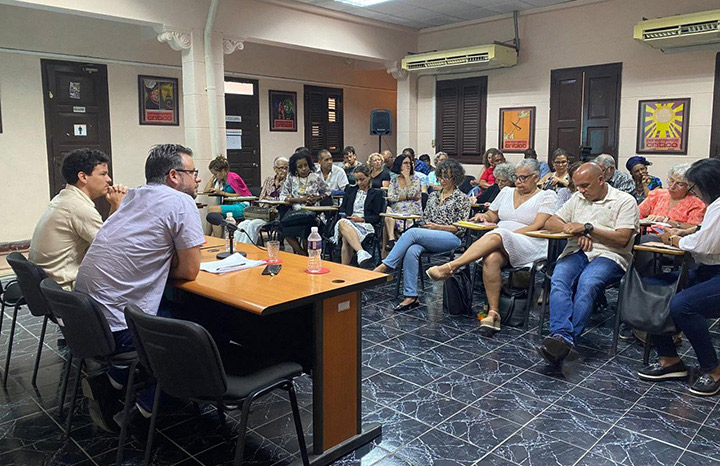
In the face of the many challenges the nation currently faces, the keynote address “Fidel and Culture” was delivered today at the closing ceremony of the International Seminar “The Struggle for Revolutionary Hegemony: Fidel Castro’s Contributions in the Cultural Sphere,” convened by the Juan Marinello Cuban Institute of Cultural Research (ICIC).
In anticipation of the 65th anniversary of the Ministry of Culture and other significant anniversaries for the Cuban nation, and taking into account the centennial of the birth of Commander-in-Chief Fidel Castro Ruz, Elier Ramírez Cañedo, member of the Central Committee of the Communist Party of Cuba and deputy head of the Ideological Department, delivered a speech in which he traced Fidel’s thought and actions regarding the cultural endeavors of the Revolution.
From a comprehensive perspective, avoiding reductionist approaches, Ramírez Cañedo emphasized that, at the outset of the struggle, the historical leader of the Cuban Revolution understood the need to transform not only economic and social structures, but also the common sense of the population, in order to eradicate the vestiges of cultural colonialism.
He recalled foundational milestones such as the speech “Words to the Intellectuals,” delivered on June 30, 1961, at the National Library, in a context of intense internal and external confrontation. In this speech, the young statesman clearly articulated the essence of revolutionary cultural thought: the Revolution defends creative freedom; it cannot dictate art, but it can aspire to ensure that creators find the best conditions to develop their work, with the people as the primary goal.
Ramírez Cañedo also referred to key interventions by the Commander, such as the one on January 28, 1988, in which Fidel affirmed that the standard of living is measured not only in material goods, but also in spiritual goods, and warned against the dangers of commercialism in culture.
He also addressed the context of the Special Period, when in 1993 Fidel Castro insisted on the need to prioritize saving culture and the work of intellectuals, and outlined how culture could contribute to strengthening the country’s economy and spiritual life.
In 1998, already in the midst of resistance against neoliberal globalization, the Cuban leader called on artists and intellectuals to take their place on the front lines of the cultural struggle, which led to the so-called Battle of Ideas.
Among the achievements of that battle, the speaker mentioned the revitalization of the cultural institutional fabric, the mass training of art instructors, the creation of new museums, and the strengthening of arts education, all from an emancipatory and anti-colonial perspective.
He also highlighted the enduring relevance of Fidel Castro’s thinking on sensitive issues such as racism, inequality, and cultural discrimination, and urged against succumbing to simplistic illusions, urging instead the creation of a school of thought and a deeper exploration of these problems through everyday cultural action.
Following the speech, a lively debate ensued among the participants, highlighting the enduring relevance of Fidel Castro’s thinking in the face of present and future cultural challenges, and under the vision he so often expressed that culture was “the shield and the sword of the nation.”
Several attendees agreed that the Commander’s ideas on culture as a pillar of the standard of living are more pertinent today than ever, in a context of profound economic and social transformations in Cuba.
They pointed out that, although his speeches remain an essential reference point, they should not be frozen in time, but rather interpreted in light of new realities.
Ramírez Cañedo’s reflections were linked to the current situation of the blockade and the imperialist cultural war, since Fidel called for a frontline cultural battle, and today that struggle is no less intense. He led by a key principle: “We must rise to the occasion, not by repeating slogans, but by creating with the people and from the people.”
The exchange concluded with a call to deepen the study of Fidel’s thought in all its cultural dimensions, not only as a legacy, but as a living tool to face the challenges of the 21st century.
IMAGE CREDIT: Photo: Sarahí Núñez Pérez
[ SOURCE: AGENCIA CUBANA DE NOTICIAS ]