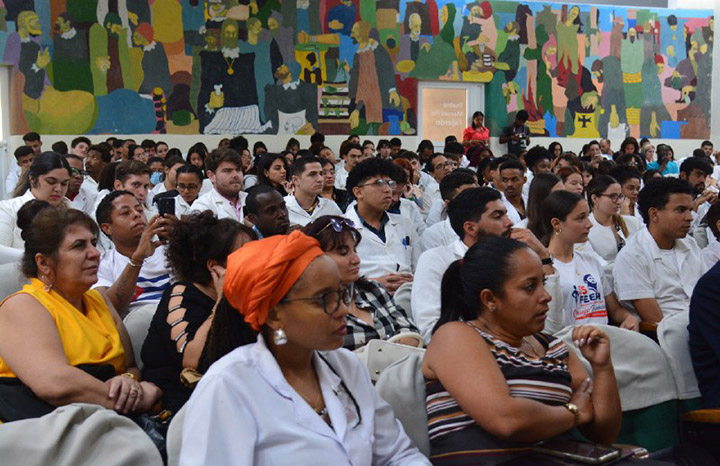
In a direct and insightful dialogue, young medical residents from Havana have shared how Washington’s economic, commercial and financial blockade criminally impacts their daily work, professional training, and the lives of Cuban patients.
The meeting, which was attended by Meyvis Estévez Echeverría, First Secretary of the National Committee of the Union of Young Communists (UJC), and Tania Margarita Cruz Hernández, First Deputy Minister of Public Health, took place in an atmosphere of reflection and denunciation, within the framework of the April 4th celebrations.
Alejandro Pérez Fonteboa, from the National Cancer Institute (INOR), explained that the fuel shortage, exacerbated by the tightening of the blockade, is causing generator failures, which puts high-tech equipment such as radiotherapy and imaging equipment at risk.
 Dr. Alejandro Pérez Fonteboa (R)
He warned that a breakdown of this equipment represents millions of dollars in investment and denounced the inability to access first-generation drugs such as monoclonal antibodies and immunotherapy, vital for prolonging survival in cancer patients.
For her part, Dr. Marileidys Collado Martínez, an endocrinology resident, referred to the inability to acquire technologies such as continuous insulin infusion pumps or glucose sensors for patients with type 1 diabetes, which prevents the prevention of long-term complications, especially in children.
 Dr. Marileidys Collado Martínez
She also warned about the shortage of growth hormones since November 2021 and the lack of antithyroid drugs, which has led to reported thyrotoxic crises in pregnant women and children in several provinces.
María Claudia Torres, a cardiology resident, detailed the impact on her specialty and pointed out the lack of pacemakers, the shortage of which prolongs hospital stays for patients with malignant arrhythmias, and the lack of stents, which forces them to resort to more invasive open-chest surgeries or prolonged hospital stays.
She mentioned the obsolescence and lack of spare parts for CT scanners, essential for cardiovascular diagnosis.
 María Claudia Torres, cardiology resident
Ricardo Rodríguez González, secretary of the Young Communist League (UJC) Committee for Medical Sciences, moderated the dialogue and highlighted how the blockade has become more visible and profound, even affecting the training of young doctors, for example, by limiting access to international scientific databases, vital for their specialization theses.
The young people agreed that, despite the immense difficulties, healthcare personnel maintain their commitment and compassion for patients.
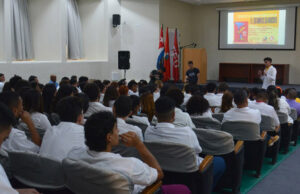 Ricardo Rodríguez González
However, they emphasized that the blockade is a silent genocide that costs Cuba billions of dollars annually, money that could save lives and guarantee treatments for years.
A single day without the blockade would guarantee treatment for five years for more than 194,000 people with diabetes mellitus, Rodríguez González reminded the audience, citing data from Cuban complaints to the United Nations.
“The blockade is not a cliché; it is a reality that kills and limits our dreams of becoming better doctors,” he concluded.
The exchange concluded with a call to maintain hope and unity, and to continue denouncing in every national and international forum the criminal impact of this policy, which violates the human rights of the Cuban people.
IMAGE CREDIT: Sarahí Núñez Pérez | Photos: Omara García Mederos
[ SOURCE: AGENCIA CUBANA DE NOTICIAS ]