By: Oscar Figueredo Reinaldo
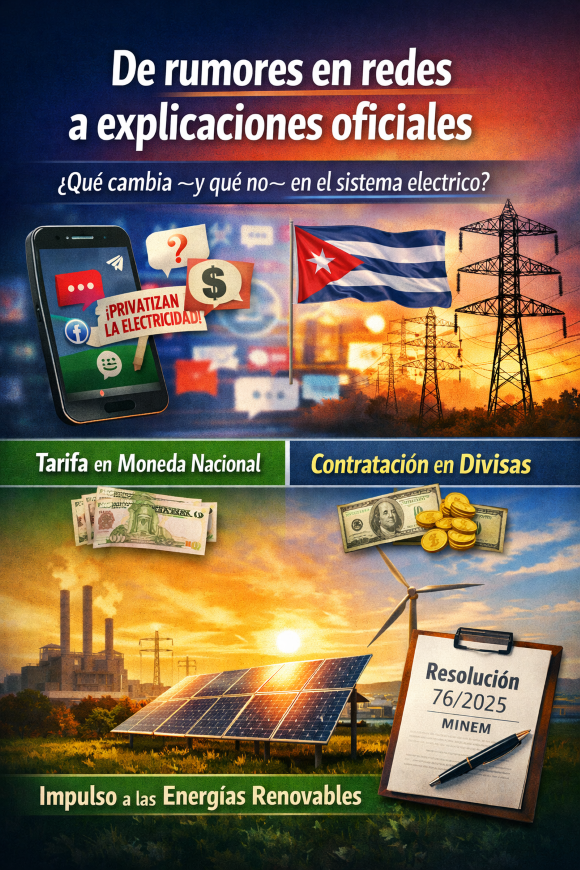
In recent hours, social media has amplified misinterpretations following the publication of Resolution 76 of 2025 by the Ministry of Energy and Mines, generating speculation about a supposed charge for electricity service in dollars, and even about a possible privatization of the sector.
However, according to statements made to Cubadebate by Ramsés Montes Calzadilla, director of energy policy and strategy at Minem, there have been no changes to the current electricity rates in the country.
“The tariff system, for both the residential and non-residential sectors, remains in national currency. There hasn’t even been an increase,” the official emphasized, insisting that the interpretations circulating on social media “do not correspond to the actual content of the regulation.”
A mechanism in place since 2021
Montes Calzadilla explained that the recently published resolution does not introduce a new scheme, but rather updates—with a significant price reduction—a mechanism implemented since 2021, related to the contracting of photovoltaic solar energy.
This model allows state-owned companies, micro, small, and medium-sized enterprises (MSMEs), and individuals to indirectly finance renewable energy generation by contracting a certain amount of installed capacity in solar parks within the National Electric System.
In practice, it is a kind of “virtual installation”: the customer does not install panels at their physical location, but rather finances the equivalent in another installation and receives a monthly discount on their electricity consumption in return.
How the Contract Works
As the executive explained, for every kilowatt (kW) contracted, the consumer receives a monthly discount of 125 kWh on their bill for the agreed period, which can range from 2 to 20 years.
“The goal is to replicate the performance of a real solar panel, but without the need for physical installation,” he explained.
This scheme has proven particularly useful for entities with space limitations—such as hotels or large urban facilities—which, despite being high consumers, cannot deploy their own solar generation infrastructure.
Price Reduction: The Focus of the New Resolution
The main innovation of Resolution 76 lies in the reduction of contract prices, in line with the international decrease in the cost of photovoltaic technology.
The highest price, corresponding to 20-year contracts, has dropped from $1,500 per kW in 2021 to $600 currently, representing a reduction of more than 50%.
This update, planned from the mechanism’s initial conception, seeks to increase incentives for investment in renewable energy and facilitate the achievement of national goals in this area.
According to Montes Calzadilla, entities that have used this system have achieved significant savings on their electricity bills, in some cases up to 50%.
This is because the contracted energy, although paid for in advance, is cheaper than that acquired through the conventional tariff.
Furthermore, companies receive a certificate that accredits the use of clean energy, which adds value to their products and services, in a context where sustainability is gaining increasing importance.
Impact on the residential sector
The mechanism is also available to individuals, although its suitability depends on the level of consumption.
In the residential sector, where the tariff is tiered and heavily subsidized at the lower levels, only high-volume consumers obtain clear economic benefits.
For those who consume more than 500 kWh per month and face rates that can reach between 15 and 25 pesos per kWh, contracting for photovoltaic energy can represent considerable savings.
The official emphasized that this system is neither mandatory nor universal, but rather an additional option for those who choose to adopt it.
“It’s not something that will affect the entire population or all businesses. It’s a possibility for those who consider it convenient,” he clarified.
He also explained that the contract is made in foreign currency because the technological components necessary for solar generation must be imported.
A Commitment to the Energy Transition
Beyond individual benefits, the mechanism contributes to the country’s strategic energy objectives, particularly increasing the share of renewable energy sources in the energy mix.
“Many entities feel committed to this process because they know they are contributing to solving the national energy problem,” he stated.
In this sense, Resolution 76 of 2025 does not introduce additional burdens for the population, but rather strengthens and updates an existing tool aimed at promoting investment in clean energy and advancing the country’s energy transition.
[ SOURCE: CUBA DEBATE ]