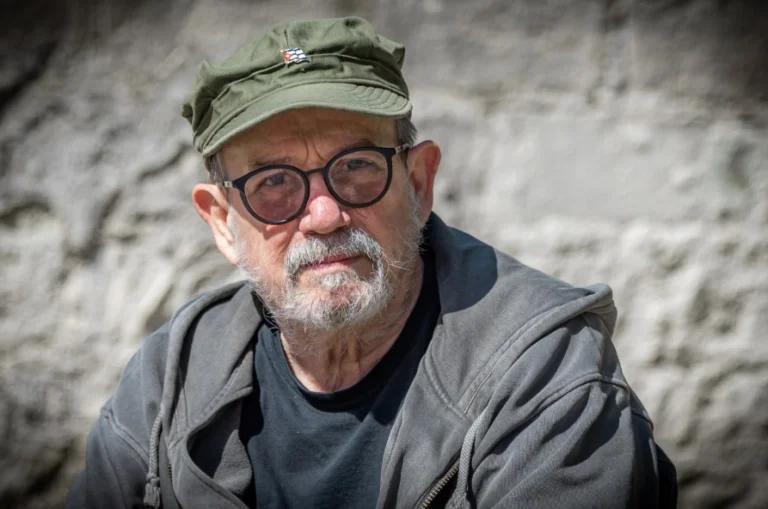
From his recording studio in the Playa municipality, surrounded by pianos, consoles, and the remnants of a career dedicated to socially conscious music, the Cuban singer-songwriter Silvio Rodríguez analyzed the complex scenario Cuba is experiencing under the current international siege.
The author of “Ojalá” and “Pequeña serenata diurna” was emphatic in an interview with the Mexican newspaper La Jornada when defining the Cuban people’s willingness to protect their independence: “A large part of our people would be prepared to defend our sovereignty with arms, if necessary.”
For Silvio Rodríguez, the defense of the island is not an abstract concept, but a reality that has shaped his own life. The singer-songwriter recalled how his musical career began precisely during his military service and his missions as an internationalist.
In the face of recent threats from the United States government to “take over Cuba,” Rodríguez reaffirmed his connection to the Revolutionary Armed Forces (FAR), an institution he considers his formative ground.
“Imperial aggression might seem like one of our natural conditions,” he noted, explaining that the people’s response to the siege is not a momentary outburst, but the result of an “intense and sometimes contradictory life” that has forged the national character.
A History of Distrust of the “Troubled North”
When asked if the civilian population would come out to defend the island in the event of an invasion, the singer-songwriter appealed to historical memory to justify Cuban distrust of Washington.
He mentioned everything from the attempts to buy the island in the 19th century to the imposition of the Platt Amendment. “There is a long history of reasons for Cubans to distrust ‘the turbulent and brutal North,’ as our apostle, José Martí, called it,” he stated.
According to Rodríguez, the strength to resist the blockade and external pressures comes directly from the “forging of the nation” and a deep sense of belonging and patriotism.
Resistance, Criticism and Evolution
Despite his firmness in defending sovereignty, Silvio does not shy away from self-criticism. He defines himself as a man of “questions rather than answers” and advocates for human improvement far removed from fanaticism.
He acknowledges that the energy and economic blockade seeks to stifle the hopes of young people, trying to convince them that “there is no future in their country.”
“I have always seen Cuba resist,” he affirmed, while supporting the need for internal reforms and an “evolution” that benefits the people, as long as these transformations do not jeopardize its status as a sovereign nation, which he considers “fundamental.”
The Role of Culture in Times of “Shield”
Faced with regional initiatives such as the so-called “Shield of the Americas,” which Silvio describes as a sign of “imperial desperation” and a return to neocolonialism, the musician defends the role of education and culture as tools for freedom.
For Rodríguez, the battle for history remains: “If Cuba falls, history will be reinvented by its enemies.”
Therefore, he reaffirms that his commitment remains that of a citizen who, through his verses, accompanies the sentiments of a people who refuse to relinquish their right to exist independently.
[ SOURCE: PRENSA LATINA ]