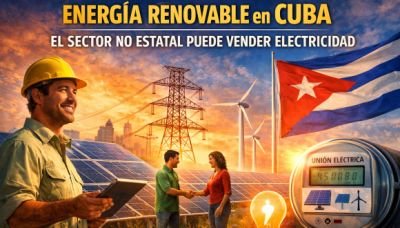
Amid the complex energy situation facing the country and efforts to accelerate the use of clean energy sources, a possibility already exists within the Cuban legal framework, although it is still little known: the option for non-state economic actors to generate and sell electricity, provided it comes from renewable energy sources.
According to statements made to Cubadebate by Ramsés Montes Calzadilla, this alternative is part of the mechanisms being promoted to advance the energy transition, especially in the development of photovoltaic solar energy, currently considered the most viable due to its rapid installation and the availability of solar radiation in the country.
“The country is exploring diverse mechanisms to advance the energy transition, especially in photovoltaic solar energy,” explained the executive, who noted that approximately 1,000 megawatts of this energy source were installed last year alone. This growth is already having visible effects: during the day, power outages have been less frequent compared to other times.
However, the deployment of solar energy is not limited to the national power grid. It has also extended to consumers, with installations in medical offices, banks, and other service centers, in a program that aims to decentralize generation.
In this context, Decree 107, which regulates the activities permitted to the non-state sector, takes on particular relevance. According to Montes Calzadilla, the decree prohibits micro, small, and medium-sized enterprises (MSMEs), cooperatives, and other forms of management from generating and selling electricity from fossil fuels, but introduces a key exception: they can do so when the source is renewable.
This distinction opens the door to significant change. Until now, the most widespread model has been self-consumption, in which an entity installs solar panels to cover its own demand and, in case of surplus, sells that energy to the National Electric Union. However, the regulations allow for going further.
“It’s possible to invest in renewable energy not as a form of self-consumption, but as a generator,” he explained. This means that a micro, small, or medium-sized enterprise (MSME) or a state-owned company can develop a solar park and sign a power purchase agreement (PPA) with the National Electric Union, under conditions agreed upon by both parties, both in terms of price and term.
This model is not new to the country. In fact, it’s the same one that has been used with foreign investment in several photovoltaic parks, where companies install the capacity and sell the electricity generated for years to recoup their investment. The novelty lies in the fact that now this logic can also be adopted by domestic actors.
But the scope of this possibility is not limited to the relationship with the electrical grid. As the official explained, direct sales between consumers are also permitted. “A micro, small, or medium-sized enterprise (MSME) can sell energy to another MSME or to a state-owned company,” he noted, introducing new forms of productive linkages around energy.
This model is especially attractive for entities that, affected by blackouts, lack sufficient capital to invest in their own systems. Instead of assuming the cost of the technology, they can contract another company to make the investment and pay only for the electricity generated, in a kind of indirect financing scheme.
The logic is simple: the investor is responsible for maintenance and needs to generate energy to recoup their capital, while the consumer gains access to a more stable supply without a large initial outlay. “It’s like paying for the system in installments, but through energy,” Montes Calzadilla summarized.
Experiences of this type already exist in the country. The Center for Molecular Immunology, for example, has a solar park installed under a foreign investment scheme, where the supplier sells the generated electricity to the institution. According to the specialist, this type of solution has proven beneficial for both parties and could be replicated on a larger scale within the national context.
Even in cases where there is no physical space to install panels, the regulations allow for alternatives. An entity can contract another to generate electricity at a different location and receive that supply through contractual agreements, which considerably expands access possibilities.
Decree 107 itself also introduces another significant opening: authorization for non-state actors to offer electric vehicle charging services, provided the energy used comes from renewable sources. This is an area that, unlike the marketing of traditional fuels, is open to broader participation.
According to the official from the Ministry of Energy and Mines, all these measures respond to the same objective: to diversify the avenues for promoting the energy transition and ensure it doesn’t depend solely on state investment. “The goal is for the entire society to participate and for the benefits of these technologies to be seen as soon as possible,” he stated.
At a time marked by severe limitations in the electricity supply, the possibility of generating and marketing renewable energy introduces a shift in perspective: the consumer ceases to be a passive actor and can also become part of the solution.
IMAGE CREDIT: Oscar Figueredo Reinaldo / Cubadebate
[ SOURCE: cubainformacion.tv ]