Luis Hernández Navarro, correspondent / La Jornada
The blockade in Cuba — explains journalist and researcher Rosa Miriam Elizalde — is not only economic and commercial, but also technological and communicative. The island faces a brutal and unequal information war that is part of the regime change attempts promoted from Washington, Miami, and Madrid.
Rosa Miriam is the coordinator of the Patria International Colloquium on Digital Communication, which will be held this month in Havana. Born in Sancti Spíritus, Cuba, she is a central figure in Latin American journalism. Founder and editor of several publications, she has received the Juan Gualberto Gómez National Journalism Prize. She is the author or co-author of books such as Before I Forget, Hustlers in Havana, Click the Internet, and Our Chávez.
In an exclusive interview in Havana for La Jornada—a publication with which she collaborates—she analyzes and dissects the online warfare in Cuba and the youth response in the battles of internet applications. Below is part of the conversation with this newspaper.
—For many years there has been a disinformation campaign surrounding Cuba. What would be the difference with the current one?
—The difference has to do with the new socio-technological reality and the internet. We are at the mercy of a very sophisticated communication management, even using military technologies.
“Cuba was late to connect to the internet due to various factors, including the United States’ obstruction of a fiber optic cable connection.
“Later, Washington understood that the internet would be an opportunity to attempt regime change. The Torricelli Act allowed Cuba to connect to the internet in 1992. It was implemented in 1994. The concept behind it was that it would allow a kind of tropical glasnost. So they designed the possibility of connecting Cuba, but with a one-way system. That is, Cuba would allow the entry of information and internet access, but would be prevented from using any service or application that promoted its development.
“Cuba was born onto the internet without the possibility of e-commerce or other basic services. It was a very small bandwidth. Every megabit had to be approved by the Treasury Department.
“Today we are witnessing a brutal information war in which there is a cluster of digital media outlets, mostly produced in Florida, whose sole content is Cuba and which use false flag tactics. There are more than 100 websites on the internet that bear the name of Cuba. However, they are produced in Miami or Spain. They have nothing to do with information about Cuba.”
“They directly contaminated, distorted information that amplifies the worst problems the country may have. They dominate the conversation about Cuba in those spaces. The platforms are American. They impose algorithmic filters on content generated from Cuba, while content generated from outside with anti-government content is admitted, even in violation of the platforms’ regulations.
“There is permissiveness toward content that incites violence against Cuba. The same does not happen when Cuba generates defensive content. This is buried by the algorithms.”
–How does the online war intersect with youth identities?
–That’s a very interesting question, because you can’t look at the case of Cuba with the same lens as any other country in the world.
“In Cuba, since the late 1990s, there has been a policy to develop digital skills. One of the leading computer science universities in Latin America was built here.”
“Young people have great skills in using these technologies. In recent years, at the United Nations, it was discussed how Cuba had a weak internet infrastructure, but also a vast capacity for using these technologies.
“There is knowledge, there is appropriation, there is use of these technologies, although conditions in Cuba are sometimes very limited by blackouts and service deficiencies. However, these young people are very similar to their peers anywhere else.
“Sometimes, judging by what one sees, it would seem that their content is frivolous. But very interesting things happen. For example, regarding the Cuban combatants who fell in Venezuela, one sees how, among these young people, expressions of solidarity and grief arose. When Fidel died, young people were the first to share this information on social media.”
In other words, young Cubans are similar to those anywhere else, but at the same time, there’s a kind of national DNA that has to do with anti-imperialist sentiments, a rejection of injustice, and a sense of solidarity. When there’s a hurricane, the first ones to mobilize are the young people.”
VPN Culture
–Digital multinationals have banned the use of their platforms. What does this mean?
–Here, you can’t access 57 or 58 percent of the platforms that are free, except through a VPN.
“That is to say, in Cuba it’s very difficult to access services that are open on the internet in other parts of the world. TikTok is completely blocked for us. But there is a VPN culture. People connect to the internet through filters.
“The most popular spaces for young Cubans are Instagram, Facebook, YouTube, and X, which are open to Cuba, although with many limited services.
“The blockade isn’t just economic and commercial, but above all, technological. There are many limitations on multiple services, especially e-commerce, which Cubans can’t access.”
–Does the dissemination of luxury lifestyles on these platforms create consumer aspirations?
–Absolutely. It’s a one-way street. Here, we’re not only dealing with limitations on internet access, but also on access to many services. For example, monetizing digital content is impossible.
“If you open any Facebook or Instagram page from Cuba, you’ll be constantly bombarded with toxic content from Florida, orchestrated by media outlets, many of which receive funding from the U.S. government to push their regime change projects. However, for content produced in Cuba to be seen outside the country, you have to fight the algorithm, which blocks and makes it invisible.”
–How widespread is cell phone use and social media access on the island?
–It’s widespread. Mobile data service was launched in December 2018, and by January 2019, almost 20 percent of the population was already connected. Over 90 percent of the population has mobile or data services.
“The problem is that, with the power outages, the cell towers without batteries go down, limiting internet connections. A phenomenon that experts call delayed waves is occurring. That is, during periods of power, there are very high waves of connections.”
—For many years, the press delivered a very clear message from the government and the party. The internet disrupts this dynamic. Is there a government communication policy for social media?
—Yes. Yes, there is. But it’s very asymmetrical. The avalanche of content generated by the transnational right wing is channeled through social media against any information or project originating in Cuba. There is a stark disparity between the content produced by media disinformation labs in Miami and Spain, and that generated in Cuba.
“The most popular services and platforms in the country are American. Regime change schemes have seen this as an opportunity to infiltrate or generate toxic information, which dominates social media when you search for something about Cuba.
“There are Cuban projects like Picta, which is similar to YouTube, or Todos, which is similar to WhatsApp, but they haven’t taken off because they need server backups and electricity. We are in the midst of a crisis.
“It’s very difficult for projects here to gain visibility. That’s why the Nuestra América convoy has had such an impact. As people who have come here and experienced our reality have shared it through their own networks and platforms, another Cuba has emerged, one that was buried and hidden by the communication asymmetry.”
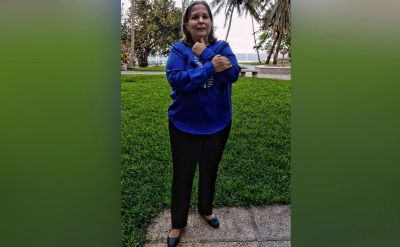
IMAGE CREDIT: Researcher and journalist Rosa Miriam Elizalde emphasizes that the blockade is also technological and communicative. Photo by Marco Peláez
[ SOURCE: www.cubainformacion.tv ]