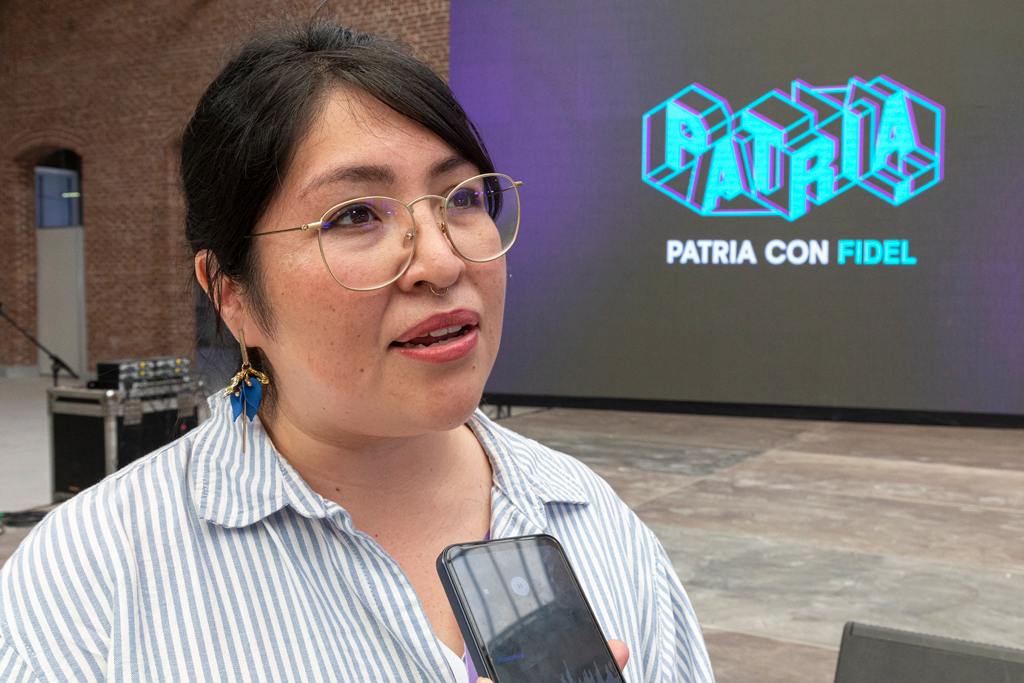
Mexican journalist Alina Duarte reflected on the challenges of cultural hegemony in times of rising fascism and the urgent need to build revolutionary communication today that transforms realities.
In an exclusive interview with Prensa Latina, from the Patria International Colloquium, Duarte placed the debate within the stark context of the present day, in connection with the panel “Cultural Hegemony and Digital Power,” which she participated in the previous day along with María Fernanda Ruiz (Argentina), Pedro Santander (Chile), and Renato Rovai (Brazil).
“Today we clearly see the rise of fascism, and it is not only the rise of ideas, but also of a practice that is devastating, that is committing genocide, that is radicalizing an absolutely genocidal blockade against Cuba,” the Mexican journalist stated.
Faced with this situation, she emphasized the need to build hope through collective, precise, and tactical dialogue, highlighting the symbolic and political value of doing so from Havana, which she described as “a city that continues to show the rest of the world revolutionary horizons and has taught us to triumph time and again.”
Regarding the Patria Colloquium, whose international representation includes more than 25 countries, she was emphatic.
“Today, this event not only brings together incredible minds, but it is an event that fosters patriotism and revolution within the revolution itself,” she stated. “We don’t just want to listen; we want to transform our communication policies within our movements, parties, and countries.”
Furthermore, Mexican journalist Alina Duarte raised the urgent need to debate technological sovereignty in a context dominated by algorithms and large digital platforms.
It is unacceptable that within our own communities we continue to be subjugated by openly colonizing platforms that can impose narratives, she emphasized, while recalling successful examples of communication resistance, such as Iran or the experiences in Chile, which her colleague Pedro Santander mentioned during the panel.
Even using their own limited resources, they were able to wage an impressive communication battle, she affirmed.
In the case of Cuba, Duarte praised how it has managed, for decades, to communicate its revolution in a way that garners international solidarity.
We must celebrate the triumphs achieved despite the asymmetrical conditions, the Mexican journalist concluded.
In closing, she celebrated the upcoming official headquarters of Patria in Havana as a space to find and build “that other way of building a nation, understood as humanity, as Martí understood it.”
IMAGE CREDIT: Photo: Panchito Gonzalez
[ SOURCE: PRENSA LATINA ]