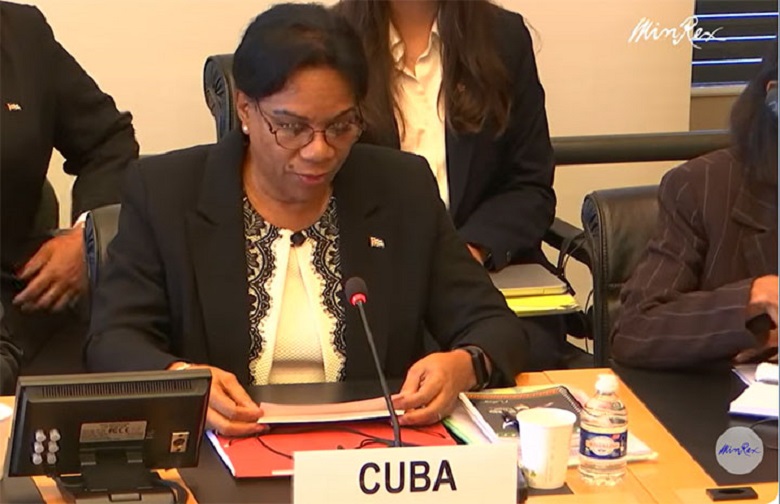
Inés María Chapman Waugh, Deputy Prime Minister of the Republic of Cuba, led the delegation that presented the 2018-2023 periodic report to the Committee on the Elimination of Racial Discrimination in Geneva this Thursday, where she reaffirmed the country’s commitment to confronting all forms of racism.
According to the Ministry of Foreign Affairs website, Cubaminrex, Chapman outlined the main points of the document and noted that, despite the intensification of the economic, commercial, and financial blockade and external pressures, Cuba has maintained its compliance with its international commitments and made progress in legislative and institutional reform.
Due to its importance, Radio Havana Cuba is publishing her address in its entirety.
Opening remarks by the Head of Delegation, Inés María Chapman Waugh, Deputy Prime Minister of the Republic of Cuba:
Defense of Cuba’s Periodic Report to the Committee on the Elimination of Racial Discrimination.
Mr. Chairman and distinguished members of the Committee:
Cuba’s presentation before the Committee on this occasion takes place in a particularly complex context. In recent months, the United States government has escalated its actions against Cuba, through the extreme intensification of a blockade that for more than six decades has attempted to suffocate us. This is compounded by the imposition of a embargo on fuel supplies to our country.
The blockade is a massive, flagrant, and systematic violation of the human rights of the Cuban people and is the principal obstacle to our development. No segment of the population or economic sector escapes its effects.
We reject the Executive Order of January 29 issued by the President of the United States, which aims to provoke a social explosion and a change in the constitutional order freely chosen by our people. We will defend with the utmost vigor, firmness, and close unity, our right to self-determination, independence, sovereignty, territorial integrity, and constitutional order.
In this context, and despite the complex situation we face today, Cuba has continued to honor its obligations as a State Party to the Convention.
I thank the President for his words of welcome. I greet the experts of the Committee, whose professionalism and objectivity are essential for the development of a respectful and fruitful dialogue.
I have the honor of introducing the delegation that accompanies me, which is composed of representatives of the Supreme People’s Court, the Attorney General’s Office, and the Ministries of Education, Public Health, Culture, and Foreign Affairs.
The report we are defending today is the result of the collective work of different state institutions and civil society. It reflects Cuba’s principled position and unwavering condemnation, since the triumph of the Cuban Revolution in 1959, of all forms of racism and racial discrimination.
It also addresses the recommendations made by the Committee in its Concluding Observations following the presentation in 2018.
Since then, Cuba has undergone a broad, profound, and comprehensive process of legislative updating and reform, which has included combating racism, racial discrimination, violence in all its forms, and intolerance.
An essential step in this process was the promulgation of the new Constitution of the Republic in 2019, approved in a popular referendum, which enshrines human dignity as a supreme value and the principle of equality with constitutional status.
Of the 38 recommendations made by the Committee in 2018, we have fully or partially implemented 35, representing 92%.
Likewise, with the aim of continuing to advance in the fight against this scourge, the National Program against Racism and Racial Discrimination, “Cuban Color,” was adopted in November 2019.
To achieve its objectives, the National Commission for the Fight against Racism and Racial Discrimination, “Cuban Color,” was established, with the participation of members of government entities and representatives of various civil society groups and movements on equal footing. I am honored to lead the work of this commission, which is chaired by the President of the Republic and whose operations are coordinated by the Ministry of Culture. The report we are defending today was prepared within the framework of this Commission.
The use of science and the study of the human genome in the implementation of the Program is particularly relevant. We can proudly reaffirm that we have a Cuban ethno-identity and that we are an inclusive and mestizo nation.
Sixty-four percent of the Cuban population aged 15 and over is white, approximately 26% is mulatto, and about 10% is Black. In line with the Committee’s recommendations, skin color data is collected in Cuba based on self-identification.
Furthermore, the presence of Black and mulatto people in decision-making positions continues to strengthen. In the current legislature of the National Assembly of People’s Power, approximately 45% of the Deputies are Black or mulatto. This represents an increase compared to the 41% they represented in 2018 and the 36% in 2011.
At the initiative of Cuban civil society, the Cuban Color Social Observatory was inaugurated in October 2023, in the context of the day against genocide, colonization, and racism.
Representatives from various organizations, movements, and networks, as well as anti-racist social actors, participated in early 2024 in the state-civil society consultation on the recommendations received during Cuba’s Fourth Universal Periodic Review.
I would like to highlight that in its Fourth Universal Periodic Review, Cuba accepted all the recommendations received on racial issues and is committed to implementing them.
As part of our work on these issues, the International Conference “New Narratives: Memories, Resistance, and Reclaiming Rights” and the “Cuba 2024: Decade for People of African Descent” International Conference took place in Havana in 2024. These events marked, respectively, the 30th Anniversary of UNESCO’s Programme on the Route of Enslaved People and the activities of the First Decade for People of African Descent in our country.
We also received an academic visit from Barbara Reynolds, then Chair of the Group of Experts on People of African Descent.
Mr. President and members of the Committee:
We take this opportunity to announce our intention to hold the second edition of the “International Conference Cuba: Anti-Racist Thought and Actions.”
This takes place within the context of Cuba’s cooperation with the UN human rights apparatus.
As part of these efforts, a virtual technical exchange was held on the 2023 National Program, which resulted in its alignment with the practical guide that the Office of the High Commissioner created for the development of these plans.
Furthermore, in February of this year, we held a training session in Havana, with the participation of staff from the Office, as well as experts on racial issues from Brazil and Colombia. Within this framework, a workshop was also held with representatives of civil society on Cuba’s presentation to this Committee.
In addition, prior to this exchange with the Committee, we held a State-Civil Society Dialogue on the progress made and the remaining challenges in the fight against racism and racial discrimination. It was a useful and productive exercise.
Having concluded this review, we intend to hold a follow-up dialogue regarding the results of our presentation to the CERD.
Among the main challenges identified is the need to continue disaggregating statistical data and expanding the collection of information on instances of discrimination based on skin color or racial prejudice. We face the challenge of further refining the collection of necessary statistical information to better identify potential gaps and patterns of discrimination.
Furthermore, public awareness of the various mechanisms for filing complaints or reporting violations of the principle of equality or instances of discrimination based on skin color remains limited. Therefore, we face the challenge of increasing their dissemination and use.
It is also necessary to continue promoting the “Cuban Color” Program and its tangible results, both nationally and locally. In this regard, we intend to conduct a public consultation on the implementation of the Program by 2027, with a view to updating and expanding its reach.
We have a clear understanding of where we must direct our efforts. In this regard, receiving objective recommendations tailored to our reality from experts will also be very helpful.
President, Committee experts:
The best tribute to the victims of slavery and the transatlantic slave trade in the current context, in addition to the necessary remembrance, is international solidarity with the countries from which millions of people were forcibly taken. We are their children. Their blood runs through our veins.
Despite the blockade imposed by the United States government, the unjustified inclusion of Cuba on the unilateral and arbitrary list of states that supposedly sponsor terrorism, the energy embargo, and the growing threats to our sovereignty, as well as the campaign of persecution unleashed by the United States government, our country will continue to develop its cooperation programs with African, Caribbean, and other nations of the Global South.
We reiterate our firm commitment to contributing to the full implementation of the Durban Declaration and Programme of Action, which remains fully in force.
On the centenary of our Commander-in-Chief Fidel Castro Ruz, we recall his words at the historic Durban Conference, when he stated, and I quote:
“Racism, racial discrimination, and xenophobia constitute a social, cultural, and political phenomenon, not a natural instinct of human beings; they are direct offspring of wars, military conquests, enslavement, and the individual or collective exploitation of the weakest by the most powerful throughout the history of human societies.” End quote.
Likewise, we reaffirm our commitment to continue advancing the implementation of the Convention.
With the progress outlined, and aware that there is still work to be done, we attend this dialogue with the Committee, intending for it to be a constructive and objective exchange, focused on our country’s performance under its international obligations within this Convention.
IMAGE CREDIT: Inés María Chapman’s Address to the UN on Racial Discrimination / Photo: ACN
[ SOURCE: AGENCIA CUBANA DE NOTICIAS ]