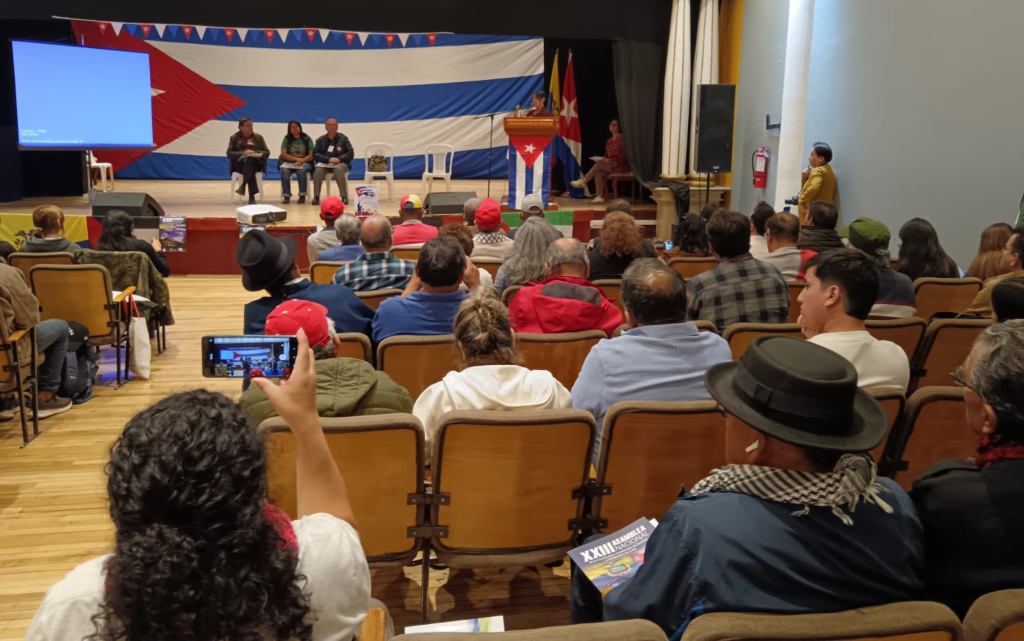
The two-day 23rd Assembly of the Ecuadorian Coordinating Committee for Friendship and Solidarity with Cuba ended on Saturday in the Andean province of Imbabura, where actions to support the Cuban people in the face of US harassment were defined.
From the city of Cotacachi, representatives of social and political organizations agreed this Saturday to highlight the island’s resistance in the face of the intensification of the US blockade and the current international situation.
Amanda Trujillo, coordinator of the meeting, stated that Cuba “has taught us how to resist” and warned that we cannot be indifferent “to this attempt by imperialism to prevent messages of humanism and internationalism from spreading.”
The activist noted that the meeting allowed them to “reaffirm our friendship with Cuba, a country that has given so much solidarity to the world.”
The First Vice President of the Cuban Institute of Friendship with the Peoples (ICAP), Noemí Rabasa, spoke via teleconference and expressed her gratitude for the support from Ecuador.
Rabasa considered the Ecuadorian government’s decision to expel Cuban diplomats “not an isolated incident” and to reflect the influence of US President Donald Trump in the region, which necessitates “strengthening alternative alliances against political isolation.”
The ICAP representative also addressed Cuba’s priorities amid the tightening of the blockade, especially in the energy sector due to Washington’s embargo that prevents fuel from entering the Caribbean nation.
Meanwhile, Norberto Chamba, of the Continental Network of Solidarity with Cuba and Just Causes, also broadcast his message digitally from Rosario, Argentina, in which he rejected the island’s inclusion on the United States’ list of state sponsors of terrorism.
Chamba called for strengthening support campaigns, such as the one aimed at acquiring photovoltaic panels for hospitals, schools, and the homes of patients dependent on electricity.
From the Indigenous movement, Eliana Pakarina, of the Confederation of Peoples of the Kichwa Nationality of Ecuador (Ecuarunari), stated that “to speak of Cuba is to speak of solidarity, internationalism, rebellion and resistance,” and compared this process to the historical struggle of Indigenous peoples.
Meanwhile, Jaime Villacís, representative of the National Union of Educators, conveyed greetings to the attendees and highlighted the resilience of the Cuban people.
Finally, the president of the Coordinating Committee, Lenín Reyes, emphasized that the meeting was being held to pay tribute “to this courageous people who have demonstrated struggle and resistance.”
Reyes, whose term leading the solidarity movement concludes this weekend, reiterated that Cuba has faced “a tremendous onslaught from imperialism,” without this preventing its example from being projected internationally.
The assembly ended on Saturday with the definition of concrete actions to support Cuba and the coordination of initiatives in the face of the regional scenario.
[ SOURCE: PRENSA LATINA ]