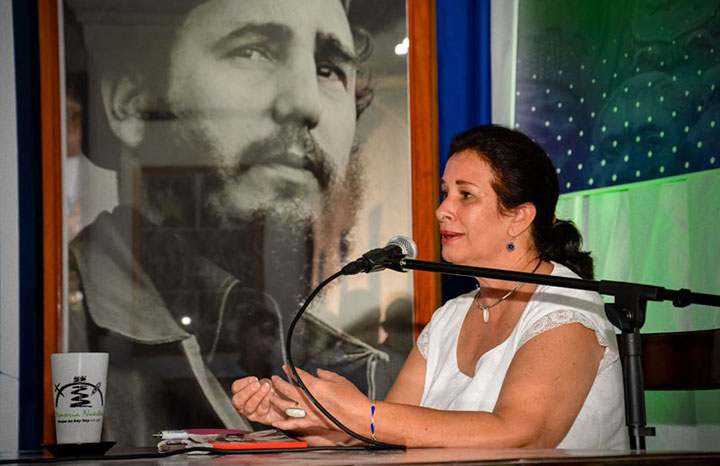
The enduring relevance of Fidel Castro’s ideology and his development as a revolutionary leader were the focus of the opening lecture given by journalist Katiuska Blanco Castiñeira at the Memoria Nuestra Thought Congress and Young Researchers Award, a cornerstone of the Romerías de Mayo (May Pilgrimages).
During her presentation, titled “Stories of Alejandro,” the biographer of the historical leader of the Cuban Revolution reflected this Sunday on the human, ethical, and political development of the Commander-in-Chief, beginning with his childhood in Birán and his subsequent intellectual formation.
Blanco Castiñeira emphasized that the early years of his life in that rural environment profoundly shaped his character and values, while also highlighting his early vocation for the study of history and great universal and national figures.
The keys to his existence, his struggle, and his values can be deciphered from Birán, she affirmed, referring to the decisive influence of that place on Fidel’s revolutionary conception.
The researcher defined him as a political genius, endowed with an exceptional capacity to accumulate knowledge and apply it to social causes, always with profound human sensitivity.
In that sense, she emphasized that his actions were characterized by audacity, resilience, and a constant concern for the problems of others, elements that distinguished his leadership.
Katiuska Blanco noted that Fidel was a man attentive to human suffering; resolving it was the main driving force behind his struggles.
She also praised his relationship with nature, his talent as a writer, and his affinity with the thought of José Martí, acknowledging that he had the opportunity to see dreams fulfilled and to set new aspirations.
For Blanco Castiñeira, Fidel’s legacy transcends his historical era and manifests itself in the symbolic construction that each generation undertakes based on its own experiences.
“Fidel is a tree that grows daily: the tree of enduring ideas, the one that is built in the collective imagination,” she expressed.
The author also recalled her personal experience as a close collaborator of the revolutionary leader, a period she described as essential in her professional and personal life, while reaffirming the enduring relevance of his intellect today.
She called on young people to study his work systematically, considering that it contains keys to understanding contemporary challenges and shaping the future.
The Memoria Nuestra Thought Congress and Young Researchers Award is part of the Romerías de Mayo activities, an event that brings together artists, researchers, and creators from around the world each year in Holguín.
This space promotes academic and cultural exchange among new generations, with an emphasis on reflection on identity and contemporary history, in line with the inclusive spirit that distinguishes the Romerías.
[ SOURCE: AGENCIA CUBANA DE NOTICIAS ]