By Deisy Francis Mexidor
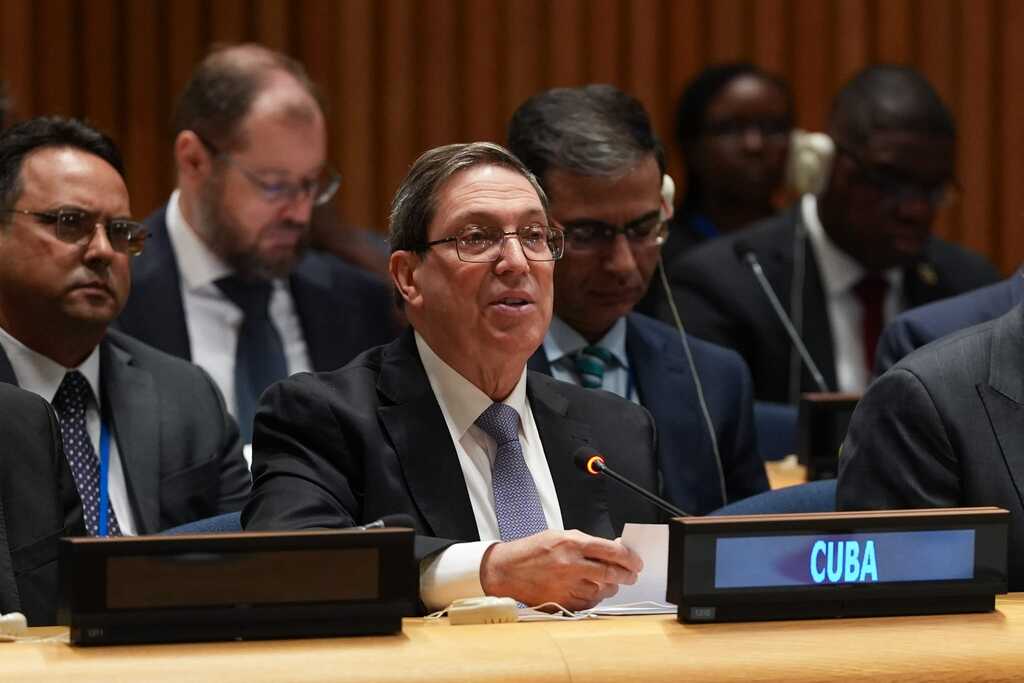
Rodríguez Parrilla, who made it clear that “Cuba is not an enemy of the United States, nor does it want to be,” answered questions from this news agency at the end of two and a half days of work in New York, where he presented his country’s position and denounced the military threat and the energy blockade at a formal session of the UN Security Council convened by China’s presidency of the body.
Prensa Latina (PL): On what basis does the United States government insist on this narrative?
Bruno Rodríguez (BR): When the United States government uses this fallacious and ridiculous argument of the supposed threat, what it intends is to manipulate American, Cuban, and world public opinion.
What it wants is to try to justify a policy that is genocidal, a crime against humanity, a form of collective punishment—all recognized under international law. They are trying to justify a fuel blockade that causes extraordinary humanitarian damage and are trying to prepare public opinion to blame the Cuban government for the effects that the measures it has taken are precisely and deliberately designed to produce.
It is pure slander, a fable, but one that must be taken seriously because U.S. imperialism is aggressive, and we must take its threats seriously and always prepare for the worst-case scenario, even though Cuba will do everything possible to avoid a military escalation.
Cuba is not a threat to the United States government, nor to its national security or foreign policy, firstly because it is a small island and the United States is a nuclear superpower. Secondly, because Cuba has a profound commitment to peace.
It is part of the principles of the Cuban Revolution; it is a peaceful people. It is a country that has always contributed to preserving international, hemispheric, and regional peace and security, and has made very important contributions to peace, such as the peace processes in Colombia.
It was in Havana, precisely, where the heads of state and government of the entire region signed the proclamation of all of Latin America and the Caribbean as a zone of peace, which is one of the great contributions of Army General Raúl Castro Ruz to the foreign policy of the Cuban Revolution.
This proclamation has since become enshrined as an essential element of international law and is constantly referenced in the debates, narratives, and documents adopted by the states of the region, in the composition of the Community of Latin American and Caribbean States (CELAC), and in other regional and subregional groups.
Furthermore, Cuba is not an enemy of the United States, nor has it ever intended to be. It does not wish to be so in any way, firstly because there are deep, affectionate, and fraternal ties between the Cuban people and the people of the United States, and because there is a strong presence of Cuban nationals residing in the United States.
Moreover, the majority of Americans and Cubans residing in the United States have always supported the normalization of relations between the two countries, opposing the hostility and the economic and commercial embargo imposed on Cuba.
Currently, the majority of Americans and Cubans here in the United States oppose a military adventure against Cuba, which would have incalculable humanitarian and other consequences, and they fervently oppose the energy blockade that causes extraordinary human damage, suffering, deprivation, and pain to Cuban families.
PL: How do you assess the treatment of the Cuba issue in the Western press given the increased aggression of the United States government?
BR: The United States government has historically, but in a very acute way now, unleashed an unconventional war against Cuba. I’m referring to a cognitive war, a cultural war, a psychological war, trying to persuade honest people in the United States, Cubans, and the international community that it has humanitarian objectives, that it wants to protect the Cuban people, while blaming the Cuban government for the current socioeconomic difficulties.
In other words, they try to censor the truth, to hide the truth, to manipulate information, and for this they have multimillion-dollar funds and very powerful digital technology platforms.
Most of the technological platforms that host digital networks and drive the operation of the internet belong to US corporations with special ties to the US government, which coerces and pressures them into using them as a digital weapon.
A characteristic of this administration’s policy during this period has been the constant issuance of hostile, threatening, and ultimatum-like public statements against Cuba, attempting to pressure the Cuban government and people into making unacceptable concessions on matters that fall solely within the purview of our internal affairs, sovereignty, and self-determination.
The major traditional US media outlets, now multimedia, wield significant influence in the communications sphere, and the US government also possesses enormous capacity, through the private ownership of digital platforms I mentioned earlier, to manipulate networks in a politically motivated manner.
I have learned that the established press and digital networks present an appearance of democracy and freedom that is entirely false. It is known that they answer to their owners, and they answer to the US oligopoly, to this plutocracy, and they will always act based on their interests.
Although it is true that there are times when the US press has acted more independently, particularly when the American people are aware of reality, when they have some level of real information, when they know even a limited amount of the truth and are therefore not deceived by their government or its policies.
Another characteristic during this period has been the constant pressure on the mainstream US press and on digital networks to publish biased, manipulated information against Cuba in order to amplify the messages of the hostile and mendacious narrative of the US government.
For example, the Cubadebate media observatory has conducted very interesting analyses on this topic and has demonstrated the links and coordination between the State Department and some media outlets such as Axios, USA Today, and Politico, precisely at the service of the State Department’s agenda against Cuba.
And thirdly, a typical feature of this period has also been the malicious leaking by the U.S. government of what is discussed in diplomatic conversations or contacts that should be productive and discreet.
So I can say that there is indeed a real military threat, but that cognitive, cultural, and communicational aggression has always been present in one form or another, but in this last period it has intensified and worsened to an extreme degree.
The Cuban people are not easily confused because they are highly educated and very well informed, and they follow these issues very closely, with interest, and in a critical and assertive manner. I hope that the American people, especially young Americans, and less so world public opinion, will not be deceived by this malicious and politically motivated propaganda from the U.S. government, particularly the State Department.
PL: We would be interested in hearing your comments on the Justice Department’s alleged indictment of Cuban leader Raúl Castro.
BR: I was working as Permanent Representative to the United Nations when the planes that violated Cuban airspace and sovereignty were shot down on February 24, 1996, and I am a firsthand witness to the events that took place here at the United Nations regarding this matter.
The indictment against Army General Raúl Castro Ruz is an infamous act, an affront to our people, to national dignity. Army General Raúl Castro Ruz is not only a recognized international leader and the leader of the Cuban Revolution, but also a recognized and venerable historical figure.
I must say that I cannot find any explanation for why the United States government took 30 years to take this slanderous and unprecedented step. Why didn’t they do it before? Why are they doing it now?
Secondly, it is obvious that this decision, which is entirely political, not legal or judicial, seeks to generate additional pretexts to justify military aggression against Cuba, the fuel embargo, or the further tightening of the embargo that has been implemented in recent days, such as the application of secondary sanctions.
That is to say, sanctions against countries, entities, businesspeople, and companies from third countries with interests in the United States, but which have no business ties with Cuba. This aims to amplify the intimidating and threatening effect that characterizes this administration, one of its defining tools.
It is a politically unscrupulous move, intended to deceive people, to deceive American citizens first and foremost, and also the international community.
Third, it is an illegal act, because neither the United States courts nor the United States Attorney General’s office can have jurisdiction over events that did not occur on U.S. territory or over people who are not on U.S. territory. Therefore, it is also a blatant, illegal, and fraudulent maneuver from the standpoint of international law and the national law of virtually all states, as well as Cuban law.
Fourth, we categorically affirm that the downing occurred as a consequence of the complicity of U.S. authorities with this group that carried out terrorist activities against Cuba. In particular, its leader is a terrorist, a direct participant in terrorist acts against Cuba, who used the supposedly humanitarian facade to carry out terrorist and hostile acts against Cuba.
I recall that there had been no fewer than 25 brutal violations of Cuban airspace. I remember the images of planes flying over Havana at very low altitudes, even dropping leaflets to the population.
I remember the outrage of the people in the streets, and the outrage of the diplomatic staff here in New York who were saying, “How long will these people be allowed to violate Cuban sovereignty?!”
This also happened—in particular—because of the complicity of the authorities and law enforcement agencies in Florida. They knew from their own sources that these flights would occur; they could have prevented the planes from taking off; they knew that the flight plans were false, that they were being altered, that they declared other routes.
The State Department, and even some State Department officials, had participated directly in these acts. The President of the United States at the time had given formal guarantees that he would prevent the continuation of these violations of Cuban airspace.
The Cuban government issued an official statement warning the world that any future airspace violations would be met with a military response, including the downing of aircraft.
The leader of this operation remained flying behind the two planes that were shot down. He was fully aware, throughout the operation, because he was warned by radio and by the conventional international signals issued by Cuban aircraft, that unless they left Cuban airspace, they would be shot down.
What the leader did was remain in international airspace and allow the other two planes to proceed, knowing they would be shot down.
Why wasn’t the third plane, carrying the leader of this operation, shot down? Out of respect for international airspace.
The United States government manipulated the information regarding the location of the downing, which, I reiterate, I assure you, was in Cuban airspace and territorial waters.
Once the downing occurred, US authorities immediately requested authorization to search for survivors and locate the wreckage of the aircraft. This authorization was granted immediately.
And where they went to search was precisely within Cuban maritime space. Then they tried to manipulate the downing site, deceiving the experts from the International Civil Aviation Organization, whom they denied access to the evidence. They were only allowed to listen to a U.S. recording, which they couldn’t work with.
They tried to establish the coordinates of the downing site based on the position of two ships that were there. Later, it became clear that the logbook of one of the vessels had been altered.
But the U.S. government could have presented irrefutable evidence of the downing site: its radar and satellite data. They never did. To this day, they still haven’t. Why hide this fundamental evidence?
Therefore, I can say that, in every ethical, political, and legal sense, this indecent, infamous act of bringing charges against the Army General is doomed to failure. What it does is strengthen the resolve and determination of our people to defend the Revolution and the leader so beloved by us all.
PL: Regarding the dialogue between the United States and Cuba, what comment can you make?
BR: At this stage, there have been some exchanges, some contacts, some conversations with the United States government, as has been reported.
We regret the lack of progress and the inconsistency in the conduct of the State Department, which does not adhere to a single standard. It behaves one way in diplomatic meetings, while on the other hand, it constantly makes hostile, aggressive, and threatening statements.
It intends to use military threats and issue ultimatums through the press—that is, what it does not do officially in the talks; however, it does so through the media.
It constantly feeds the press with malicious, false and inaccurate narratives and constantly leaks toxic information to digital networks, all aimed at confusing the American people, the Cuban people, and the international community.
Despite this behavior, Cuba will continue to try to resolve bilateral problems through diplomatic means and hopes that the U.S. side will show goodwill and demonstrate in practice its desire to move toward a better bilateral relationship.
It was demonstrated in the past, when the Five Heroes returned to Cuba, when individual travel by U.S. citizens to our country was permitted, and when embassies were established, that it is possible for both countries to resolve bilateral problems.
This enjoys widespread consensus among the Cuban people, within the United States, and significant recognition from the international community. Although no real measures were taken to ease the embargo at that time, progress was made in 22 areas of cooperation that were beneficial to both countries.
Cuba, for example, has cutting-edge medical treatments and pharmaceuticals that would be beneficial for U.S. citizens to have access to.
Why prohibit U.S. citizens from traveling to our country and forming a firsthand opinion by visiting us?
Why not maintain cooperation on health, scientific, cultural, academic, sporting, environmental, or other matters? There is no justification for it other than the hostility and regime-change policies pursued by the United States government.
Historically, the Revolutionary Government, Commander-in-Chief Fidel Castro, Army General Raúl Castro, and First Secretary and President Miguel Díaz-Canel have consistently been open to dialogue with the United States aimed at resolving bilateral issues and finding a way to maintain a civilized relationship despite the differences between the two governments.
It has always been maintained that this dialogue must be based solely on universally recognized principles, on the principles of international law and the Charter of the United Nations.
It must be serious, responsible, based on international law, on the sovereign equality of states, on an absolutely equal footing, on the basis of mutual respect, for the reciprocal benefit of both countries, and of course, without preconditions or interference in the internal affairs of either country.
PL: How was Cuba’s message received in the Security Council?
BR: It was a ministerial-level meeting that addressed issues related to international law, multilateralism, and the international order, and it reflected a broad global consensus against war, in defense of peace, against unilateral coercive measures, in support of the right to development, the right to self-determination, and the right to life.
It was a session in which the centrality of the United Nations in conducting international affairs was reaffirmed, and in which the supremacy of international law was asserted against attempts to impose other rules at the whim of U.S. imperialism or to impose the completely illegal and supremacist doctrine of imposing peace by force, and in the case of our region, the Monroe Doctrine and its new corollary.
Therefore, I can say that the debate was positive and intense, and that it supported the positions that Cuba defends regarding these important issues.
He listened attentively to Cuba’s denunciation and the appeal we made on behalf of the President of the Republic and our Government to the international community, the American people, and especially its youth.
We also held some twenty bilateral meetings with other foreign ministers and dignitaries in attendance. We also had the opportunity to address the world, the Cuban people, and the American people through two major U.S. television networks.
I feel it has been a brief, intense, and productive visit that has helped to present the positions and demands of our people at a particularly critical moment in the U.S.-Cuba conflict.
[ SOURCE: PRENSA LATINA ]