The cause of the largest island of the Antilles for respect for its sovereignty and the self-determination of its people found a powerful global echo through a massive collaborative broadcast called “Chain Broadcast for Cuba.”
The communications initiative successfully coordinated the efforts of more than 50 media outlets from over a dozen countries in the region.
Starting at 8:00 p.m. (Cuban time), the participating journalistic and activist groups simultaneously shared diverse content on their platforms and social media networks aimed at highlighting the resistance of the archipelago’s inhabitants against the criminal conditions of the energy blockade, which has recently been intensified by the United States government.
On the island, coverage was followed through the platforms of the Cuban News Agency, Resumen Latinoamericano, and the Cuban chapter of the Network of Intellectuals, Artists, and Social Movements in Defense of Humanity.
The radio and digital program broadcast a series of interviews given in Havana to Gabriel Vera Lopes, correspondent for Brasil de Fato.
In these dialogues, representatives from various organizations offered a snapshot of the current Cuban reality and warned of the danger posed by the actions of a “decaying U.S. imperialism” that, through a revival of the Monroe Doctrine, is attempting to reestablish control over the region while disregarding the independence of its peoples.
Six Decades of Asymmetric Hostility and Social Attrition
Ariel Dacal Díaz, a popular educator at the Martin Luther King Memorial Center, pointed out during his remarks that Cuba is experiencing a period of intensified historical resistance, rooted in more than six decades of consistent hostility from Washington. Dacal Díaz denounced that the impacts suffered by the population, exacerbated by recent executive orders and sanctions, bear the accumulated weight of an asymmetric and unilateral aggression.
“This adds to the erosion inherent in such a long period of resistance and is degenerating into a decline in the population’s quality of life, which is consequently suffering unimaginable costs,” the activist emphasized, after refuting the notion that the island represents a threat to the U.S. and reiterating that revolutionary diplomacy promotes the peaceful resolution of conflicts.
For his part, Fernando Luis Rojas, a member of the Cuban chapter of the Network of Intellectuals, shared the concern about the deterioration seen in strategic sectors such as energy, whose decline directly impacts all aspects of daily life.
The Relevance of the Mallory Memorandum and the Moral Debate
Rojas assessed that the White House’s actions revive the principles of Lester Mallory’s historic memorandum (1960), which openly advocates for the precariousness of people’s living conditions to generate social discontent and channel anger toward the revolutionary government.
Likewise, the intellectual criticized the narrative that attempts to normalize Cuba’s dependence on oil imports as a negative factor, pointing out that this normalizes the “overbearing exercise of power by a single state” above international law and the norms of free trade.
According to forum participants, the relentless effort to cut off access to fuel establishes an ethical and moral debate on a multilateral scale regarding impunity and hegemonic relations.
In the days leading up to the event, journalists and activists insisted that this demonstration represents an urgent duty to reciprocate internationalist solidarity with Cuba at a time when the US offensive is at its most intense.
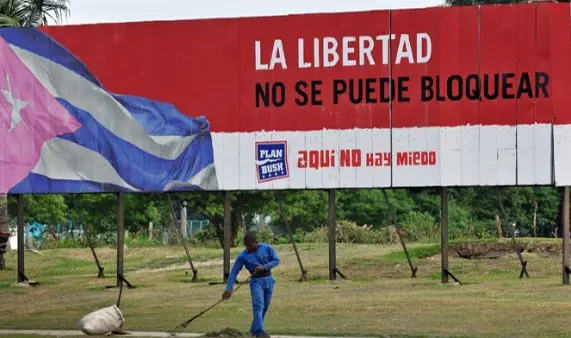
IMAGE CREDIT: The US’s relentless pursuit of cutting off access to fuel establishes, according to forum participants, an ethical and moral debate on a multilateral scale regarding the impunity and permissiveness with which US imperialism operates. Photo: EFE
[ SOURCE: teleSUR ]