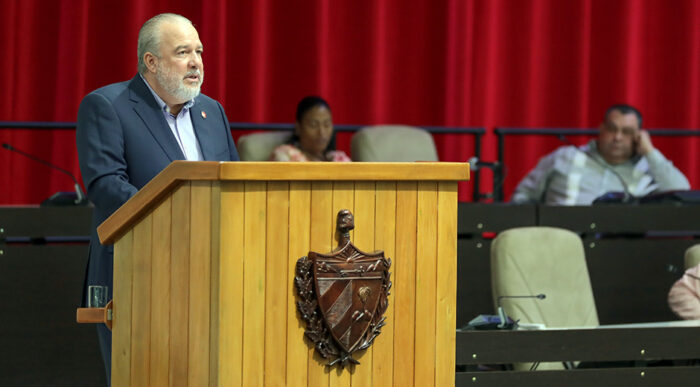
In presenting the report on proposed economic and social reforms to the National Assembly, Prime Minister Manuel Marrero Cruz noted that the disruption of fuel supplies and the impact on all sources of foreign currency revenue have significantly contributed to the deterioration and instability of the energy infrastructure, with the consequent negative impact on the quality of life of millions of Cubans.
He emphasized that Cuba has never denied its own errors and shortcomings; however, he affirmed that this set of factors has consistently influenced the effective implementation of the economic and social model reforms approved by the Party in 2011, a process that showed positive results until mid-2019, when the United States government substantially intensified its sanctions policy.
The Prime Minister recalled that the country, in the exercise of its legitimate sovereignty, has promoted measures aimed at reactivating the economy and correcting distortions, an effort strengthened by the approval of the Government Program to Correct Distortions and Revitalize the Economy, validated through a public consultation.
In the current scenario, he specified, any proposal for transformation starts from the premise of not relinquishing the preservation of the Revolution’s main achievements. In that sense, he explained that the proposed transformations are based on the thinking of the Commander-in-Chief and are conceived not as a renunciation of building socialism, but as an indispensable condition for its preservation.
The Prime Minister recalled a reflection by Commander-in-Chief Fidel Castro Ruz, who warned that certain circumstances would force the country to adopt decisions that, had it possessed sufficient capital and technology, it probably would not have needed to make.
In that sense, he assured that the proposed transformations have been conceived without ever renouncing socialism and under the guiding principle of “doing what is necessary to preserve what is essential.” He explained that expanding the participation of all economic actors on equal terms, promoting foreign investment, and using market mechanisms for resource allocation do not constitute a capitulation, but rather a response to the specific circumstances facing the country.
He also noted that the updating of the Cuban economic and social model, formalized in the Guidelines and the Conceptualization of the Economic and Social Model, has been marked by overcoming views that mechanically associated socialism with egalitarianism. In this regard, he affirmed that socialist planning does not exclude market rules, but rather must incorporate and regulate them according to the objectives of national development.
The proposals for economic and social transformations took into account the directives of Army General Raúl Castro Ruz and President Miguel Díaz-Canel Bermúdez, as well as the proposals contained in the Government Program. Specialists from the National Association of Economists and Accountants of Cuba, academics, and representatives from the economic commissions of the Party and the National Assembly also participated.
As a result of this consultation and analysis process, 390 proposals were evaluated, of which 66.7% were accepted.
Next, the Prime Minister began outlining the 176 proposals for economic and social transformations, organized into 23 fundamental pillars of the country’s economic and social life.
State-owned socialist enterprises and forms of non-state management
The first thematic pillar is dedicated to state-owned socialist enterprises and proposes a profound expansion of their powers and management autonomy. Among the proposed measures are the possibility for these enterprises to engage in any lawful activity, greater decentralization in wholesale and retail price formation, and greater flexibility in the use and allocation of profits once tax obligations have been met.
The transformations also include the creation of procedures for bankruptcy, liquidation, and restructuring of companies, as well as the possibility of converting state-owned socialist enterprises into commercial companies with shares or equity interests. It was explained that the State would define its shareholding in each sector of the economy and maintain a majority stake in those considered strategic for national development.
Management Models
The proposals related to non-state management models aim for a significant expansion of their participation in the national economy. Among the planned measures is the authorization of all pending applications from economic actors currently registered on the corresponding platform. It was reported that there are 12,771 established non-state micro, small, and medium-sized enterprises (MSMEs), while 7,254 applications remain pending, of which 3,505 have already been certified.
The package of transformations also includes reducing approval times for the creation of companies and allowing them to exceed the current limit of 100 employees. Entities exceeding that number would be recognized as private companies.
The proposal also includes allowing individuals to own more than one private company, expanding the corporate structures under which these businesses can be organized, and authorizing participation through shares. Furthermore, it anticipates granting real rights, such as usufruct and surface rights, to non-state management entities.
Among the most far-reaching measures are the authorization to open bank accounts abroad with the right to make withdrawals and the possibility of developing additional activities without abandoning the primary purpose for which they were created.
The Prime Minister also announced plans to reduce the activities currently prohibited for non-state economic actors and improve the management platform for these actors through the use of artificial intelligence tools.
The transformations would also extend to the agricultural sector. For the first time, the creation of micro, small, and medium-sized enterprises (MSMEs) in agriculture would be permitted, an area where, until now, only cooperatives could operate. In parallel, plans are underway to develop an input market accessible to all economic actors and to create a national platform for production chains that will require companies to publish their demands for goods and services, as well as their purchase levels and incentives for domestic production.
Digital Transformation
The proposals include the creation of a national technology hub comprised of hardware, software, and artificial intelligence, as the foundation for the country’s digital modernization.
The incorporation of artificial intelligence into public administration, under human supervision, is proposed, as well as the implementation of competitive compensation systems for the technology sector.
It is also proposed to allow foreign investment in areas such as ETECSA data centers, mobile networks, and other digital infrastructure, excluding those related to national security.
IMAGE CREDIT: Cuban Prime Minister Manuel Marrero Cruz, during his address at the third Extraordinary Session of the National Assembly of People’s Power in its 10th Legislature. Photo: Abel Padrón Padilla/Cubadebate.
[ SOURCE: CUBA DEBATE ]