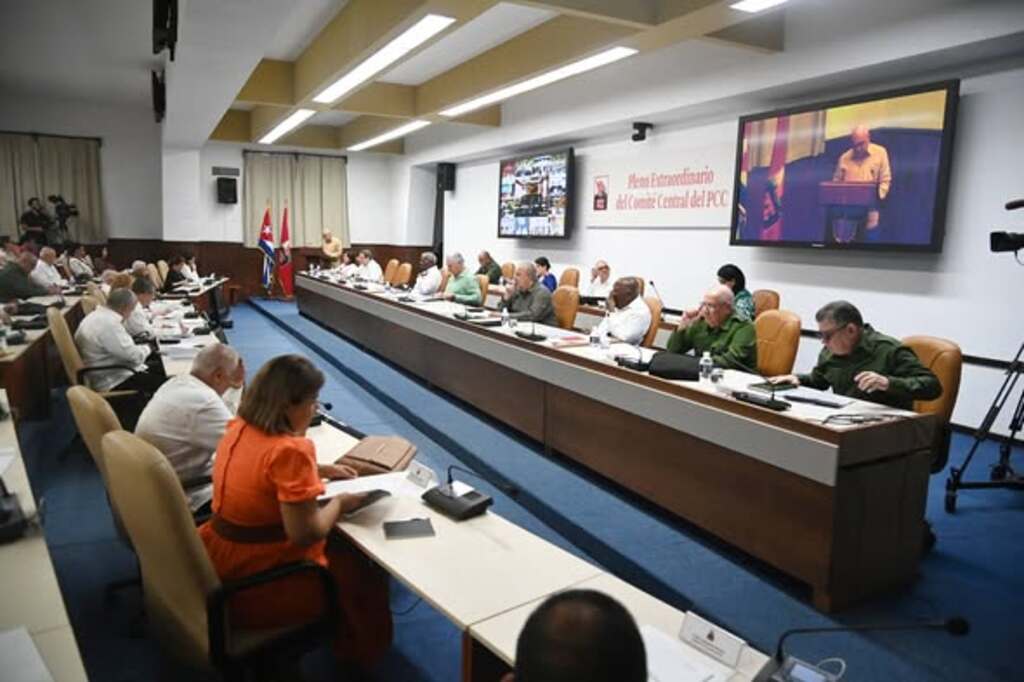
The Secretary of Organization of the Central Committee of the Communist Party of Cuba (PCC), Roberto Morales, affirmed on Wednesday that the profound transformations being debated in the organization’s Extraordinary Plenum are to preserve the Revolution and the achievements of Socialism.
The Presidency reported on its Facebook page that the member of the PCC’s Political Bureau stated that Cuba “is a State that resists and seeks alternatives.”
Morales emphasized that the Party will continue to be the most revolutionary element within the Revolution and that unity will continue to be “our response” to imperialist attempts to destroy the Revolution.
For his part, the island’s Prime Minister, Manuel Marrero Cruz, outlined the details of the transformations announced days earlier by Cuban President Miguel Díaz-Canel, which will allow the country to move forward amidst the complex difficulties caused by the intensification of the economic, commercial, financial, and energy blockade.
Manuel Marrero indicated that these transformations address issues such as the management of economic actors, the economic planning system, the resizing of the budgetary sector, and municipal autonomy.
He also specified that they encompass energy development, agricultural recovery, social, labor, and wage reforms, the modernization of the banking and financial system, changes to the tax system, and foreign investment, among others.
The prime minister emphasized that the proposals envision profound changes, in accordance with the Government’s 2026 Economic and Social Plan.
Manuel Marrero affirmed that the measures “do not constitute a deviation from the socialist project; on the contrary, they respond to the inherent logic of its development,” he asserted.
This party meeting began Wednesday afternoon with the participation of the Political Bureau of the Communist Party of Cuba (PCC) and is being led by its First Secretary and President of the Republic, Miguel Díaz-Canel.
Among the changes announced by the Cuban head of state are the elimination of the requirement to conduct import and export operations through state-owned enterprises, which would allow for more direct participation by economic actors.
Tariff incentives are planned for the import of raw materials destined for domestic production, along with a reorganization of logistics chains to promote exports and foreign exchange earnings. State-owned enterprises will also be granted greater autonomy, allowing them to define their own salary systems and expand their commercial powers.
Similarly, the proposals grant municipalities greater authority to manage foreign currency, authorize businesses, and participate directly in foreign trade activities. An institutional reform is also being promoted that would reduce the number of ministries from 27 to 21.
[ SOURCE: PRENSA LATINA ]