By Katiuska Blanco
1956. The wooden planks creak indiscreetly at this hour of the night, where the slightest noise becomes a damned betrayal and threatens to ruin everything in the blink of an eye. The planks, from swallowing so much seawater, are rotten, and the nails, from so much gripping the salty wood, are rusted. This makes the narrow, makeshift strip over the river threaten to unravel with every step. The rain and fog turn the pier into a tightrope covered in grease, along which they have to transport the crates of telescopic rifles—Garands, Mendozas, Johnsons, and Remingtons—machine guns, and ammunition. Along this same wobbly passageway pass sacks of oranges, boxes of cookies, medicine, cigarettes, coffee, backpacks… The planks seem to buckle under the weight of the men’s coming and going, from the house to the yacht, from the yacht to the house…
From Mexico City, Juan Manuel Márquez and one of the groups of revolutionaries travel by road to Tuxpan. Ramiro Valdés is among them. Once in the city, they wait in a downtown motel until the hours tick by before meeting up with the others in a humble neighborhood of fishermen’s houses, across the Pantepec River.
They efficiently and quickly unload the luggage and begin loading supplies and weapons. Juan Manuel thinks of his children. Camilo plots some mischief or whispers a joke. Almeida remembers the love he’s leaving behind. Che thinks of Guatemala, the old folks, and Hildita. Efigenio thinks of Mel and María de las Angustias. Ñico thinks of afternoons at the Café Soda Palace and of Vero, who returned to Havana and wishes she were here. Chuchú wonders if the last-minute repairs to the boat will be enough to get them there. Roque calculates, for the umpteenth time, always one more time, the yacht’s course. Pedrín Soto thinks of his girlfriend. Raúl thinks of all these people. Fidel thinks that it’s time to keep his word.
Ramiro, like everyone else, carries the boat again and again. He’s not thinking about anything. He only listens to the clacking of the old planks beneath his feet. He should have something to think about, too. He has plenty of reasons for the trip; But his thoughts remain silent…
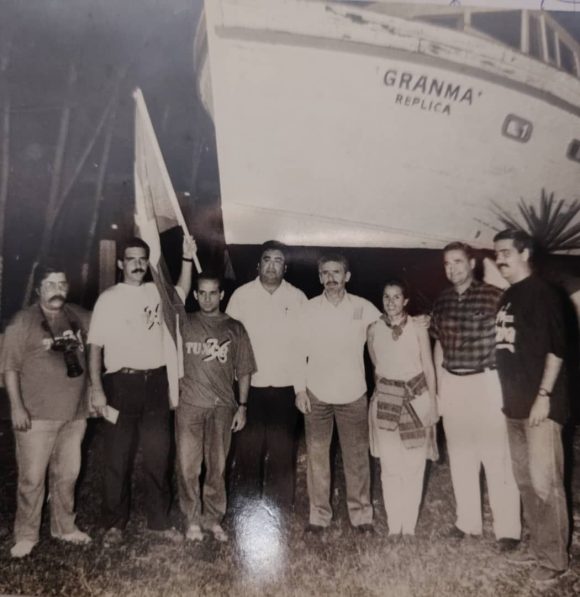
1992. Along that same wooden path, three decades later, the experiences of the Commander of the Revolution return to the present. Now he is once again by the river, a few steps from where the makeshift dock rattled that early morning. Now he thinks intensely.
The images, like a kaleidoscope, flash before him: his uncle returning from the sugar mill, he hears him mention the name Jesús Menéndez, the newspaper always in his hands. His mother, reading by lamplight, admires Céspedes, Gómez, Martí, and Maceo. She feels a profound devotion to history. Throughout the pseudo-republic, and especially during the 1950s, his hopes slipped away, leaving only disillusionment, frustration, skepticism, and a longing for the days of the Mambí War as persistent feelings in his soul—almost like incurable illnesses.
The encounters with the neighborhood youth turned into political meetings. In the Orthodox Youth, he joined Ciro, Julito, Ponce, Pepe Suárez—among others—and they launched a campaign against the candidates for representatives and senators in the 1952 elections, which they considered a farce. The early morning of March 10th brought the political struggle to a halt, exhausting the channels of representative democracy.
From the day Ramiro left his house with Pepe Ponce, under the pretext of traveling to the capital to promote the printing press’s publications, events unfolded rapidly. It was a plausible explanation for their five-day absence. At that moment, they had no idea that the Moncada Barracks was their chosen destination, nor that July 26th was the exact date. The battle, the arrest, the trial, the imprisonment, the exile.
The ticket indicated: destination Mérida.
Ramiro never attached much importance to phone numbers, addresses, or dates. He always made a point of recording that information only as long as necessary and then deleting it permanently. He thought—and still thinks—that it’s the most effective way to prepare for an interrogation because—although you’re not supposed to talk, by principle—everything is easier if you have nothing to say. Because of this conviction, his time in Mexico is a jumble of streets and places without any real sequence in his memory.
“I traveled alone. From Cuba, I had written down the address of a hotel and a phone number that I was supposed to dial upon arriving in Mexico City. When I called, they gave me the address of Emparan 49. At María Antonia González’s house, I found
“I traveled alone. From Cuba, I had written down the address of a hotel and a phone number I was to dial upon arriving in Mexico City. When I contacted them, they gave me the address of Emparan 49. I found Raúl at María Antonia González’s house. When we weren’t on a specific mission, Ciro, Julito, Raúl, and I lived together permanently. We always tried to stay together. We formed a core group from the prison, where the Abel Santamaría Academy operated, but our group had its own curriculum. We would get up at five in the morning to study all day until about midnight. It was a demanding schedule. We followed it together until Raúl was isolated and separated from us, just like Fidel. We continued without him, maintaining the same study rhythm.”
At Camp Santa Rosa (that’s what they called it for security reasons, but it was actually Rancho San Miguel), in Chalco, Guevara served as chief of staff and Ramiro as second in command.
“Che was surprised by his appointment and commented that others had more involvement. He was interested in learning how things had happened at Moncada. He and I had become close during target practice. It’s true that some had reservations about him, but even they, he won over with his prestige, authority, and his already outstanding human and political qualities. Everyone knew about his health, his occasional asthma attacks. I admired seeing him feel unwell without ever saying, ‘You do it.’
“To learn to navigate by the North Star, we would climb mountains at night. I remember it was freezing and raining. Che, who was practically a mountaineer, led the hikes. We climbed tied to each other with ropes to avoid falling or getting lost in the dark. At the top, we would fire our weapons. We would return in the early hours of dawn. By six or seven in the morning at the latest, we would hide.”
The Batista dictatorship was relentless in its plans to assassinate Fidel. Confidences and rumors confirmed the plot. The details had to be analyzed like a chessboard, observing every move of the enemy pieces, anticipating the next step to neutralize the attack.
Ramiro was assigned to be among those who were to keep a close eye on Fidel. His shadow followed him to meetings, visits, and political activities.
Because of this special circumstance, they were arrested together as they left the building at Kepler and Copernicus.
“I saw two men coming toward me. I didn’t notice anything unusual about them. Suddenly, they lifted me up, and a third disarmed me from behind. A Federal Police car pulled up, and they threw me onto the floor of the vehicle. Three minutes later, Fidel and Universo were there. In *A Grain of Corn*, Fidel comments on this event and says he thinks I’m behind it. It was very fast. It happened in seconds. I don’t have a clear understanding of the sequence.” From there, I think they took us to the Federal Security Police Office, then to the Attorney General’s Office, and later to the immigration detention center on Miguel Schultz Street.”
The Mexican side claimed it was a coincidence. They argued that they had set up a drug operation and the arrest happened by chance. “Yes, but I’ve never thought it was by chance,” Ramiro clarifies.
“In jail, we slept in a common room. Some people threw mattresses on the floor. Fidel cooked several times before being separated from his family, just like on the Isle of Pines. We read a lot again. Che played chess and challenged his comrades to blindfold games. They would place the boards behind him, and he would call out his moves and listen to his opponents’ replies. He kept several boards and each opponent’s position in his mind. It was quite a spectacle.”
Mexican General Lázaro Cárdenas took an interest in the detained young men and began negotiations for their release. A first group was freed. From then on, Ramiro “imprisoned” himself at the prison entrance. The possibility that Fidel might be transferred elsewhere or that something might be attempted against his life remained a real threat. The only entrance and exit were under the constant control of Ramiro and other comrades.
All the preparations were rushed until their departure for Tuxpan.
“I traveled by road with Juan Manuel Márquez. I don’t remember the house in Santiago de la Peña. They say that Fidel claimed, when he was here, that the Granma had left from a point further downstream. We finished loading the provisions and weapons and stayed on board. The yacht immediately started taking on water, and we had to bail it out. I spent practically all my time outside, in a seat in the bow. I tried not to be below deck because they were very crowded, and the stench was unbearable.” Julito, Ciro, and I shared a bunk next to a porthole or hatch. If anyone felt seasick, they lay down to cool off. I felt nauseous and unwell. I vomited only once. Raúl made jokes. If someone vomited, he would ask them in French if they were afraid. I was one of the last to disembark. We searched the yacht to make sure nothing was left behind. He’d forgotten an anti-tank rifle with its ammunition.
Then came the trek through the mangroves and the days that followed. They camped at Alegría de Pío. Ramiro was assigned to fetch supplies from a nearby store. He paid for the crackers and the sausage, then returned to the sugarcane field. He distributed the meager rations to the platoons and then headed toward the outposts for the same purpose. As he approached the forward position, he spotted the soldiers moving toward the rebel positions. The firing became widespread, and he was the only one carrying the submachine gun. His equipment had been left with the platoon to make it easier for him to distribute the food to the troops.
“I fell back to where my platoon was supposed to be. Only my backpack, rifle, and cartridge belt were waiting there. I was left alone.” I grabbed my gun, the bullets, the ammunition I kept in my backpack, and a can of condensed milk. The bullets sliced through the reeds in a specific direction and at a specific height. I calculated where the enemy fire was coming from, as there was a rattle of gunfire from weapons we didn’t have. The position of our men could be determined by the sporadic shots. I ran into Almeida’s group, and we continued retreating toward the mountain.
“From hut to hut, we ended up at some Adventists’ place. To help us break through the encirclement, they made it a condition that we leave our long guns behind. We had no other option, surrounded as we were by guards and with no sense of direction whatsoever. Continuing like that would have been suicide. We evaded ambushes. Almost without food, we finally reached Mongo Pérez’s house, and then the reunion took place.”
Ramiro was 24 years old at the time. He joined Column 1, then Column 4, and later—as second-in-command—Column 8, Ciro Redondo, commanded by Commander Ernesto “Che” Guevara. As in Column 4 and at the ranch in Mexico, he was again his second-in-command.
From that time, Che wrote to Fidel: “…I was hit by an M-1 bullet in the ankle, which is still there and completely prevents me from walking for now. Ramiro took charge of the column and is going with most of the men to the place the messenger will tell you about…”.
Ramiro was not initially among those who would participate in the campaign in the west.
“I insisted with Fidel. The main column, Column 1, fed the rest of the columns to extend the war, and I asked him not to deny me the opportunity to participate. He reluctantly agreed because, perhaps, he felt that the old combatants were leaving for other missions and he was being left alone. Death opened wide gaps in the ranks of the initiators, and many survivors were already fighting on other fronts. New comrades joined; but he was surely left with a longing for the faces of those difficult days.”
Commander of the Revolution Ramiro Valdés is at the edge of the gangplank. Soon, El Taíno—the ship on which Cuban youth will reenact the Granma voyage to the archipelago 36 years after “the adventure of the century,” as Che called the 1956 expedition—will set sail. He is not only the sole witness to both eras, but also the only combatant who participated in all the significant events of the Cuban Revolution—a fact acknowledged by Fidel: the attack on Moncada, imprisonment, exile in Mexico, the voyage of the Granma yacht, the guerrilla war in the Sierra Maestra, and the invasion of the country’s interior. After the triumph, the fighting and ambushes continued, only then the war was silent. He has also been the Commander of the silent war.
He has lost neither his youth nor his romanticism. I listen to the short bursts of his narration. He is not one to tell stories, yet he has told them. His words are not bombastic. He speaks softly about a profound story. He recounts a life of love with natural ease. I listen to him, and he, surely, hears within himself the creaking of the planks of the old makeshift pier by the river, that November morning in 1956.
IMAGE CREDIT: Photograph by Juvenal Balán, November 25, 1992, Tuxpan, Mexico.
[ SOURCE: CUBA DEBATE ]