By Ricardo Ronquillo Bello
Several years ago, during one of capitalism’s cyclical crises, I heard the prominent analyst Osvaldo Martínez Martínez, then president of the Permanent Commission on Economic Affairs of our Parliament, say that with that recession and the corresponding adjustment, “capitalism was taking its purgative.”
In other words, it was cleansing itself of one of its ingestions, rectifying its mechanisms to advance to its higher phase of exploitation and subjugation. Capitalist crises, seen in this way by the renowned director of the Center for International Economic Studies, were the system’s way of rectifying itself.
Focused on critically examining the humanitarian opponent, those of us who defend a viable alternative don’t always see the speck in our own eye, or aren’t as open to recognizing our own crises, especially their depths. Much less do we admit that, on this side, from time to time, and sometimes with regrettable consequences, we too are forced to swallow our own burdens. Our capacity for rectification and renewal also depends on these spoonfuls—sometimes hefty ones, not always palatable to our social and political dreams and aspirations.
The first thing we must recognize is that the collective punishment, the criminal reconcentration to which the current neo-fascist administration of the United States subjects us, arrived at a time of profound adjustment to the Cuban socialist model.
This adjustment, which began to take shape in the 6th… The Communist Party Congress, which culminated in the second Constitution after the triumph of the Revolution—the one approved in 2019—has reached its most radical chapter with the economic and social transformations that have just been submitted for analysis by the Extraordinary Plenum of the Central Committee of the Party and the 3rd Extraordinary Session of the National Assembly of People’s Power.
If there is one thing we must admit, it is that from the 6th Congress of the country’s highest political body until these difficult, indeed very difficult, and trying times for the Cuban people and their historical project of independence and freedom with social justice, we failed to acknowledge the true magnitude of our structural deformities and the highly corrosive reach of the purgative we must ingest as a society, not only in the face of internal deformities, but also in the face of the criminality, breadth, and magnitude of the isolation imposed today by the external genocidal blockade.
If there is one thing we must admit, it is that from the 6th Congress of the country’s highest political body until these difficult, indeed very difficult, and trying times for the Cuban people and their historical project of independence and freedom with social justice, we failed to recognize the true magnitude of our structural deformities and the highly corrosive reach of the purgative we must ingest as a society, not only in the face of internal deformities, but also in the face of the criminality, scope, and magnitude of the isolation imposed today by the external genocidal siege. This period of maturation, of course, has come at a cost, which is lamented in its many ramifications, but the Revolution is in power, it has built a legacy of enormous value—both real and symbolic—and it has the capacity to face it, provided that technical decisions find their proper counterpart in sound policy.
A certain cult of harshness, inflexibility, and intolerance, conditioned by the very circumstances of aggression in which the country had to survive, by errors of vision and calculation in various areas, and even by bursts of idealism, as Commander-in-Chief Fidel Castro Ruz acknowledged at the time, fueled excessive bureaucratization and other “excessive” problems that we now intend to shake up with a depth and scope we could never have imagined under other circumstances with the announced transformations.
While condemning the revolution to paralysis under the aggressive saga of imperialism, one cannot ignore the emphasis on promoting incentives, rather than prohibitions, in the public policies that are reshaping the socialist project with recent announcements.
Another attribute that can be pointed out, regardless of the dangers and threats they pose—the comprehensiveness and magnitude of the changes imply a shift in the social contract of the Revolution—is its attempt to restore one of its founding purposes: to open up opportunities, many opportunities, even if their nature may contradict some of the purest socialist aspirations.
When revolutions persist in creating incentives, instead of generating prohibitions, they achieve a special formula for endurance, as I noted a few years ago, when the solutions to this contradiction were not yet clear, and whose delicate consequences were paid for dearly in other socialist experiences.
Those were the times when, to give just one example, the words “entrepreneurship” or “entrepreneurs” seemed like taboo words in our circles, words now accepted more naturally, despite the attempts by not a few enemies of the Revolution to manipulate them for insidious political ends, or the lingering effects of the so-called old mentality.
There are even those who boast that entrepreneurship, with all that this term implies, is a quality applicable only to a specific social sector, especially the private sector, when in reality it should be a generalized condition, both in the public and private spheres, including cooperatives and other forms of economic organization.
Without entrepreneurs and entrepreneurial ventures, the success of any organization, and consequently of any society, is highly doubtful. Therefore, it is wise to continue moving away from the distortions caused by coercive or prohibitive approaches and toward more stimulating and beneficial ones derived from incentives.
Although one of the essential purposes of updating the socialist model from its inception was to reduce the contradictions between what is legal or legitimate under the conditions of socialist construction in Cuba, and in many cases this was achieved, other contradictions emerged as the changes unfolded, some with even more costly social consequences.
Let’s take, for example, the serious weakening of the role of public banks in the face of the emergence of alternative financial forms that citizens are forced to resort to without defined legal mechanisms. That very debate surrounding the draft of the new Constitution strongly revived the idea of passing a law against vagrancy, something I remembered from my teenage years, when the street corners of our neighborhoods, as I mentioned at one point, began to swell with a certain kind of parasitism, in this case, a social “intestinal” one.
The best solution to this problem is the one we are currently promoting, through the pluralization of our economic landscape fostered by the opening up to new forms of ownership—from the most individual to the most socialized—a process that must be intensified by the economic and social transformations under discussion. With this, along with other measures to transform the socialist state enterprise and link work, income, and prosperity, we dismantled old and absurd obstacles, brought previously demonized practices into transparency, and created a system of incentives for productive forces desperately needing these and other powerful stimuli to finally untangle their Gordian knots.
I once reflected that we sometimes allow phenomena to spiral out of control in a dangerous sequence of action and reaction, in an uncontrolled chain of social physics, where imbalances are confronted more from passion or instinct than from reason.
The result—I warned then—could be an ephemeral, inconsequential state, but never a permanent, lasting dignity. And we cannot forget that when José Martí envisioned a new republic for Cuba, he christened it with the sacred name of “moral.” But a moral republic—I commented—is not built by prohibiting but by inspiring love, uplifting, transforming, and saving.
Like Julius Caesar in the midst of his conquering struggle, the Cuban economy seems to be facing another Rubicon, even more turbulent and profound than the one at the beginning of the socialist model’s modernization, because it must mark the start of the deepest stage of the radical economic transformation underway.
This is happening even though the force of the magma shaking the country is not always perceptible amidst so many daily anxieties, some do not clearly see the paths opened up, or the transformations have not yet delivered all the expected benefits. But what is occurring is a veritable volcano, which will ultimately leave a new landscape in the economy and in other important aspects.
It is now easier to agree with the analysts who assert that the magnitude of the previous measures, and the most recent ones, transcends the meaning traditionally assigned to the word “modernization,” which was used to define the transformations approved in the 6th Congress. The Party Congress—with no concessions to capitalism—is reflected in the Guidelines for the Economic and Social Policy of the Party and the Revolution, in its new conceptualization, and in the 2026 Economic and Social Government Program, which is now being abruptly reinforced.
It is evident that nothing seems to be safe from the enormous process underway. The questions and changes range from a topic as defining and sensitive as the role of the State and the ways in which property is managed, to how and to whom subsidies should be directed, to mention only two extremes of the vast and unmanageable array of definitions and changes encompassed by the 23 pillars and more than 170 proposed transformations.
On the chessboard of these transformations, structural, functional, institutional, jurisdictional, and even political aspects are at stake, with economic and social repercussions. One of the least publicized, yet most significant, conceptual and practical shifts is precisely the clear alignment with economic practice of the distinction between the State as owner in the name of the nation and the people, and the various models through which property can be managed, as chosen in the conceptual framework.
This clarification is what allows us to move toward expanding self-employment, small personal or family property ownership, opening up to cooperatives of varying sizes, small, medium, and large private enterprises, increasing foreign presence in the economy, radicalizing the changes in socialist state-owned enterprises, the banking and financial system, and the allocation of subsidies and social security, to mention just a few defining areas.
While the initial years of the modernization process, with its relatively modest transformations compared to today’s proposals, already altered the landscape of our economy and its underlying concepts, moving beyond state hegemony and substantially redefining the role and functions of the state, what has been announced represents an unprecedented deepening of this process.
Cuba is leaping from a highly verticalized economy and society to a more horizontal one, opening itself to more diverse economic forms, from private to the most socialized forms of property management, and further defining the differences between public, private, and social ownership. All of this should help to overcome the legacy of socialist experiences regarding the alienation of workers from the production process.
This indicates that this is the boldest and riskiest step since the modernization process began. So much so that, as the First Secretary of the Central Committee of the Communist Party and President of the Republic, Miguel Díaz-Canel Bermúdez, emphasized in the debates of the National Assembly of People’s Power last Thursday, it is not essentially a response to external pressure, although it is part of the strategy to confront it. This incision to the very heart of the Cuban economy had to be made, without exception, because it could no longer bear the costly burden of so many errors, paralysis, and distortions.
It is perfectly logical, then, that many are asking: Where is Cuba headed? Is it updating itself toward a socialism adapted to the concrete possibilities of the 21st century—with that sense of the historical moment of Fidel’s concept of Revolution—or will it drift toward capitalism in its attempt? Can ours continue to be the socialist Revolution of the humble, by the humble, and for the humble that the Commander-in-Chief proclaimed at the historic Havana corner of 23rd and 12th Streets?
In such troubling times, we must not ignore that the great lesson of Cuban history, as I stated in another article, is not that of persistent failure, but rather that of resurrection, of persistent, growing, and continuous regeneration.
Our salvation as a people lies in regenerative constancy, in the understanding that the Revolution that began in 1868 and was rekindled on the centennial of José Martí’s birth achieved victory, but many of the definitive contours of that triumph remain to be defined, some of which depend on the boldness, depth, and speed with which we prepare ourselves to implement the unavoidable changes.
The Revolution is challenged to advance in the inevitable and delicate terrain of trial and error demanded by the unknown path toward building socialism. Because, as I also reiterated elsewhere, revolutions are not made and exist in “Facilitonia,” the paradise of easy things, an imaginative creation of the Spanish writer Pedro Pablo Sacristán.
Yes, I believe that Osvaldo Martínez’s idea that capitalism takes its purgatives should be enriched with the certainty that socialism, in order to purify itself, also requires its own.
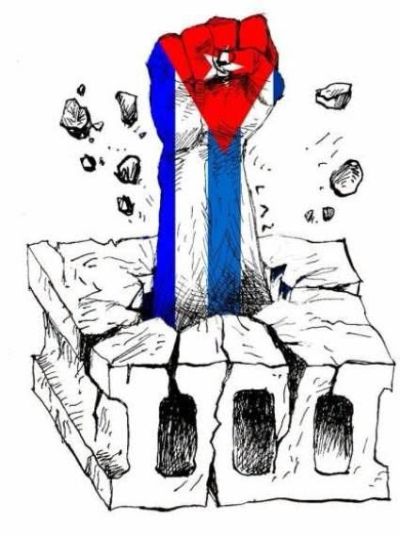
IMAGE CREDIT: Published in the Sunday edition of the digital newspaper Juventud Rebelde on June 21st
[ SOURCE: www.cubainformacion.tv ]