Marc Vandepitte / Rebellion
What has a population of ten million people done to deserve this? Why must this island endure the longest blockade in history? Why was former leader Fidel Castro the target of more than 600 assassination attempts? And why have thirteen consecutive US presidents made regime change in Cuba a veritable obsession?
Cuba has never invaded a neighboring country. It has never supported terrorist groups or bombed another nation. When a devastating earthquake strikes a country or when an Ebola outbreak needs to be combated, Cuban doctors and aid workers are usually among the first to arrive. Despite being a poor country and facing enormous economic difficulties, Cuba sends more doctors to the Global South than the World Health Organization itself.
But none of that seems to matter. Trump has vowed to “take control” of the island. First, resolve the Iran issue; then Cuba, and perhaps later Nicaragua. Today, Washington accuses the island of being “the center of world communism,” a threat that, according to this rhetoric, must be eliminated.
The rhetoric is grotesque, but it has a clear purpose: to prepare American and international public opinion for a possible military intervention against Cuba.
Meanwhile, the country is being economically strangled. Financial transactions with Cuba are virtually impossible. Access to international credit exists only at usurious interest rates. And, in addition to the extremely severe economic blockade, an energy blockade has been in effect since January. Countries that previously supplied oil to Cuba now receive threats of harsh sanctions from the White House, which has reduced crude oil supplies to historic lows.
This energy blockade is also extending to other essential sectors, such as food, medicine, and other basic necessities. Companies and governments that maintain trade relations with Cuba are subjected to intense pressure. And the intimidation strategy is yielding results.
Cuba finds itself practically alone today. Countries like Mexico, China, Vietnam, and Spain continue to maintain economic relations with the island, but they are ultimately yielding to pressure from the Trump administration. Currently, some 7,000 containers of essential goods are blocked en route to Cuba.
The port of Mariel, the country’s largest and located near Havana, presents a desolate scene. Large foreign companies, such as the Canadian mining firm Sherritt and the Spanish hotel chain Meliá, are reducing or abandoning their operations.
What is happening is a form of economic waterboarding. For ordinary Cubans, the situation is devastating and deeply distressing.
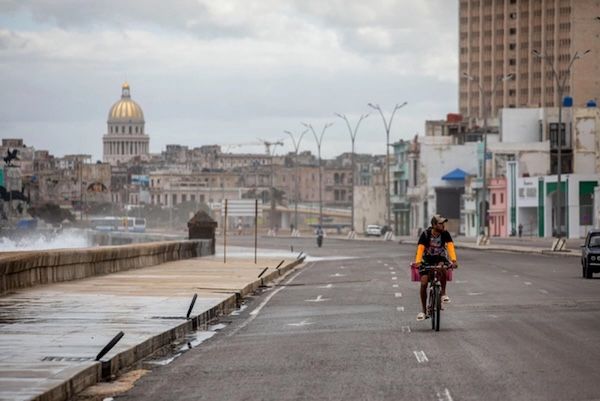
Public transportation, traditionally inexpensive, is barely functioning. Private transportation is prohibitively expensive due to the exorbitant price of the scarce fuel available. In many places, electricity is only available for two hours a day. This means living without fans, even though temperatures consistently exceed thirty degrees Celsius (86 degrees Fahrenheit).
It also means that food cannot be preserved and that, often, there is no drinking water either, because there isn’t enough energy to pump it. Some neighborhoods in Havana have been without water for months. Many families cook with charcoal or simply with firewood. Without electricity, the elevators don’t work either. Just imagine what it’s like to live on the tenth floor.
Since numerous services have stopped working—due to a lack of spare parts or the energy shortage—any procedure can require hours of waiting. Garbage collection has also been severely affected by the lack of fuel, and waste is piling up in numerous places throughout the city.
The shortage of energy, medicine, and medical supplies is also forcing the postponement of surgeries and countless medical treatments. More than 100,000 patients are already affected. Ibis told us that her father died in November because he was never able to have surgery. “Infant mortality has doubled,” she says resignedly. “This is a war without bombs.”
After the collapse of the Soviet Union in 1991, Cuba went through a severe economic crisis from which it never fully recovered. The current situation is even worse. Back then, blackouts lasted a few hours; today, in many areas, there is barely any electricity. More than thirty years have passed without the country being able to invest significantly in infrastructure. Everything is aging, and much of it is in an alarming state of disrepair.
Furthermore, the Cuban peso is worth five times less today than it was in the 1990s, which has greatly widened the gap between Cubans who have access to dollars — because they receive remittances from abroad or work in sectors linked to that currency — and those who are only paid in pesos. In the 1990s, the strong charismatic leadership of Fidel Castro still existed, capable of reinforcing the psychological resilience of a large part of the population. That element no longer exists.
This is the second time in a single generation that the country has faced an economic crisis of such magnitude. Thirty-five years of hardship, uncertainty, and scant prospects for improvement are finally taking their toll. And yet, the resilience of the Cuban people remains extraordinary. Despite extremely harsh living conditions, they have not lost their sense of humor or their ability to smile. It’s something we witness here every day.
The population is very clear about who they consider responsible for this situation. The long blackouts began right after Trump tightened the energy embargo. For the vast majority of the Cuban population, the connection is obvious. He has also witnessed how Trump has “helped” the Iranian people.
The US midterm elections will be held in November. Until then, the situation will remain particularly delicate. There is a real possibility that Trump will want to turn Cuba into a new political trophy before those elections. Afterward, his room for maneuver could be considerably reduced. In any case, the coming months will be decisive for the Cuban people.
[ SOURCE: www.cubainformacion.tv ]