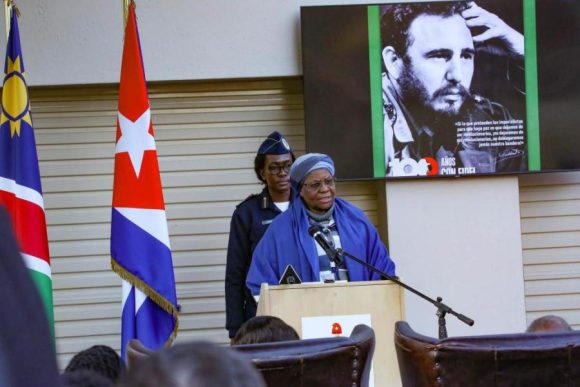
Speech by Her Excellency Dr. Netumbo Nandi-Ndaitwah, President of the Republic of Namibia, on the occasion of the centenary of the birth of Commander-in-Chief Fidel Castro Ruz, delivered at the Cuban Diplomatic Mission in Windhoek.
***
Master of Ceremonies;
Her Excellency Lucia Witbooi, Vice President of the Republic of Namibia;
His Excellency Elijah Ngurare, Prime Minister of the Republic of Namibia;
Her Excellency Saara Kuugongelwa-Amadhila, Speaker of the National Assembly;
Her Excellency Jenelly Matundu, Deputy Minister of International Relations and Trade;
Your Excellency Sergio Vigoa de la Uz, Ambassador of the Republic of Cuba;
Honorable Cabinet Ministers;
Honorable Members of Parliament;
Your Excellencies Heads of Mission;
Ambassador Tuliameni Kalomoh, Vice President of the Namibian Campaign Committee in solidarity with Cuba;
Comrades;
Members of the media;
Ladies and gentlemen.
We gather today to commemorate the centenary of the birth of one of the most transcendent figures of the 20th century: Commander-in-Chief Fidel Alejandro Castro Ruz.
We honor the legacy of a man whose life became inseparable from the struggles of oppressed peoples throughout the world; a revolutionary whose vision transcended the shores of Cuba to embrace the aspirations of Africa; a statesman whose unwavering commitment to justice helped change the course of our own history.
Although a century has passed since his birth, the ideals for which Fidel Castro lived continue to resonate across continents and generations. They remind us that true leadership is not measured by power or privilege, but by the lives it transforms, the dignity it defends, and the hope it inspires. For Namibia, today is not merely a commemorative occasion; it is a profoundly personal one.
The story of our liberation is intertwined with the solidarity and internationalist commitment of the Cuban people under the leadership of Comrade Fidel Castro. For our people, Cuba was not a distant voice of solidarity, but a steadfast partner in our struggle for freedom, independence and human dignity.
It is impossible to recount the story of Namibia’s liberation without acknowledging Cuba’s immense contribution and the unwavering leadership of Commander-in-Chief Fidel Castro Ruz, who led Cuban internationalists in defense of the lives of so many oppressed peoples around the world.
It is, therefore, with profound gratitude that we remember President Fidel Castro, not only as the leader of the Cuban Revolution, but also as a friend of Africa and a committed ally of the liberation movements of our continent.
His legacy endures in the unbreakable bonds between Cuba and Namibia, forged in the trenches of struggle and sustained by a shared commitment to sovereignty, solidarity, internationalism and justice.
Thus, Comrade Fidel Castro sowed seeds of generosity, solidarity, and internationalism that have since germinated, taken deep root, and grown into a flourishing tree, whose fruits continue to nourish and benefit humanity across generations and continents.
The ties that bind Namibia and Cuba were not forged out of convenience or political opportunism. They were forged in the crucible of struggle, strengthened by sacrifice, and consecrated by the blood of courageous Cuban men and women who believed that no people should remain under the yoke of colonialism, racism, and apartheid. Cuba selflessly shared what little it had with many countries in need.
Comrades and friends:
An African proverb reminds us: “The river that forgets its source soon dries up.” Namibia has not forgotten the helping hand extended to us at a decisive moment in our history.
We have not forgotten, nor will we ever forget, the sons and daughters of Cuba who stood in solidarity with the peoples of southern Africa—and Namibia in particular—nor the unwavering leadership of Commander Fidel Castro, who understood that the struggle for freedom in Africa was inseparable from the struggle for human dignity everywhere.
Ours, therefore, is a relationship born of shared struggle, sacrifice, and humanity. It is a friendship forged in the fires of a historic revolution; a friendship that history itself has tested and proven indestructible.
Thousands of Cuban soldiers traveled thousands of kilometers from their homeland, not in search of territory, wealth, or political power, but in defense of the freedom and dignity of peoples they had never met. They came because they believed that the fight against colonialism, racism, and apartheid was a common struggle for humanity.
For Namibia, the decisive Battle of Cuito Cuanavale remains one of the defining moments of our liberation struggle. It was the largest battle fought on African soil since the Second World War.
It was that battle that marked a turning point, fundamentally altering the political trajectory of southern Africa. He demonstrated that it was possible to resist and defeat the apartheid military machine, and he helped create the conditions that accelerated Namibia’s path to independence and precipitated the end of apartheid itself.
Therefore, in commemorating the centenary of President Fidel Castro’s birth, Namibia does so not only in remembrance, but with gratitude, solidarity, and a renewed commitment to the values that united our two peoples.
Our third president, Dr. Hage Geingob, reminded us that Cuba “did not assist Namibia in its search for mineral resources or other sources of wealth. It harbored no imperialist ambitions. It acted driven by principles of justice, equality, and respect for the freedom of all the peoples of the world.” These words summarize the essence of Cuba’s contribution more powerfully than any historical analysis.
Consequently, every Namibian child born in freedom walks on a freedom won not only thanks to the sacrifice of our own heroes and heroines, but also to the sacrifice of the sons and daughters of Cuba.
Namibia will forever honor the Cuban people—our brothers and sisters—whose solidarity with Namibia was not merely expressed in words, but in courage, sacrifice and action.
We will never forget the sons and daughters of Cuba who stood with Africa when our continent faced the brutal forces of colonialism, racism and apartheid.
We will never forget Comrade Fidel Castro Ruz, whose moral courage, internationalist conviction, and unwavering solidarity inspired a nation to support Africa during one of the darkest chapters in our history.
His legacy endures not only in history books, but in the freedom of our people, in the enduring friendship between Namibia and Cuba, and in the generations that continue to benefit from the seeds of solidarity he sowed.
Therefore, Fidel Castro’s greatness was never measured solely by military victories or political achievements. His enduring legacy lies in his profound commitment to humanity. He believed that every person, regardless of race, nationality, or economic status, deserved dignity, education, healthcare, and opportunity.
Following Namibia’s independence, the relationship, solidarity, and cooperation between the peoples of Namibia and Cuba continue to strengthen. Cuban professionals and experts—including doctors and healthcare personnel—continue to provide services in various sectors of our national development, such as engineering, urban planning, and sports, among others. This support is a clear testament to the bond of friendship and solidarity between our two peoples.
Comrades and friends:
In honoring the legacy of this extraordinary leader, we must also reflect honestly on the persistent challenges facing the Republic of Cuba today.
For more than six decades, Cuba has endured a unilateral economic, commercial, and financial blockade imposed by the United States of America, which has intensified in recent times. Behind every statistic lies the lived reality of ordinary people: a mother searching for essential medicines, a family struggling to provide for their children, a young person seeking opportunities, and communities working tirelessly to preserve their dignity in the face of immense adversity.
The greatest cost of this blockade has never been measured solely in economic losses. It has been measured in deferred dreams, limited opportunities, and the quiet resilience of a people who have refused to relinquish hope. Yet, despite these challenges, the Cuban people have continued to demonstrate extraordinary dignity, determination and resilience.
Namibia has consistently maintained that such unilateral coercive measures, and any form of economic coercion, are incompatible with the purposes and principles upon which the United Nations was founded.
Measures that seek to isolate or economically strangle sovereign nations undermine these principles and cause the greatest suffering to ordinary citizens.
Therefore, we reiterate our firm call for the complete and unconditional lifting of the economic blockade against Cuba. No nation should be punished for exercising its sovereign right to determine its own political, economic, and social path.
Comrades and friends:
As we commemorate the centennial of President Fidel Castro Ruz’s birth, may this occasion renew our collective commitment to the principles that defined his life. Let us reaffirm our commitment to solidarity, justice, equality, and the unwavering defense of human dignity.
Let us also teach future generations that freedom is never inherited without effort; it is won through sacrifice, protected with courage, and preserved through unity and collective responsibility.
To the people of Cuba, our brothers and sisters, we once again express the enduring gratitude of the Namibian people. Namibia remembers. Namibia honors. Namibia stands with you in friendship, in solidarity, and in our shared pursuit of a more just, peaceful and equitable world.
May the enduring legacy of Commander-in-Chief Fidel Castro Ruz continue to illuminate the path toward justice, peace, and human dignity for future generations.
Long live Cuba!
Long live Namibia!
Long live international solidarity!
Long live Fidel Castro Ruz!
Heroes never die!
Thank you very much.
(Taken from Cubaminrex)
IMAGE CREDIT: Photo: Cubaminrex