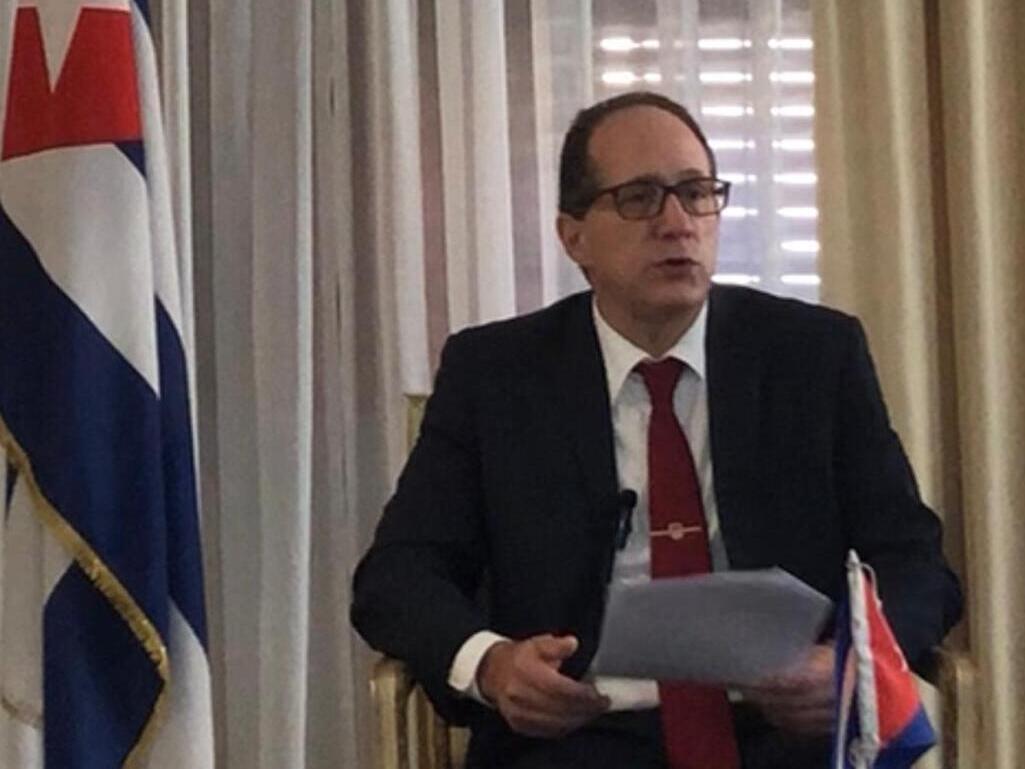
The Cuban ambassador to the Holy See, Leyde Rodríguez Hernández, has denounced the extraterritorial impact of the U.S. blockade against his country, which hinders maritime transport and the arrival of food, medicine and humanitarian aid for the population.
In a press conference this Thursday, the diplomat pointed out that Washington’s unilateral coercive measures affect shipping lines, insurance companies, and banking institutions. He asserted that these measures impede legal commercial operations and increase the costs of transporting goods destined for the island.
Rodríguez Hernández indicated that, according to the latest available data, more than 7,000 containers had been unable to reach the port of Mariel, in western Cuba, due to these restrictions—a figure he estimated may have risen further in recent weeks.
The ambassador warned that these shipments include food, medicine, and medical equipment, as well as supplies for dining facilities serving vulnerable individuals, children, and schools.
He also warned of the risk that perishable products and medicines could spoil or be lost as a result of these delays.
Among the specific cases mentioned, he cited containers of humanitarian aid from the Order of Malta, which were diverted to the Mexican port of Veracruz — where, he explained, they now face additional costs of approximately $6,000 per container.
This situation forces the search for new routes and the contracting of alternative transport services, which drives up the cost of providing assistance, he said.
The diplomat also noted that shipments from the Italian organization *Semillas de Paz* (Seeds of Peace) and the Community of Sant’Egidio have been affected by the difficulties in reaching Cuba. He emphasized that these restrictions harm not only the Cuban people but also solidarity organizations, businesses, and other countries involved in humanitarian cooperation efforts.
In the view of Rodríguez Hernández, the extraterritorial nature of the blockade turns this policy into an obstacle for Cuba’s commercial, academic, cultural, and tourism-related relations with the rest of the world, as it exerts pressure on third parties that maintain legitimate ties with the island.
Speaking before the Vatican, he linked these restrictions to the energy challenges facing the country, stating that—according to information he had consulted—out of approximately 90 oil tankers that could have arrived in Cuba over the last 10 months, only one managed to do so. “It is a war against Cuba and against the world,” he declared, denouncing the fact that U.S. measures also affect those who seek to maintain normal relations with the Caribbean nation or provide assistance to its population.
The Cuban representative maintained that the consequences of these sanctions underscore the need to put an end to a policy which, he asserted, violates Cuba’s right to trade freely and harms third countries, businesses, and humanitarian organizations.
Rodríguez Hernández expressed his confidence that the international community would support the resolution calling for the lifting of the blockade—a resolution set to be considered by the United Nations General Assembly on October 27th and 28th.
[ SOURCE: PRENSA LATINA ]