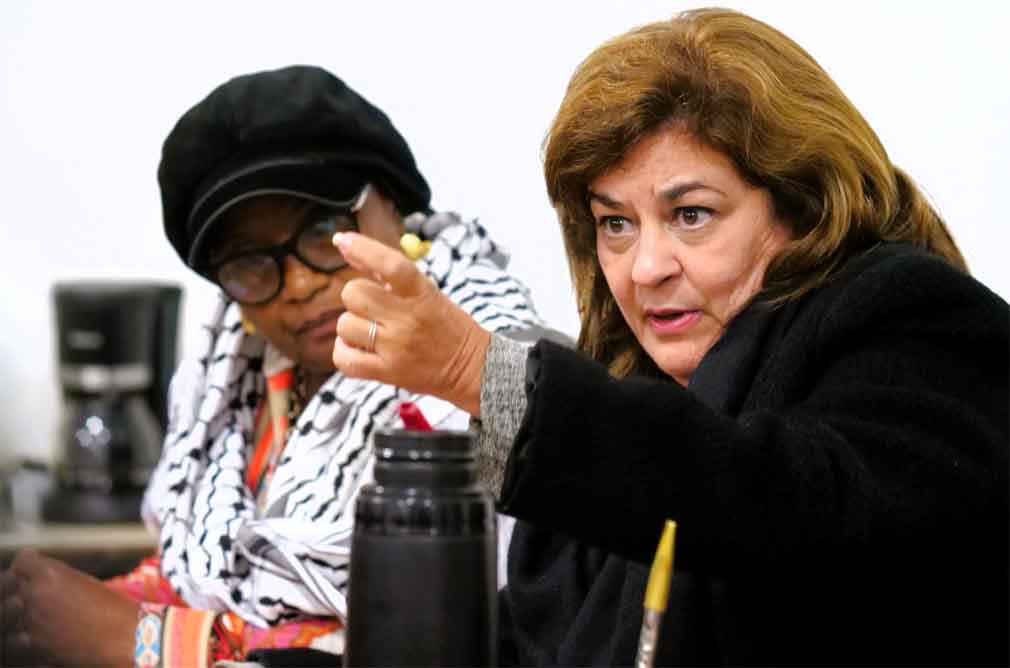
Cuba is currently immersed in implementing economic and social transformations to continue building socialism despite the obstacles of the blockade, stated the island’s Deputy Minister of Foreign Trade and Foreign Investment, Déborah Rivas.
This statement was made during a meeting at the headquarters of the PIT-CNT labor federation, whose president, Marcelo Abdala, welcomed her to “the house of solidarity with Cuba.”
Rivas is leading her country’s delegation that will participate in the Sixth Meeting of the Regional Conference on Population and Development in Latin America and the Caribbean. which begins in Montevideo.
In her meeting with the Uruguayan labor and solidarity movement, the Cuban Deputy Minister explained the latest consequences of the strengthened US blockade against Cuba, now including the energy embargo.
“The blockade is killing people,” she denounced, as a consequence of the lack of medical supplies and medicines, fuel, and water.
“There are 15,000 children waiting for surgery because hospitals lack the resources to treat them.”
Cuba’s Deputy Minister of Foreign Trade and Foreign Investment Déborah Rivas said that in this context, the Cuban Revolution did not stand idly by.
In a sovereign manner, our country decided, in this very complex scenario, to approve a series of economic and social transformations aimed at making the economy more efficient, producing wealth, distributing it, and preserving social achievements, particularly the universal and free healthcare and education systems.
These objectives entail social transformations and the participation of all economic actors and civil society organizations, she added.
She referred to the transformation related to corporate social responsibility, which thousands of small and medium-sized private companies operating on the island, particularly at the local level, must embrace.
The deputy trade minister explained that the policy of subsidizing the losses of public companies and products that make the economy unsustainable is a thing of the past. From now on, only the most vulnerable people or companies with specific social responsibilities will receive such support, but everyone else must manage their own resources.
Rivas pointed out that the State needs revenue to cover a budget that allocates 21 percent to education and 24 percent to health.
She asserted that the transformations adopted and underway are the result of a sovereign decision and denied that they represent a transition to capitalism.
“We are convinced that this is the path to saving socialism in Cuba.”
At the meeting, the president of the Cuban Association of the United Nations (ACNU), Norma Goicochea, said that this is a process in which all civil society organizations on the island must be involved.
On behalf of the Union of Jurists of Cuba, lawyer Ivonne Pérez emphasized that the implementation of the 176 measures entails work involving the population and academia, particularly the adaptation of regulations and legal support.
From the audience, questions arose regarding the role of unions in these new realities, the role of public ownership, and Cuba’s capacity to overcome the obstacles and impediments of the blockade. The political thought of Che Guevara was also recalled.
The Cuban ambassador to Uruguay, Lissett Pérez, participated in the meeting.
[ SOURCE: PRENSA LATINA ]