By Leticia Martínez
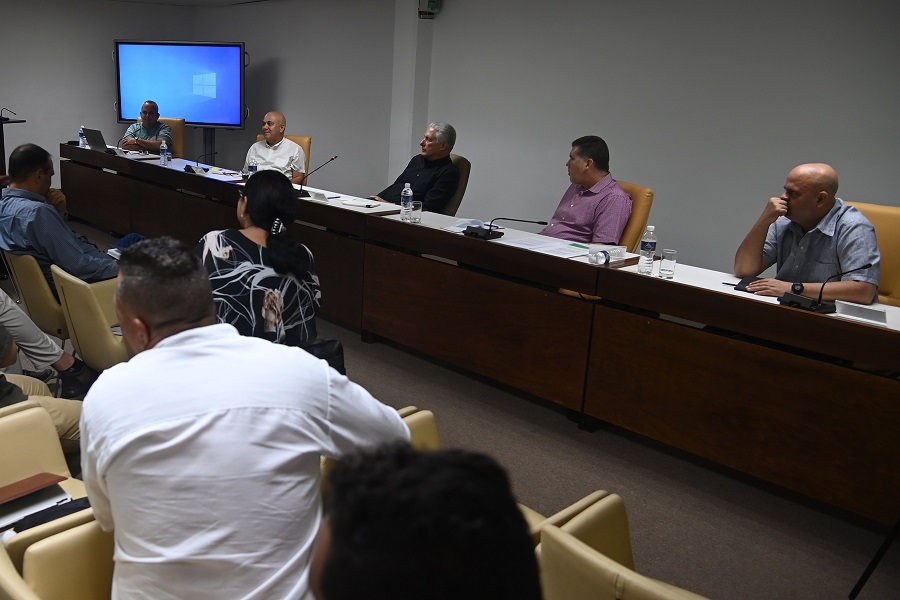
President Miguel Díaz-Canel Bermúdez met with representatives of the private sector in Cuba, a contact that, he explained, will be constant with the Cuban business system, which is a single entity encompassing both state and non-state enterprises.
“We cannot build everything we want to do for the benefit of the country if we don’t achieve this communication,” he said during the meeting, which included business owners from the food, agriculture, energy, transportation, legal services, and other sectors.
“Without systematic dialogue, we cannot know what we are thinking and how we are building consensus,” emphasized the Head of State, who attended this meeting accompanied by Roberto Morales Ojeda, Secretary of Organization of the Central Committee; Oscar Pérez-Oliva Fraga, Deputy Prime Minister; Osnay Miguel Colina Rodríguez, Secretary General of the Cuban Workers’ Federation; Jorge Luis Broche Lorenzo, Head of the Economic Department of the Central Committee; and Lázara Mercedes López Acea, President of the National Institute of Non-State Economic Actors.
Díaz-Canel affirmed that “what we are doing is for Cuba to grow and for there to be a proper relationship between what you can aspire to as businesspeople and what the country aspires to, so that we can combine them into a framework where everyone benefits.” And, above all, he added, “we are strengthening the momentum that the country requires in such complex times as these to achieve the prosperity that our people need.”
The Head of State advocated for increasing the country’s production of food, goods, and services; by reducing unproductive costs and dependence on imports of finished goods; and by incorporating technology, knowledge, and innovation.
It makes no sense, the president argued, to consider all economic actors in our economic and social model if they are not aligned with territorial and local development strategies and the National Development Plan.
“If the country wants to boost the energy sector, what is the role of state-owned enterprises in the energy sector? What is the role of private companies in the energy sector?” And that, he specified, must also be reflected in the numbers: how much have you contributed to the energy sector, to job creation, to national revenue, how much have you contributed to electricity generation?
At the same time, Díaz-Canel was critical of issues such as illicit profits. He emphasized that profit must be linked to effort, results, productivity, efficiency, innovation, and the risks taken, not to speculation or price gouging that harms our people.
Miguel Diaz-Canel urged that this sector cannot become a breeding ground for illegal activities, tax evasion, speculation, corruption, hoarding, or price fixing disconnected from reality.
He specifically condemned the refusal to accept payments by bank transfer, a harmful practice that harms our population, and against which an offensive will continue until it is completely resolved.
The Cuban leader advocated for “not judging the effectiveness of an economic project, in any of its management forms, solely by the amount of money deposited into a bank account, but rather, and above all, by what it contributes to a family’s table, to a young person’s employment, to helping a promising young person find a place in the country to develop, to what we can do to improve a community, to what it can contribute to the economy and development of a municipality, and ultimately, to sovereignty.”
Díaz-Canel affirmed that Cuba will move forward with the implementation of economic and social transformations, giving everyone a voice, always with a focus on the well-being of the people and the development of the country.
During the meeting, several business leaders shared their work experiences and spoke about prejudices and obstacles that persist at intermediate management levels, sometimes motivated by a lack of understanding of the 176 recently approved economic and social transformations.
They also presented new business projects and informed the country’s leadership about social programs they are developing in their communities; they explained priorities such as changing the energy matrix in their businesses so as not to stop production; and they advocated to be considered part of the Cuban business network, in the collective challenge of moving the country forward.
IMAGE CREDIT: Díaz-Canel meets with private business owners. Photo: Estudios Revolución
[ SOURCE: CUBA DEBATE ]