Mokhtar Benabdelkader, a 30-year-old engineer living in Adrar, about 1,500km from Algiers, remembers the stories his grandfather Mohamed told him as a child about the Blue Jerboa.
He was not talking about the small, harmless desert rodent, but about the French atomic bomb named after the animal, which exploded on 13 February 1960 in Reggane, in the heart of the Algerian Sahara.
At the time, Algeria was still a French colony, and Paris, with its nuclear ambitions, had chosen the North African country for its first experiments.
“My grandfather died in 1992. But his story is still vivid in my mind. It haunts me,” Mokhtar told Middle East Eye.
In 1960, the Benabdelkader family was living in Bahou, a hamlet located a few dozen kilometres from Hamoudia, where the explosion surprised the inhabitants early in the morning.
“My grandfather described a blinding light in the sky followed by a muffled sound that ripped through the earth like an earthquake,” Mokhtar recounted.
The 70-kiloton plutonium bomb – four times more powerful than the one dropped by the US on Hiroshima in 1945 – spread radioactive fallout across an area 200 km wide and 100 km long.
It left death in its wake, killing people, animals and plants alike.
Before he died, Mohamed had battled liver cancer for years. In his village, other residents had succumbed to the same disease before him.
“Officially, the exact number of victims is unknown. After independence [in 1962], my grandfather left Bahou and took his entire family to live in Adrar, thinking he was escaping danger,” Mokhtar said.
But in reality, the threat had not disappeared, and the Gerboise Bleue operation was only the beginning of a long series of underground and atmospheric nuclear experiments – 17 in total and across two Saharan sites, In Ekker and Reggane – which continued until 1966. France has yet to acknowledge the health and environmental fallout of these experiments.
Crucially, the French army has so far refused to provide Algeria with maps showing the locations where equipment used for the tests and buried waste are located, from simple screwdrivers to military vehicles.
‘Colonialist project’
In her essay Colonial Toxicity, Algerian historian Samia Henni discusses the remnants of these experiments left lying on the ground.
“Vast areas are littered with abandoned objects and materials… The waste scattered across them is likely to be contaminated and radioactive. Not only does it pollute the desert and the many forms of life it shelters, but it also infringes upon the dignity of the Saharan people, who are denied the right to live in uncontaminated territory,” she writes.
‘In the Reggane region and its surroundings, the population has halved, dropping from 40,000 to 20,000 inhabitants’
– Samia Henni, Algerian historian
Henni continues by asserting that “France’s refusal to identify and name the material and geological consequences of the first French atmospheric bombs in the Sahara is an integral part of a colonialist project, which obscures and erases the violence of spatiality and the long temporal reach that are intrinsic to colonial toxicity”.
The French nuclear tests in Algeria took place during a pivotal historical period: that of decolonisation. Starting in January 1961, after more than six years of war, the French state and the Algerian National Liberation Front (FLN) began negotiations on organising a referendum on self-determination, which was held a year later.
The status of the Sahara was a key issue in these negotiations. Ultimately, Paris obtained authorisation to use this vast territory for five years after Algeria’s independence to pursue its nuclear programme, while simultaneously refusing to sign international agreements banning nuclear testing.
France justified the choice of the Sahara by claiming it was an uninhabited area, even though Tuareg populations had long lived in the region.
According to Henni, the tests had terrible demographic repercussions.
“In the Reggane region and its surroundings, the population has halved, dropping from 40,000 to 20,000 inhabitants,” she told Middle East Eye, adding that it is still impossible to know the precise number of victims because “the testing programme remains secret and the archives inaccessible.”
France keeps the documents on its nuclear tests under military secrecy, arguing that their release could expose techniques still deemed sensitive and create a precedent for opening other nuclear‑related military archives.
Secret defence
In a previous interview with MEE, Patrick Bouveret, a member of the International Campaign to Abolish Nuclear Weapons (Ican) and a cofounder of the Arms Observatory, an independent centre of expertise based in Lyon, explained that “French nuclear archives are subject to a double lock”.
In 2008, a heritage law created a category of archives that cannot be declassified, specifically those relating to weapons of mass destruction, including nuclear weapons.
In 2021, the French parliament passed an anti‑terrorism and intelligence law that further tightened the restrictions on classified “secret defence” archives.
“This [2021] law grants military authorities a veto over the release of documents concerning, for example, the fallout from nuclear tests in the Algerian desert – that is, the amount of radioactivity released at the test sites and on the waste buried there,” Bouveret said.
He noted that underground and surface waste “can remain polluting for tens of thousands of years by contaminating the food chain and groundwater” and that the bombs used were 10 to 20 times more powerful than those dropped on Hiroshima and Nagasaki by the United States.
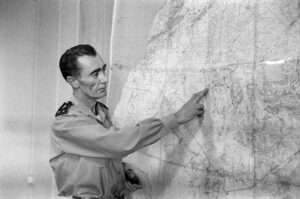
Photo taken at Reggane in December 1960 of General Jean Thiry speaking to journalists about the explosion, on December 27, 1960, of the third French atomic bomb on the test polygon at Reggane in the Sahara during the operation called “Gerboise rouge”. General Jean Thiry, director of nuclear experiment centers, during the first French thermonuclear device in the Pacific in 1968, died on December 14 in Paris at the age of 84. (Photo by AFP)
French General Jean Thiry speaks to journalists about the explosion, on 27 December 1960, of the third French atomic bomb at Reggane, in the Algerian Sahara, during the operation called “Gerboise Rouge” (AFP)
In 2020, Bouveret and Jean-Marie Collin, Ican’s president, conducted a study that included a non‑exhaustive list of radioactive waste in the Algerian Sahara. The inventory is based on some declassified archives and documents held by former civilian and military personnel who participated in the tests.
“The Algerian authorities use this study to call on France to address its refusal to cooperate in order to resolve the issue of nuclear testing,” Collin told MEE.
“President Abdelmadjid Tebboune and the army chief of staff, Said Chengriha, are specifically asking Paris to help Algiers take charge of rehabilitating the contaminated areas,” he added.
This request has been reiterated several times since 2021. But France has consistently dodged the issue.
“It provides no information to the Algerians, either officially or unofficially,” Collin said. According to him, this refusal to cooperate can be explained by several reasons.
“Algeria is a complex domestic political issue [in France], one that creates tensions within the political class,” he said. “There is also a reluctance on the part of the Ministries of the Armed Forces and Foreign Affairs to release information about the tests that would commit them to financial and moral reparations.”
Another reason, according to Collin, is that acknowledging the human and material damage caused by the tests in Algeria would weaken the nuclear deterrence doctrine France has long defended, as such an admission would cast a shadow over that policy.
No clean up, no compensation
In 2021, El Geith El Kadem, a charitable organisation that helps the sick in Adrar, warned of a “worrying” resurgence in cases of all types of cancer, birth defects and infertility due to radioactivity induced by nuclear explosions.
“Diseases linked to radioactivity are passed down through generations,” the NGO’s founder, Abderahmane Toumi, said, adding that the health and environmental risks will continue as long as the sites are not cleaned up.
‘To obtain redress, victims must have stayed near the test sites at the time the tests took place. Yet the inhabitants of the Sahara were mostly nomadic and could not provide proof of a fixed address’
– Jean-Marie Collin, president of Ican
Last year, Algeria’s parliament approved a law obliging France to decontaminate the Sahara test sites used between 1960 and 1966. It requires France to clean the polluted areas of Reggane and In Ekker and hand over topographic maps of the radioactive waste burial sites.
From a legal standpoint, however, France is under no legal obligation to clean up the contaminated areas.
According to Collin, the Evian Accords, which ended the war and allowed France to continue its nuclear tests in Algeria until 1966 – Paris conducted 11 tests in independent Algeria – did not include any commitment to the rehabilitation of the test sites.
He also notes that France refused to approve new clauses added in 2017 to the Comprehensive Nuclear Test Ban Treaty, which require signatory states to clean up the affected sites.
A decade earlier, however, the French government had agreed to open discussions with Algeria on the issue. A joint committee of experts was established in 2008 to assess the nuclear testing sites, produce an overview of their hazards and provide a diagnosis for decontamination.
It never really worked, though. The roller‑coaster relationship between Algeria and France has hindered progress on this issue.
French President Emmanuel Macron, who made some symbolic moves during his two terms to ease the historical dispute between the two countries, has taken no meaningful steps to meet Algeria’s demands.
In 2021, however, he acknowledged “France’s debt” to French Polynesia for having carried out 193 nuclear tests in the Pacific between 1966 and 1996.
That same year, a commission on the opening of archives related to nuclear experiments in the French overseas territory was established. The government also created a service to monitor the cleanup operations of the explosion sites in French Polynesia and to facilitate compensation for victims under the Morin law.
Adopted in 2010, this law introduced a compensation procedure for individuals suffering from illnesses resulting from exposure to radiation from nuclear tests conducted in French Polynesia as well as in Algeria.
To date, only one Algerian is among the just over 1,000 victims who have been compensated.
“The Morin law contains a condition that makes compensation particularly difficult in the case of Algerians,” Collin told MEE.
“To obtain redress, victims must have stayed near the test sites at the time the tests took place. Yet the inhabitants of the Sahara were mostly nomadic and could not provide proof of a fixed address,” he explained.
In May, under pressure from Polynesian activists, the French parliament passed a new bill that exempts sick individuals from proving the causal link between their illness and the tests, including Algerians. But the requirement of residence at the time of the experiments remains in place.
In Algeria, the adoption of the French bill did not prompt any official reaction or media commentary. In 2024, President Tebboune made it clear that Algerians do not want money.
“We respect our dead so deeply that financial compensation would be a humiliation. We are not a begging people,” he told the French weekly Le Point.
As France continued to withhold the maps, Algeria launched its own cleanup operations in February, drawing on its own investigations and studies.
The method used consists of collecting and storing the waste in concrete containers prepared for this purpose.
The decontamination, organised by the army, began at the Taourirt Tan Afella site near In Ekker. It was in this area that the second French underground nuclear test took place, known by its code name “Operation Beryl”.
The experiment, which suffered a major containment failure, caused an explosion equivalent to 30-40 kilotons of TNT. Cracks in the test chamber led to gas leaks, producing a radioactive cloud and flows of molten material that destroyed the region’s ecosystem.
The region still suffers today from cesium‑137 and plutonium radiation resulting from the test. A recent French parliamentary report found that four of the 13 underground tests in the Algerian Sahara were never fully contained.
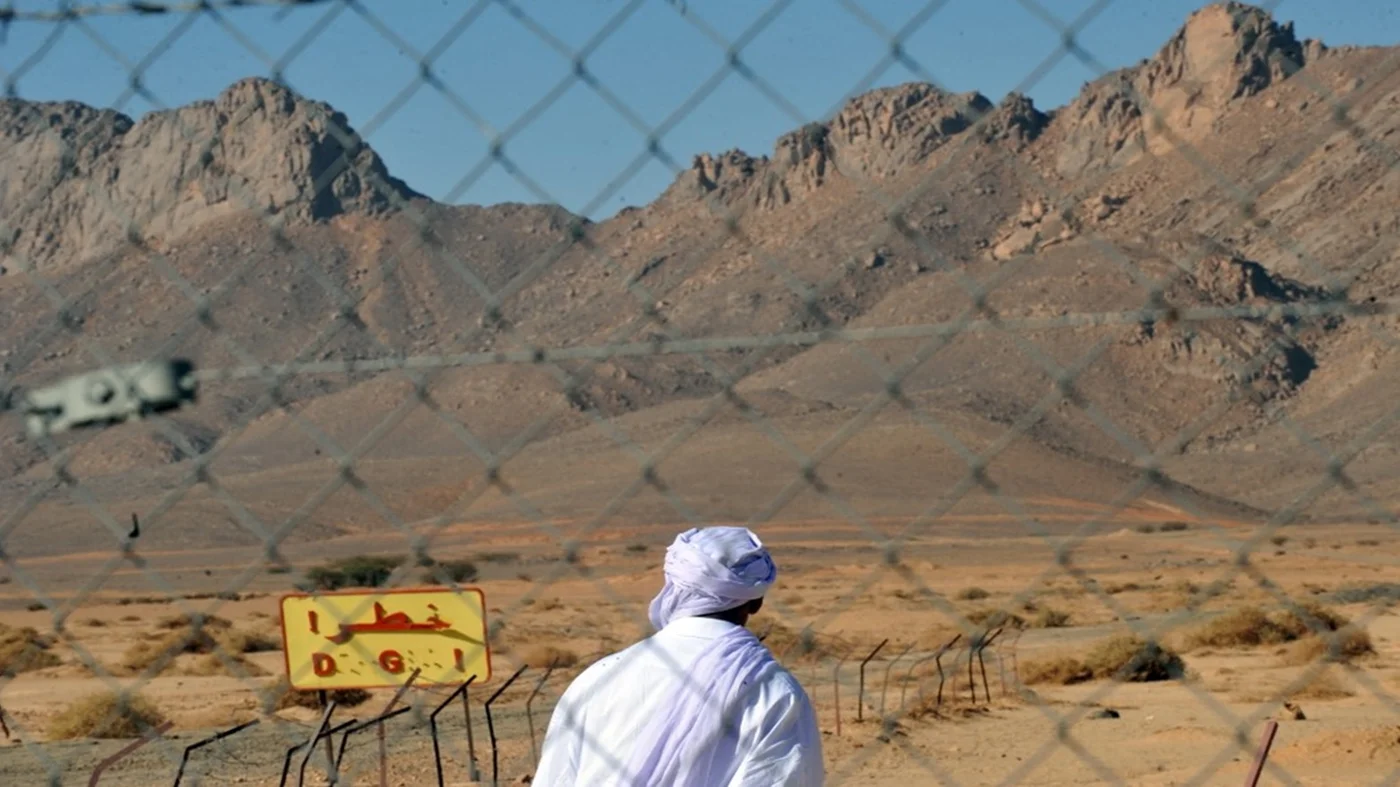
IMAGE CREDIT: An Algerian man looks at a danger sign at the entrance of the nuclear bomb test site of Tena Fila mountain at Ain Ekra, Algeria, on 25 February 2010 (Fayez Nureldine/AFP)
[ SOURCE: MIDDLE EAST EYE ]