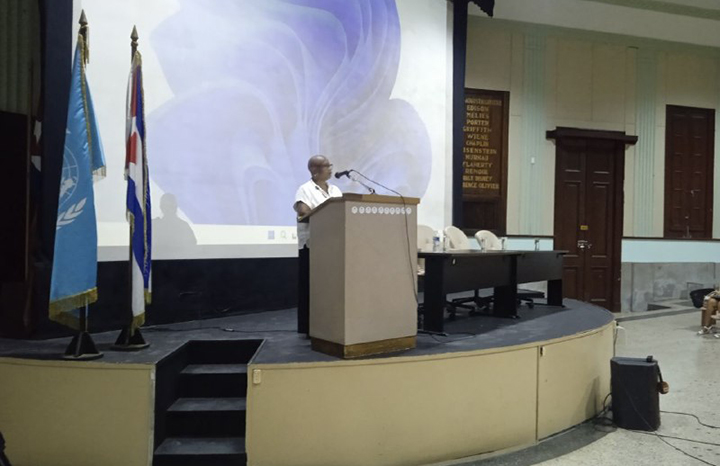
The severe impact of the U.S. government’s hostile policy toward Cuba on public health — and its consequences for the well-being of the population — was the subject of discussion during the 22nd Civil Society Forum Against the Blockade.
In his remarks, Dr. José Armando Arronte, head of the Department of International Organizations at the Ministry of Public Health (MINSAP), noted that the intensification of the economic, commercial and financial blockade significantly hinders the country’s efforts to provide medical care to its citizens.
He pointed out that, as a result of this imperialist and genocidal policy, the surgical waiting list in the country has reached over 100,000 patients, 12,000 of whom are children.
He further highlighted that, for the same reasons, there are significant challenges in providing follow-up care for more than 39,000 pregnant women who require diagnostic ultrasounds.
He noted that the infant mortality rate has doubled compared to previous periods — reaching 9.9 per 1,000 live births in 2025 — and that it has become extremely difficult to maintain the immunization schedule for 67,000 infants under one year of age.
He added that the overall survival rate for children with cancer has dropped from 85% to 65%, a consequence of having to rely on second- and third-line treatments as alternatives.
He emphasized that in Cuba, 16,000 patients undergoing radiotherapy, over 12,000 receiving chemotherapy, and another 3,000 dependent on hemodialysis services are all being harmed by the U.S. government’s unconventional war. He added that, at present, only 30 percent of the essential medicines approved for use in the country are being supplied.
The doctor argued that the energy blockade hinders the transport of patients by ambulance and places an additional strain on medical personnel, who — like the rest of the population — suffer the consequences of the fuel shortage.
Arronte explained that actions taken by Washington have led to the detention, at various ports, of shipping containers holding arteriovenous lines, fistula needles, dialyzers and other supplies intended to support the country’s healthcare services.
He noted that the pressure exerted by the White House also limits access to the technologies necessary to provide better care for the people.
He further highlighted the smear campaign orchestrated by Washington against Cuban medical brigades working around the world, as well as its efforts to pressure other nations into ending collaborative medical partnerships with Cuba.
At the opening of the meeting, Norma Goicochea Estenoz, president of the Cuban United Nations Association (ACNU), once again condemned the actions taken by the U.S. administration against the island—actions she described as genocidal.
Goicochea Estenoz emphasized that no one can threaten a dignified people who fight for their ideals and remain unafraid in the face of imperialist maneuvers directed against their homeland.
She also denounced the United States’ use of the United Nations (UN) headquarters as a platform to influence other governments regarding their stance on Cuba.
The 22nd Civil Society Forum Against the Blockade, hosted by the ACNU, serves as a platform to denounce this imperialist escalation, ahead of the upcoming vote at the United Nations General Assembly on the need to put an end to this policy.
IMAGE CREDIT: Jessica Jimenez Gainza | Photos by the author
[ SOURCE: AGENCIA CUBANA DE NOTICIAS ]