By Arelys García Acosta
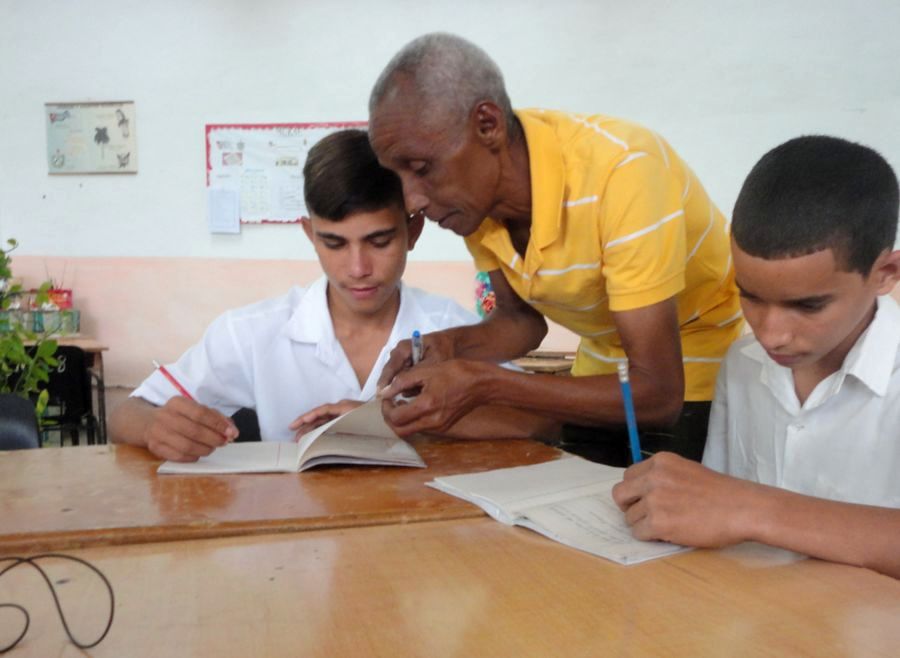
Miguel Mariano Clavo Gómez, one of the educators who has contributed most significantly to Special Education in Sancti Spíritus, preserves a wealth of knowledge and unique experiences — memories, he asserts, that will never fade. Having spent over half a century in front of a blackboard, he has dedicated his life to one of the noblest professions in existence.
The earliest glimpses of this young man — who would go on to become an itinerant teacher — place him at the Martín Klein primary school, located three kilometers from Mencía, in the provincial capital’s municipality. He recalls that, during his first days in the classroom, the chalk did not tremble in his hand — thanks to his mother’s advice, which taught him how to cast aside his fears.
Known for his proactive spirit, he was sent — almost as if on a sacred mission — to establish the Bienvenido Pardillo primary school in Guasimal. He taught his first lessons in the milking area of a dairy farm; later, he held classes on the porch of a private home, and finally, in a structure built with palm-wood planks and a dirt floor—constructed by the parents and the young educator himself. In the shade of a majestic flamboyant tree, the students would eat their snacks, laugh and run about.
Then came other schools and new discoveries. Special Education would ultimately define the path of what, for Miguel Mariano Clavo, became a true vocation—a calling akin to a priesthood. The Efraín Alfonso and Protesta de Jarao schools, in the city of Sancti Spíritus, solidified his commitment to teaching and to embracing — as if they were his own — children who needed a father figure, even if the bond was not one of blood.
Colleagues from that time recall how he shared both bread and knowledge with his students, and how he made it a habit to bring those who lived in distant municipalities into his own home. He used to seat them at his own table — alongside his wife, Maritza, and his son, Jailer– and tell them about trades they could learn: shoemaker, carpenter, mason, electrician. “What matters is earning your money honestly,” he would emphasize, while affectionately patting the boys on the shoulders. Compassion often stirred his heart, and acting generously brought a sense of well-being to his spirit.
When, in his capacity as a methodological advisor, he traveled through the rural primary schools of the Sancti Spíritus municipality, he could be seen crossing fences and pastures to shorten his journey — ensuring he reached even the most remote schools with the same punctuality he preached to his students when classes were set to begin.
This same teacher was a member of the Augusto César Sandino Pedagogical Contingent, which arrived in Nicaragua on November 5, 1979, to launch the nation’s first great crusade against illiteracy — a truly worthwhile endeavor.
According to an article in the digital magazine *Cubahora*, by the time this altruistic mission — undertaken by 10,400 educators from the Caribbean island — concluded, the illiteracy rate in Nicaragua had dropped from 50.35 percent to 12.96 percent.
In the department of Río San Juan — a jungle region in southern Nicaragua inhabited primarily by farmers living in extreme poverty and with very limited formal education — the Sandinista government set up a makeshift school, where the teacher known as “Clavo” taught his classes.
In the early days, an open-air classroom was established in the shade of a lush *Guanacaste* tree; the students used the tree’s roots as seats, while a small board placed across their laps served as a desk. Perhaps it was this great man’s unique charisma, his innovative teaching methods, or his knack for winning the affection of even the most reluctant students — whatever the reason, he became quite well-known in the town, and his enrollment grew steadily; he began with eight pupils and ended with 42.
The student most fondly remembered is Juanita, a girl of barely nine who was always barefoot and wore a dress worn thin by time. It was her habit to unsaddle the scrawny horse the teacher rode to and from class each day — a man who knew how to teach, but knew nothing about tack or beasts of burden. Juanita — as the educator from Sancti Spíritus recounts — would watch him leave each day until he disappeared into the countryside.
In the evenings, back in town, he served as a technical advisor for the adult literacy campaign. On weekends, he would visit people’s homes, share coffee, learn the local dialect, and even became the community’s barber and electrician.
Possessing that nobility — found in such abundance among humble people — this man from Sancti Spíritus left for Venezuela in 2010. The setting changed; instead of students, he now had patients. Each day brought new challenges in the speech and language therapy clinic at the Comprehensive Rehabilitation Unit of the Cuban Medical Mission, located in the Oropeza Castillo neighborhood of Guarenas.
The expertise he had gained in Cuba proved to be a true balm for children with language disorders — children affected by conditions such as thrombosis, stroke, hemiplegia or autism.
SOURCE and IMAGE CREDIT: Text and photos: Arelys García Acosta