By Hedelberto López Blanch * / Special Contribution for Resumen Latinoamericano
Only those of us who live in Cuba can truly gauge the intensity, the injustice, and the inhumane tightening of the blockade — a policy that the United States regime has, of late, intensified against this Caribbean island with extraordinary malice.
I recently experienced firsthand what Cuban Foreign Minister Bruno Rodríguez Parrilla described in a recent press conference: “The crime being committed against our country is evident. There is no pretext — no matter how deceitful — that can justify the act of collective punishment to which the U.S. government is subjecting our people.”
He added: “The entire world knows what is happening to our people today. The deliberate effect of this policy results in long hours without electricity for our families; days and weeks without a supply of potable water; a decline in healthcare services; and deaths that should never have occurred—deaths directly attributable to the blockade. This includes cases such as the doubling of the infant mortality rate, caused by the lack of appropriate medication, the absence of the latest medical technology, the failure of medical equipment due to a lack of spare parts, or the lack of power. It also manifests in the shortage of medicines, the lack of public transportation, the constraints on food production — which drive up prices — the high cost of living, and the erosion of wages in certain economic sectors that have ceased operations.”
Last Wednesday, October 21, after managing to secure a three-wheeled vehicle for transport (hardly the ideal mode of travel for a patient with a heart condition), I took my brother-in-law to a cardiology appointment at the 10 de Octubre Hospital. They were unable to perform an electrocardiogram because the equipment was broken and there were no spare parts available. The doctor who attended to us — very kindly — adjusted her treatment, which includes doubling her dose of carvedilol. However, the medication is unavailable at the pharmacy, so we must either obtain it through donations or purchase it at high prices on the informal market.
That same night, my partner developed severe pain in her abdomen and back. A neighbor managed to drive us to the 10 de Octubre Hospital, the closest facility to Luyanó, where we live. We paid only for the fuel (about 7,000 pesos). Upon arrival at the emergency department, a doctor attended to us promptly, but she immediately informed us that there were no reagents available to perform a urinalysis — needed to assess a suspected case of renal colic — nor were there any medications to alleviate the pain.
She suggested an ultrasound, which revealed a kidney stone passing through the urinary tract.
Needing to find an injectable pain reliever, I began calling friends at 10:30 p.m. One of them mentioned having injectable diclofenac. Since they lived near the hospital, our neighbor drove us to pick it up; once we returned home, I administered the injection, which provided quick relief.
Can you imagine the immense tension this situation creates? Consider how many patients must return home unable to access the medication they need — or the helplessness and distress experienced by our dedicated, compassionate doctors, who find themselves unable to provide even basic treatment to their patients.
One example speaks volumes: more than 7,000 shipping containers—filled with food, medicine, and medical devices destined for the island—remain stranded in foreign ports due to pressure exerted by the United States.
It is an inhumane blockade — a form of genocide against Cuba—that inflicts a heavy toll on the entire population. As the Cuban Foreign Minister stated at the press conference: “No pretext of any kind can justify acts of genocide or collective punishment — not even political differences between governments, nor even in times of war. No pretext linked to the United States’ persistent objective — regime change in Cuba — can in any way justify acts of genocide or collective punishment. It is a matter of suffocating an entire population, of destroying a small nation.”
Dear reader, this is the reality that the entire Cuban people live with today; for the truth is that Cuba is not a threat — the blockade is.
(*) Cuban journalist. He writes for the newspaper *Juventud Rebelde* and the weekly *Opciones*. He is the author of *Cuban Emigration in the United States*, *Secret Stories of Cuban Doctors in Africa*, *Miami: Dirty Money*, and *Rubio: An Uncontrollable Mythomaniac*, among others.
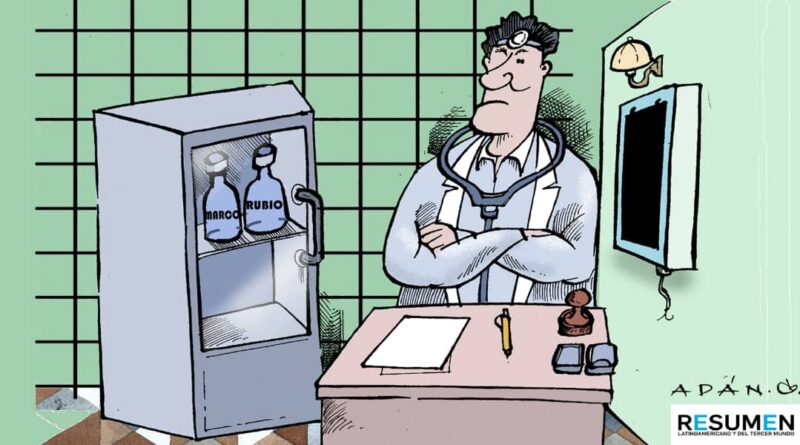
Cover illustration: Adán Iglesias Toledo.