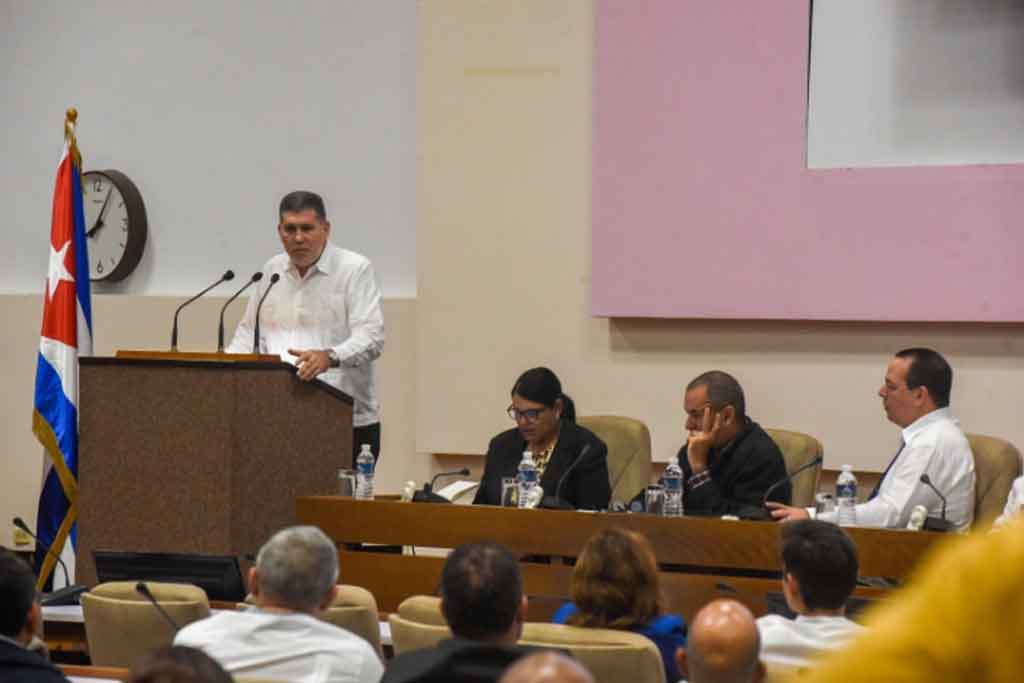
Oscar Pérez-Oliva, Cuba’s Deputy Prime Minister and Minister of Foreign Trade and Foreign Investment (MINCEX), presented the 2026–2027 Portfolio of Business Opportunities on Thursday at the Havana International Fair (FIHAV 2026).
«We want more companies to commit to our country and recognize the opportunities it offers—even during these times of great difficulty—so that they may grow alongside us by actively participating in Cuba’s economic and social development,» he stated.
He highlighted that the 2026–2027 Portfolio of Opportunities includes 461 projects, primarily distributed across the following sectors: oil (139), tourism (115), agri-food (82), industry (30), and mining (28).
Of these, he noted, 98 are priority projects focused on generating foreign currency revenue and promoting exports. These projects are also at a more advanced stage of preparation, allowing for faster progress toward their implementation.
To expedite these processes, he emphasized that the country is working to strengthen the MINCEX «Single Window» (Ventanilla Única) system and is moving forward with the drafting of a new Foreign Investment Law, which will be reviewed during the next session of the National Assembly of People’s Power.
As he explained, the new legislation responds to ongoing economic and social transformations; it aims to streamline, simplify, and reduce bureaucracy in procedures, while also enhancing transparency and legal safeguards for foreign investors. He added that this legislation also recognizes a greater role for Cubans residing abroad, while granting local authorities broader powers and prerogatives to manage procedures related to foreign investment.
The minister also provided an assessment of the results achieved so far this year, highlighting the impact of the 176 implemented reforms.
As of November 20 of this year, he noted, 40 new business ventures—valued at over two billion dollars—had been approved. This represents an increase of eight projects compared to the previous year, with the new ventures concentrated primarily in the trade, oil and fuel, tourism, mining, and banking and financial services sectors.
All of this has taken place within a complex environment, marked by an intensification of the blockade and an energy-related siege, he indicated.
Among the key changes introduced by these reforms, he mentioned the elimination of the requirement to hire personnel through a state-run employment agency. Furthermore, businesses are now permitted to make and receive payments in either foreign currency or Cuban pesos, depending on their specific needs; they may also operate bank accounts from abroad without requiring prior authorization.
He also highlighted the reduction of bureaucracy and the streamlining of processes, achieved by replacing formal feasibility studies with business plans.
Additionally, the 99-year surface rights—a benefit previously limited to the tourism sector—have now been extended to all sectors of the economy. Meanwhile, the term for usufruct rights has been increased from 25 to 99 years, with the possibility of an extension for an additional 99-year period.
These measures are complemented by significant tax incentives and expanded authority for the import and export of products and raw materials.
IMAGE CREDIT: Photos: Endrys Correa (FotosPL)
[ SOURCE: PRENSA LATINA ]