By Mohammad Ali Haqshenas
FIFA, the world football governing body that rushed to ban Russia following the latter’s military operation in Ukraine, has been dragging its feet for more than two years over the modern-day holocaust perpetuated by the Israeli regime and the United States in Gaza.
FIFA has rejected repeated calls from football fans, human rights groups, UN rapporteurs, as well as many governments, to suspend the Israeli football team over the regime’s slaughter of more than 72,000 Palestinians since October 7, 2023 – most of them women and children.
Now, all of a sudden, in a move smacking of blatant hypocrisy, the world football governing body has decided to fund the construction of football facilities in the besieged and bloodied territory.
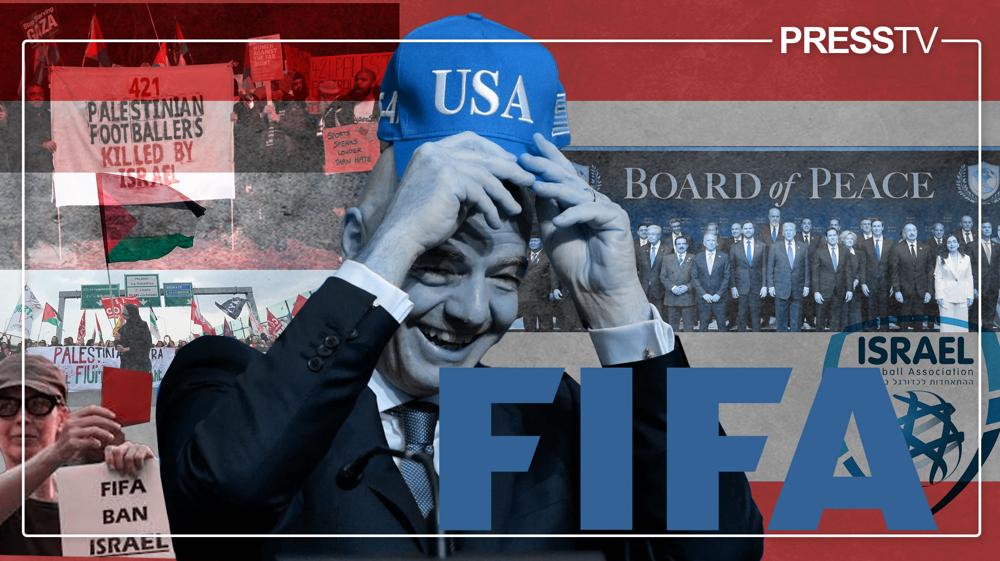
At the spectacle called the “Board of Peace” presided by US President Donald Trump in Washington earlier this week, FIFA president Gianni Infantino formally pledged $50 million for the football infrastructure in the coastal Palestinian territory.
The package includes funding for a new stadium, training facilities, and broader football infrastructure in a territory where, after more than 28 months of genocide – which continues as I write – graveyards now outnumber residential neighborhoods.
Rather than suspending Israel over a war that even UN experts have explicitly described as genocide, FIFA has chosen a more comfortable and convenient course: donating to Gaza.
The announcement came roughly two months after the Spanish media outlet AS reported that, at a FIFA Council meeting in Doha, the governing body had decided to allocate a portion of revenues from the 2026 World Cup to “support Gaza.”
FIFA’s decision is telling. It exposes a governing body unwilling to confront the mass murderers, yet conspicuously prepared to help finance the fire brigade.
The stated objective is to help the Palestinian people recover from a genocidal war that has stretched beyond two years. But the hypocrisy reveals itself in multiple layers.
The apolitical alibi
The first layer is the doctrine of selective morality. FIFA insists it is “apolitical” when pressed to sanction Israel, yet it has no hesitation in stepping into the political arena whenever it wants.
The message emanating from Zurich is unmistakable: banning a federation is framed as a political act, while collecting applause for signing a check is presented as a humanitarian gesture.
Infantino has perfected this rhetorical balancing act. On October 2, facing mounting pressure to take action, he dismissed calls for suspension by characterizing the crisis as a “geopolitical issue.”
“We are committed to using the power of football to bring people together in a divided world,” Infantino said at the time, despite mounting calls for FIFA to act.
This is the “apolitical” shield. It allows FIFA to ignore the desperate pleas of UN experts who, on September 23, called on FIFA and UEFA to suspend Israel.
They noted that the obligations to prevent genocide are “peremptory norms of international law that apply to all, at all times, without exception,” noting that sports “must reject the perception that it is business as usual.”
Normalizing injustice
Pretending to support Gaza financially does not address the question of accountability. Instead, it reframes an issue of legal and moral responsibility as one of disaster relief.
It allows FIFA to project compassion while sidestepping the more difficult question: why does a member association linked to systematic genocide face no sporting consequences whatsoever?
The no-holds-barred war on Gaza has killed over 72,000 people and wounded 172,000, with footballers among the dead and multiple stadiums and sporting facilities damaged or destroyed.
Against this backdrop, FIFA’s financial pledge risks monetizing the aftermath of the genocidal violence while legitimizing the status quo of the perpetrator.
As UN experts have warned, sporting bodies “must not turn a blind eye to grave human rights violations, especially when their platforms are used to normalise injustices.”
By keeping Israel on the pitch while writing checks to the victims, FIFA is doing precisely that: normalizing injustice. It signals that the destruction of Gaza is a tragedy to be funded, rather than a crime to be punished.
Accountability reaches The Hague
This tension between so-called humanitarian gestures and institutional impunity has now entered a new phase. On February 16, a detailed legal communication was formally submitted to the International Criminal Court (ICC) against Infantino and Aleksander Čeferin, UEFA’s president.
The complaint said they have aided and abetted war crimes and crimes against humanity under the Rome Statute, centering on FIFA and UEFA’s continued inclusion of Israeli football clubs based in illegal settlements on occupied Palestinian land.
These clubs are allowed to compete in leagues organized by the Israel Football Association and to host matches on seized land, while Palestinians are barred from attending games, playing for the clubs, or managing them.
The filing argues that this practice normalizes and legitimizes Israel’s illegal occupation and facilitates the transfer of the civilian population into occupied territory and asserts that both organizations ignored repeated warnings from UN experts, human rights groups, and even their own internal monitoring mechanisms.
Spanning 120 pages, the submission comes from Palestinian footballers, clubs, landowners, and international advocacy groups. It challenges the notion that FIFA and UEFA are neutral actors and exposes the legal cost of pretending otherwise.
It is only the latest in a series of complaints against both FIFA and UEFA, but this one is significant. Israeli mass murdered Benjamin Netanyahu is already facing an arrest warrant from the ICC, which he has been evading with the help of his Western masters.
The Russia precedent
FIFA cannot claim its inconsistency is accidental or a bureaucratic oversight. In 2022, it moved with record speed to sanction Russia, citing the need to protect football’s integrity.
Gaza now tests that same integrity, yet the response could not be more different.
“It is difficult to explain and understand that there is a double standard,” said Spanish Sports Minister Pilar Alegría in September. “It is important that sport, given this situation, takes a position at least similar to what it did against Russia.”
Former Manchester United captain Eric Cantona echoed this sentiment at a fundraising event in London, stating bluntly: “FIFA and UEFA must suspend Israel. Clubs everywhere must refuse to play Israeli teams.”
By refusing to act, FIFA is arguing that some civilian deaths violate football’s values more than others. When tanks rolled into Ukraine, the threat to the “football family” was deemed existential. When bombs fall on Gaza for two years, destroying stadiums and killing athletes, it is deemed a “geopolitical issue” best solved with a donation.
The pressure has not just come from high-ranking officials but from the grassroots, the very fans FIFA claims to represent.
The “Game Over Israel” campaign, launched in New York City in September and funded by the American Arab Anti-Discrimination Committee, has initiated efforts for a boycott.
Fans have used banners, tifos, and stadium walkouts to register their dissent.
Yet the executive committees of football’s governing bodies remain paralyzed, hiding behind fragile ceasefires and endless deliberations to avoid doing what they did so swiftly in 2022.
Laundering inaction
By pledging millions to Gaza while keeping Israel fully integrated, FIFA is effectively laundering inaction through so-called humanitarianism. It seeks moral credit without political consequence. But this is not ethics, it is accounting as the football governing body is attempting to balance the books of its conscience.
On one side, it maintains the lucrative normalcy of international competition, keeping broadcasters and sponsors happy by avoiding the potential messy business of banning an aggressor. On the other side, it deploys a fraction of billions to “support the Gaza Strip,” hoping the glitter of philanthropy blinds the world to their “double standards.”
It is a calculation that relies on the public’s exhaustion. It assumes that if FIFA throws enough money at the problem, fans may forget that UN experts urged them to “stop legitimizing the situation arising from Israel’s unlawful presence in the Occupied Palestinian Territory.”
It assumes the football community will not notice that while they prepare for the glitz of the 2026 World Cup in North America, they are actively ignoring the fact that “Israel is committing genocide,” according to the United Nations Commission of Inquiry.
FIFA and UEFA’s refusal to act against Israel is an uncomfortable fact for many fans worldwide, and the donation does not erase it. The check may clear. The stain does not.
The pressure has not just come from high-ranking officials but from the grassroots—the very fans FIFA claims to represent.
The “Game Over Israel” campaign, launched in New York City in September and funded by the American Arab Anti-Discrimination Committee, has initiated efforts for a boycott.
Fans have used banners, tifos, and stadium walkouts to register their dissent.
Yet the executive committees of football’s governing bodies remain paralyzed, hiding behind fragile ceasefires and endless deliberations to avoid doing what they did so swiftly in 2022.
* Mohammad Ali Haqshenas is a Tehran-based journalist.
[ SOURCE: PRESS TV ]