José Luis Méndez Méndez
Special for Resumen Latinoamericano
The crime of murdering seventy-three people by blowing up a civilian airliner in mid-flight remains unpunished regarding the masterminds; both Orlando Bosch Ávila and Luis Posada Carriles were protected in the United States until their deaths. Other individuals involved were never brought to trial.
This act was condemned even by those who actively despised the Revolution. One of them, Andrés Cuevas, said: “[…] I was an anti-Castro fighter […]; I was one of those who felt happy when I heard an embassy had been dynamited. But when the plane exploded in Barbados, I felt ashamed of my cause. I never saw any justification for that […] we cannot turn into murderers to overthrow him [Castro].”
Meanwhile, one of the instigators, Bosch Ávila, offered his own assessment: “The accident involving the Cubana de Aviación plane—which was packed with G-2 agents, intelligence service personnel, five North Korean communists, and ten Guyanese scholarship students bound for training in Cuba as part of the communist infiltration plan via that country, a fact the Venezuelan government is aware of.” Without the slightest humanitarian feeling for the victims—and without a shred of decency or respect for the young Cuban athletes (whom he described merely as “some four little Black guys”) or the Guyanese teenagers aspiring to become doctors in Cuba—this is how the mastermind behind such an abominable crime against humanity spoke.
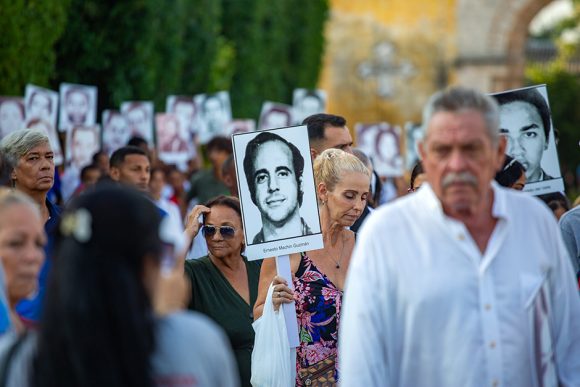
The downing of the Cuban plane in Barbados shocked millions of people around the world. There were photos of the young Cuban fencers; of the body of the Guyanese girl that emerged from the depths of the Caribbean to accuse her killers; and of the dozens of relatives of the North Koreans, Guyanese, and Cubans weeping in outrage alongside more than a million people of all ages, genders, races, creeds, political views, and nationalities. These people gathered on October 15 to bid farewell to the few victim remains that could be symbolically recovered from the deep waters of the sea—a moment when the virility of a grieving people made injustice tremble.
Just as the terrorist Orlando Bosch expressed his jubilation—assessing, in the aforementioned declassified secret document, the positive effects his plans derived from the assassination of Orlando Letelier in the U.S. capital (an act that demonstrated the terrorists’ capacity to hatch and execute such sinister plots within the United States and boosted his men’s criminal egos)—the downing of the Cuban civilian airliner also gratified the fanatics. This is attested to by another FBI document—the one previously described regarding the agency’s historical knowledge of the creation of CORU. On November 7, 1976, the Coordination of United Revolutionary Organizations (CORU) claimed responsibility for planting a bomb targeting the airline Cubana de Aviación in Madrid, Spain; the device detonated, causing material losses amounting to fifteen thousand dollars. The document signed by then-FBI Director William H. Webster and dated August 16, 1978, is a substantive compilation detailing the agency’s monitoring of the anti-Cuban terrorist group. It reveals that at least eight secret sources kept U.S. counter-terrorism officials constantly informed about the plans, agreements, and actions of CORU between 1976 and 1978. One paragraph notes that on May 11, 1977, the aforementioned source MM-T-3 reported a meeting of CORU members at the sporting goods store owned by one of their own, Orlando “Bebo” Acosta. There, Francisco Eulalio Castro Paz—known as Frank Castro and the deputy to Orlando Bosch (who was then detained in Caracas, Venezuela)—had directed the creation of new CORU cells, effectively calling for a reorganization to continue operations. Castro added that CORU intended to issue a press statement holding both Cuba and the United States responsible for any acts of terror the organization might carry out in response to what it deemed provocations against the exile community: specifically, efforts in the U.S. Congress to ease the blockade against the island and the promotion of tourism travel.
Next, without any omissions or alterations, the document records: “Frank Castro stated that Intelligence (CORU) was currently meeting in Mérida, Yucatán, Mexico—the midpoint of a proposed tourist travel route between the United States and Havana. He said the flight would be operated by a Mexican airline traveling from the United States to Mérida and then to Havana. He expressed that the plane should be sabotaged to instill fear in anyone attempting to travel to Cuba as a tourist.” This information would seem inconceivable were it not for the numerous examples—recorded in the history of aggressions against Cuba—of willful leniency shown by various U.S. authorities toward anti-Cuban extremist groups. How was it possible that the FBI—an agency warned, as previously noted, by eight different sources about CORU’s plans and intentions—learned after the Barbados sabotage that a similar plot was being hatched just six months later, yet failed to take proactive measures to prevent it? The plan outlined by Frank Castro carried even graver implications: it involved sabotaging a plane originating in the United States—potentially carrying U.S. citizens, as well as naturalized Cubans or Florida residents—operated by an airline from a neighboring country like Mexico, thereby violating international aviation security obligations undertaken by U.S. authorities. Yet, all of this was ignored; CORU continued to operate undisturbed, and no terrorists were arrested—or even questioned—for devising or conceiving such lethal schemes. It did not matter that their own citizens might be exposed to danger.
But if the story of exposing Americans to the risk of being blown up mid-air aboard a civilian aircraft seems implausible, the events that took place that same year are even more terrifying. As Cuban customs officers prepared to inspect cargo that had arrived in the country on an Iberia flight from Spain, security scanners revealed something suspicious inside two boxes. Upon closer inspection, they discovered wires, timers, batteries, and substances foreign to the product listed on the labels inside two tins of Pelargón—a Spanish brand of infant formula. Explosives experts were summoned; they opened the containers and confirmed the presence of two assembled bombs, complete with all the components needed to detonate. The devices were deactivated and analyzed; they had been rigged to explode in mid-flight—a catastrophe averted only by errors in the wiring intended to trigger the blasting cap. These explosive devices had been concealed within innocuous baby food tins and carried aboard a plane filled with passengers of various nationalities; the aircraft had traveled hundreds of miles from its point of origin, flown over several countries—including the United States—and finally arrived on Cuban soil. Following the Barbados bombing, specialized Cuban agencies had received intelligence from their own sources regarding plans by anti-Cuban terrorists to repeat such an act of terror. In Spain, terrorists José Luis González Gallareta and Oscar Alfonso Carol Armand—alias “El Rubio”—had spoken of plotting such attacks. When acts of terror are hatched, it is impossible to calculate their full impact; they can spiral out of control, causing unpredictable collateral damage—a reality acknowledged even by U.S. aggressors.
An international criminal and his accomplices hatched fourteen plots to bring down planes in mid-flight; they succeeded in Barbados half a century ago, while in Cuba, a spirited and resolute people still weep over the memory, while injustice still trembles.
October 6, 2026