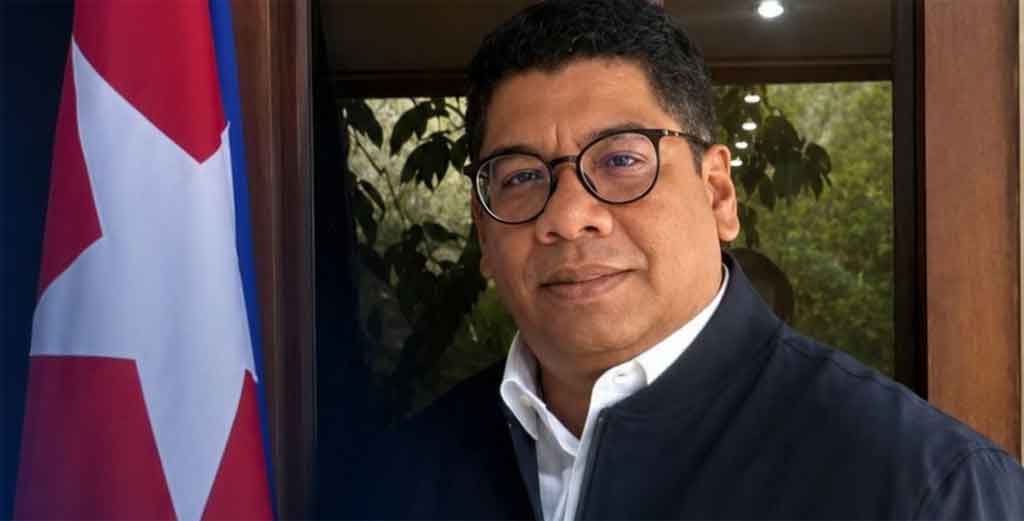
Cuba’s Ambassador to Brazil, Víctor Cairo, denounced in an interview published on Wednesday that the U.S. government seeks to destroy Cuba, while treating Latin America and the Caribbean as subordinate territories.
During the interview with Grupo Record, the diplomat stated that the Donald Trump administration has adopted cruel measures, reinforcing, like no other, the aggression against Cuba.
“It is a government determined to destroy our country, which considers Latin America and the Caribbean as inferior peoples subordinate to the interests of the United States,” he asserted.
He acknowledged that, despite the current situation, there have been attempts at dialogue between Havana and Washington, although he described these efforts as very difficult due to what he characterized as the U.S. intention to impose “a model of destruction on Cuba.”
The ambassador maintained that the Caribbean nation remains willing to engage in dialogue with the United States, but only under principles of respect and sovereign equality.
“Cuba does not discuss changes to the U.S. political system, nor to its social problems. Likewise, it does not accept any attempt by the United States to change the Cuban political system,” he stated.
According to the diplomat, Havana is willing to discuss issues such as trade, drug trafficking, and organized crime with Washington, but rejects any form of interference in its internal affairs.
These statements come amidst increasing U.S. aggression against Cuba during Trump’s second term.
The U.S. government has maintained and strengthened the economic, commercial, and financial embargo it has imposed on the island for more than 60 years, and since the beginning of this year, it has added an energy blockade that prevents access to fuel.
In the interview, Cairo referred to the impact of the blockade, mentioning accumulated losses of some $2.1 trillion since 1960, with damages exceeding $7.5 billion between March 2024 and February 2025 and $8 billion in the following 12 months.
He also linked the aforementioned energy embargo to problems with fuel supply and electricity generation, as well as difficulties in ensuring the operation of essential services.
“We are dealing with a country that does not allow oil to enter Cuba. This has a brutal cost for the entire economy. And how do you measure the impact of a mother who gives birth and whose child dies because there is no electricity? How do you measure, economically, the impact of infant mortality in Cuba, which rose in less than seven months from 4 to 9.9 per 1,000 live births?” he asked.
Furthermore, the diplomat highlighted Brazil’s solidarity with Cuba and mentioned the recent shipment of 48 tons of powdered milk via two flights by the Brazilian Air Force, in addition to medicines destined for the Cuban population.
[ SOURCE: PRENSA LATINA ]