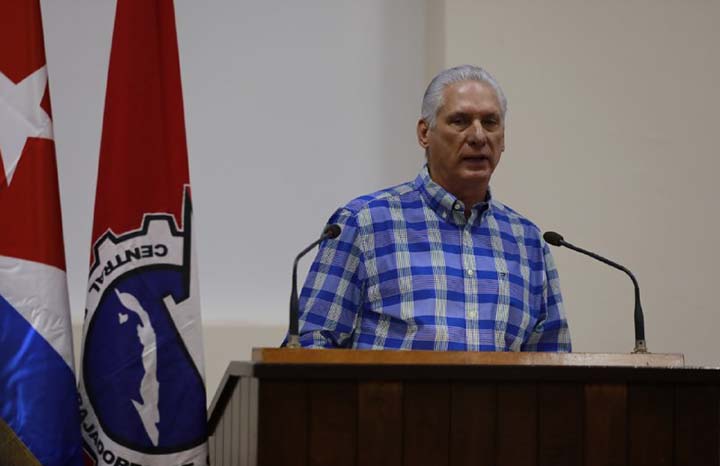
Speech delivered by Miguel Mario Díaz-Canel Bermúdez, First Secretary of the Central Committee of the Communist Party of Cuba and President of the Republic, at the closing of the XXII Congress of the Cuban Workers’ Federation, at the Convention Palace, on June 27, 2026, the Year of the Centennial of Commander-in-Chief Fidel Castro Ruz.
(Stenographic Versions – Presidency of the Republic)
Cuban workers:
Comrades delegates to this Congress:
My first words express my congratulations to the people and workers of the province of Pinar del Río for hosting the National Commemoration of July 26; to Villa Clara and Matanzas for being outstanding provinces; and to Guantánamo and Sancti Spíritus for the Well-deserved recognition for their work (Applause).
The spirit present at this Congress multiplies our revolutionary energy.
This 22nd Congress of the Central Organization of Cuban Workers (CTC) could not have been more timely for the country. Completely atypical in terms of the number of delegates and duration, given the complex economic and energy conditions facing the nation, which demand the utmost rationality in the use of resources, it had to take place.
Cuba is experiencing one of the most serious and challenging moments in its history, to which we, the Party and the Government, are responding with urgent economic and social transformations.
The CTC, whose main representatives have a voice and a vote in these decisions, because this is a socialist society where the workers rule, has participated in the process of analysis and approval, but it was essential to debate them at this Congress, which, under the slogan “For Cuba Together We Create,” was precisely designed to address the enormous challenges facing the nation at this time.
The rich discussions of these past two days have confirmed this, and this is, I would say, the first resounding support from our workers for these transformations (Applause).
Without the conscious mobilization of the workers, nothing will be possible, neither the great leap in productivity that the national economy demands nor the quality of all the control and oversight processes that must accompany it.
A statement by Lázaro Peña, great Captain of the Cuban working class, remains valid, and I would say is stronger than ever, when he said that our strength lies in that conscious unity that does not ignore difficulties, but rather uses them to overcome them in daily action.
The act of genocide that constitutes the policy of maximum strangulation by the United States government against Cuba impacts the daily lives of our workers, both in their workplaces, in their productive activities, and in their social and family lives.
The unprecedented financial and energy blockade imposed on our nation has plunged the electrical power system into a severe crisis. This crisis not only causes unbearable blackouts for households but also paralyzes our industries and forces thousands of workers to labor under extreme conditions, while others have been forced into unemployment or have had to find new jobs.
Faced with this scenario, as the leadership of this Congress stated, the response cannot be inertia, but rather the constant search for alternatives.
As we have done so many times throughout six decades of blockade, let us raise the banner of innovation, a proven way to resist creatively.
There are countless examples of work collectives, as some have mentioned here, from significant industries, that have demonstrated how to confront the chronic lack of parts, spares, and supplies.
In all productive sectors, workers have been able to reinvent themselves and modify technologies to continue producing and providing us with light, even if only minimally, using our own resources.
Today, when the Cuban labor market is so severely affected by a multidimensional crisis, caused primarily by external factors, these creative responses are a concrete expression of the conscious unity that does not ignore difficulties but rather uses them to overcome them, to which Lázaro Peña referred in the quoted phrase.
The complexity is known and suffered, but it can only be overcome if it is faced with intelligence, responsibility, courage, and audacity.
As for the current generations, upon whom rests the historical responsibility of saving and continuing the Revolution, we face an unprecedented challenge: How can we continue building socialism in a small Caribbean nation that emerged from the Revolution after four centuries of colonialism and 60 years of neocolonialism, and that undertook a project of social justice unparalleled in the region, under the sustained pressure of six decades of economic, commercial, and financial blockade—the longest in human history—exacerbated by more than 240 measures, inclusion on an infamous list as a supposed sponsor of terrorism, and six months under a total oil embargo?
The economic and social transformations we have approved are aimed at answering this question, at saving the Revolution and its social gains—that is, the socialist orientation of the economy—regardless of what counterrevolutionary propaganda says.
Since its approval by the Plenum of the Central Committee and the National Assembly, we have been closely monitoring tens of thousands of opinions gathered from the people and on digital networks, as well as expert opinions and even the always biased and malicious propaganda of the US-funded media outlets that promote their agenda regarding Cuba.
The coordination of the enemies of the Revolution to attack this process is clearly visible, as they attempt to promote neoliberal proposals and demand changes to the Cuban political model, which will never be accommodated in the plan of economic and social transformations we have undertaken.
I want to speak especially to those compatriots who express doubts, concerns, and genuine expectations about this momentous process for the nation, and there is no better place to do so than this large gathering of the working class, the fundamental pillar and guarantee of the Revolution.
I begin by emphasizing one thing: these are economic and social transformations. Let us never allow the need to shorten words to lead to the omission of the term “social,” because it is not only about transforming the economy with respect for the environment, but about doing so in terms of social development and social justice, which is the very essence of the Revolution.
No one to this day has explained, much less demonstrated in practice, how to build socialism in a nation under the conditions of siege that Cuba has endured from the very beginning of the Revolution’s triumph on January 1, 1959, to the uncertain times of these years in which international political and economic relations have ceased to be guided by minimal rules and multilateralism has become an aspiration of many that a few constantly thwart.
In this context, riddled with threats and policies of force against any sovereign and emancipatory process like the Cuban Revolution, it is vital to revisit the thinking of Commander-in-Chief Fidel Castro Ruz, and particularly his ideas on building socialism in the difficult circumstances of Cuba during the harsh 1990s of the Special Period, when significant transformations were undertaken in the economy.
Let us recall his historic speech on November 17, 2005, and I quote: “One conclusion I have reached after many years: among the many mistakes we have all made, the most important mistake was believing that anyone knew about socialism, or that anyone knew how to build socialism. It seemed like common knowledge […] But we are idiots if we believe, for example, that economics—and forgive me, tens of thousands of economists in this country—is an exact and eternal science […] All dialectical sense is lost when someone believes that today’s economy is the same as it was 50 years ago, or 100 years ago, or 150 years ago, or is the same as in Lenin’s time, or in the time of Karl Marx.
I want to reiterate something, so that it is perfectly clear to our compatriots, to our friends, and even to our enemies: We do not propose, nor will it ever be among our purposes, the restoration of capitalism in Cuba! (Applause.) It is about, and let no one doubt it, saving the Revolution and its Undeniable social achievements, because we will never renounce the majority’s aspiration for socialist construction.
But to achieve social justice, to maintain and expand the Revolution’s gains in health, education, sports, science, culture, and so many other fields of human development, we must generate and have access to material and financial resources, which the Cuban state is increasingly deprived of, to guarantee a fair redistribution.
The ongoing project of economic and social transformations aims, in essence, to unleash the nation’s productive forces to generate wealth and distribute it with the greatest possible social justice.
This process we are beginning is complex and urgent, but we must do it well, with agility and a strong sense of responsibility, to guarantee the desired effectiveness, always defending, above all else, the maintenance of maximum social protection in whatever we implement.
The economic and social transformations we are planning are not new, nor did they arise from nothing, nor are they a last-minute, improvised plan, much less the result of concessions in the face of threats from other states. United. They do not respond, I reiterate, to a requirement of the recent bilateral talks.
We don’t care what the U.S. government thinks of these measures. They weren’t designed to please them. This is a sovereign decision of Cuba, of the Cuban people (Applause).
A close review will show their alignment with the Guidelines for the Economic and Social Policy of the Revolution, approved at the Sixth Party Congress in 2011, and subsequently updated at the Seventh and Eighth Congresses.
Since the end of 2025, when we discussed updating the Government Plan, we emphasized actions that now seem surprising to some, even though they were already planned, such as the autonomy of state-owned enterprises and municipalities; the relationship between the Economic Plan and the market; changes to foreign direct investment; and opening investment opportunities to emigrants, among many others we have discussed recently.
We are acting consistently based on actions for which we should already be prepared and ready to implement, given how often they have been mentioned and analyzed.
At this point, we must all engage in self-criticism, starting with the country’s top leaders and those of its organizations and institutions, regarding the delays in waiting for greater collective awareness of the need for change and a more favorable context.
We cannot afford to repeat this mistake in these circumstances. Therefore, we have insisted that each measure have designated responsibilities and deadlines, and that progress be reported periodically.
To achieve this objective, the process must be accompanied by a robust communication strategy that includes systematic information on its progress and any difficulties, taking into account everything that needs to be modified or eliminated. The fundamental mission of those responsible for this task will be to keep the people informed about how and when the agreements are being fulfilled.
All measures and decisions that contribute to immediately unleashing productive forces must be implemented without delay. To achieve this, all economic actors must operate with a different dynamic than the current one, and anything that contributes to this direction must be prioritized, while maintaining social protection.
State-owned enterprises and non-state economic actors must receive equal treatment based on their contributions to the economy and society. It is essential to harmoniously integrate all stakeholders for the sake of national development, their contribution to the country, and the generation of wealth indispensable for a fair redistribution.
As I have already stated, there is one clear condition: we have the responsibility to carefully consider every step we take, ensuring that inequalities do not increase. In cases where such an increase is anticipated, plans must be in place to support the most vulnerable families, communities, or segments of the population.
At the same time, as we move forward with their implementation, we must prepare to explain the origin of these transformations, what they stand for, why they must be applied, and what their potential impacts are.
We will not be able to implement these transformations effectively if, as a people, we do not all get involved and participate consciously and enthusiastically; nor will we be able to do so if you, the leaders of our working class, do not participate as an integral part of this people. To achieve this, we must deploy an efficient political and communications plan that mobilizes, explains, and informs.
It is not about mechanically repeating each transformative measure, but about arguing for each action individually. We must explain how each one defends the construction of socialism, how it will contribute to the country’s economic growth, how, as we are able to generate more wealth, we will distribute it more equitably, and how relief will reach Cuban homes—all of them.
The discussion about these measures is not over. If someone proposes something better than what we have envisioned, it will be received, analyzed, and incorporated to the extent that it contributes to the political, economic, and social significance of the transformations.
The country needs debate, but for it to be fruitful and effective, we must listen to everyone and build consensus, because we are heading toward a very complex process that responds to an equally complex situation.
We must work with expert criteria, seeking knowledge wherever it may be found to help implement and guide this endeavor. We must take advantage of the wisdom of all those willing to work toward these objectives, with the sole condition that they respect our principled positions.
The use of artificial intelligence is an essential tool. Recognizing its biases, it cannot be used uncritically, but we cannot renounce it because the volume of actions to be undertaken, their control and gradual implementation, and their optimization involve variables and matrices that can only be streamlined with the algorithms provided by these new technologies; doing in days what would take us years through conventional means.
Revolutionary Cuba has never turned its back on scientific advancements. It is important to report that we are already working with Cuban artificial intelligence models designed by our capable computer and communications professionals.
To give just one example: the comparison of the 176 measures with the Cuban legal framework, carried out using a Cuban AI model, considerably shortened this process. With traditional methods, we would not have been able to discuss, approve, and even consider their implementation today.
I reiterate: we must use this technology critically, with expert criteria, and above all, work with and engage all those colleagues who are already prepared to use these tools, while also preparing ourselves to learn how to use them in our processes.
A fundamental element, on which we are already working rapidly, is the legal certainty of economic and social transformations, with clear rules for everything that can be done.
At the same time, it is essential to create effective mechanisms that promote transparency and facilitate popular, worker, and institutional oversight, particularly regarding all processes involving the bidding of real estate or assets. Public platforms are needed that clearly state what is available, who is bidding, who is awarded the contract, and why.
In terms of the critical path, tactically, it is urgent to immediately implement everything we have already identified as possible without delay, such as granting powers to municipalities and state-owned enterprises, redesigning the State Business Organizations (OSDEs) to unleash productive forces, and other measures.
Strategically, it is crucial to move forward decisively with the legal framework. Without the support of this legal component, political and communicational assurance, the resizing of the State, social protection, and two issues that will directly impact the equality of economic actors—the foreign exchange market and the tax system—are doomed to failure. In fact, I am outlining here the strategic priorities for implementing these measures.
Comrades:
We cannot overlook the democratic process that the massive consultation on the Draft Labor Code has represented.
In an exercise that honors the tradition of participation of our working class, more than two million workers, between September and November 2025, had the opportunity to shape the law.
This Congress has captured the sentiment of the rank and file, where the debates were not mere formalities, but rather a barometer of current concerns. Workers have been emphatic that the new Code must be a real shield against the new dynamics facing the country.
The demands that the new law guarantee protection against termination of employment for reasons beyond the workers’ control, both in the state and non-state sectors, deserve recognition; as does the way in which workers are supported by the creation of community brigades to serve their neighborhoods and communities during their work stoppage. This is a dignified way to contribute and not be left unprotected.
Also encouraging, especially in the context of the coming economic and social transformations, are the demands that the Labor Code not only regulate duties but also formalize the real and proactive participation of workers.
Workers demand to have a voice and a vote in wage formation, profit distribution, and transparency in the economic management of their companies.
Nor can I fail to acknowledge the proposals that point to flexibility and modernization of work, given the support received for the incorporation of teleworking, even from abroad, and the elimination of obstacles to professionals holding multiple jobs.
These points, within a broader range of benefits offered by the Code, show us that it is a regulation suited to its time, to current development conditions, and, above all, to the model of a just society that we will not abandon and that we intend to continue building.
Socialism is the work of the workers. Therefore, our union leaders must cease being mere transmitters of instructions and become important voices in the space of real participation in administrative decision-making.
We do not abandon the idea that the Economic Plan be built from the ground up, from the companies, from the economic actors, with the voice and vote of the workers, and that the workers be the most vigilant guardians of its implementation.
From the perspective of the Cuban labor movement, the role of workers in defending the Revolution is historic, multifaceted, and essential for the survival of the socialist construction project.
The fundamental axes of this role of the labor movement in defending the Revolution can be summarized in five key pillars: the defense of national sovereignty and socialism; production and constant, increasing innovation; participation and oversight, with a keen eye on vices and practices that foster corruption; community contributions to the neighborhood and locality; and historical continuity.
These five pillars encapsulate the essence that has guided this Congress.
We congratulate the election of this new National Council and its General Secretary. We trust in their commitment to the Revolution, to work tirelessly so that the Union has the credibility and real representation that our workers deserve.
Achieving all that we have set out to accomplish with this Congress and with the ongoing economic and social transformations demands will and a deep conviction that we can. It means rising to the challenge of this historic moment.
Go back to Fidel a thousand times, especially to that brief yet invaluable work that is his concept of Revolution. All the categories of that concept are, in one way or another, showing us the path to face the colossal challenges ahead.
In the centennial year of the Commander-in-Chief, we will not allow our generation, upon whom today rests the historical responsibility of saving the Revolution, to betray history or tarnish the memory of our heroes and martyrs.
For them, for Cuba, for the future of socialism, we will continue resisting, working, creating and winning!
Long live the valiant workers, protagonists of the victorious resistance!
The Homeland defends itself!
For Cuba, together we create!
Socialismo o Muerte! Socialism or Death!
Patria o Muerte! Homeland or Death!
Venceremos! We will win!
IMAGE CREDIT: ACN | Photo: Luis Jiménez Echevarría
[ SOURCE: AGENCIA CUBANA DE NOTICIAS ]