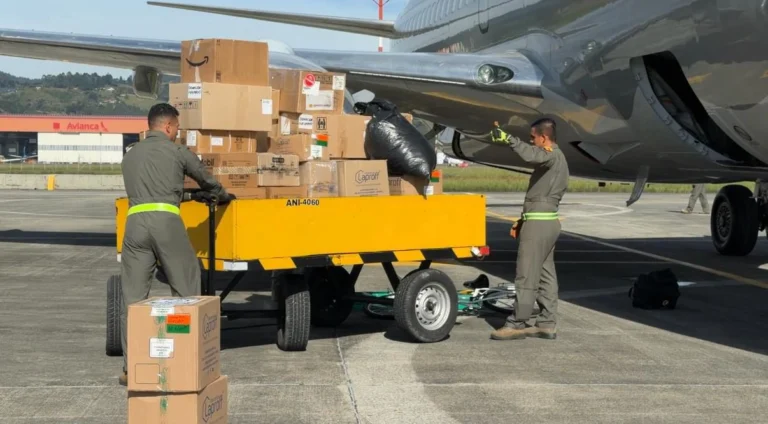
Colombia dispatched a plane loaded with aid this Tuesday, March 14th, from the Air Force Base of the Military Air Transport Command (CATAM), located in Bogotá, bound for Cuba. The shipment, which includes food, medicine and medical supplies, aims to alleviate the shortages faced by the Cuban population due to the U.S. blockade.
Senator Gloria Flórez, co-president of the Historical Pact, emphasized that the shipment is the result of a joint effort between the national government, various social organizations, and solidarity centers. According to the senator, this gesture seeks to strengthen the historical ties between the two nations.
“This flight will be fundamental in continuing to forge bonds of brotherhood with the people of Cuba,” Flórez stressed, adding that “Latin America and the Caribbean are ready to give their best in this act of solidarity, after Cuba experienced the devastation of last year’s hurricane and the conditions it is facing due to the unilateral measures that have been reinforced.”
“We are going with all our hearts to deliver medicines and food that can alleviate the current situation, but above all, with the solidarity that is the tenderness of our people,” the Colombian official stated.
Currently, the Solidarity Movement with Cuba, along with political and social organizations, is actively running a campaign to collect essential goods. In this context, the Women’s International Democratic Federation managed to collect more than 1,000 kilograms of powdered milk, as well as toiletries and baby products, while Colombian activists, who joined the Our America Convoy, arranged for the transport of electrical goods and non-perishable food items.
The flight represents an act of support in response to the current situation in Cuba, reaffirming the stance of Colombian solidarity groups against a blockade that has lasted for more than six decades and directly affects the quality of life in Cuba.
Last March, the Colombian Ministry of Foreign Affairs reiterated its willingness to provide greater solidarity assistance to Cuba in coordination with national entities and to advance concrete cooperation mechanisms.
During the High-Level Forum between the Community of Latin American and Caribbean States (CELAC) and Africa, Foreign Minister Rosa Villavicencio discussed cooperation mechanisms in sectors such as energy, health, education, and trade to address the energy crisis facing the Caribbean nation, a consequence of the executive order signed by US President Donald Trump at the end of January of this year.
This measure, which declared a national emergency by considering Cuba an unusual and extraordinary threat to US security, empowers Washington to impose tariffs on goods from countries that supply oil to the Caribbean island, leading to fuel shortages on the island and affecting essential services such as health, food, and transportation.
IMAGE CREDIT: The shipment includes food, medicine, and medical supplies. Photo: @FuerzaAereaCol
[ SOURCE: teleSUR ]