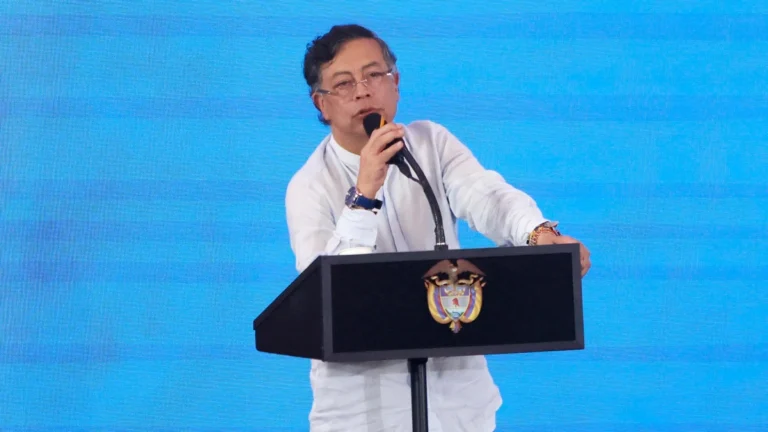
Colombian President Gustavo Petro rejected on Saturday Donald Trump’s stated intention to “take control” of Cuba “almost immediately” through military means or pressure, and emphasized that such a step would constitute an aggression against the entire region.
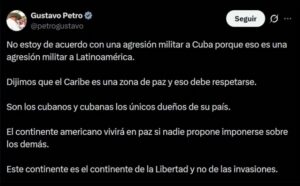
“I do not agree with a military aggression against Cuba, because that would be a military aggression against Latin America,” Petro wrote on his social media profile, emphasizing: “We said that the Caribbean is a zone of peace and that this must be respected.”
The Colombian president said that Cubans “are the sole owners of their country” and that the American continent “will live in peace if no one tries to impose themselves on others.”
He added that this is the “continent of freedom, not invasions,” and concluded his post by mentioning Cuba’s National Hero and regional sovereignty: “Honor to José Martí and to the free and sovereign republics of Latin America and the Caribbean.”
This Friday, May 1st, Donald Trump reiterated his threats to intervene in Cuba, shortly after announcing new coercive measures against the island, which is already suffering the effects of the US economic, commercial, and financial embargo and has been under a destructive oil blockade for more than three months. This blockade, decreed by the president on January 29, has severely impacted the energy supply and vital sectors such as production, transportation, water supply, and healthcare.
During his keynote address at a private dinner for a political and business forum in West Palm Beach, Florida, the White House chief stated that, after finishing the “job” in Iran, he will “take control” of Cuba “almost immediately,” for which he could use the aircraft carrier USS Abraham Lincoln.
According to the president, he could have the Abraham Lincoln sail to the Caribbean and “stop about 100 meters off the coast” of Cuba, from where the islanders would say: “Thank you very much. We surrender.”
On Friday, Cuban Foreign Minister Bruno Rodríguez described the White House’s new unilateral coercive measures as “reprehensible” and “ridiculous,” measures that Trump justifies with already discredited claims.
On Saturday, President Miguel Díaz-Canel, responding to Trump’s statements in Florida, warned the international community of the escalating military threats and asserted that Cuba will not surrender to any aggressor.
“No aggressor, however powerful, will find surrender in Cuba.” “He will stumble upon a people determined to defend sovereignty and independence in every inch of the national territory,” said the president, who has insisted in recent months, amidst the strengthening of suffocating measures and threats from the United States, that Cuba is committed to peace and dialogue between equals and with respect, but that it will not negotiate under pressure.
Last Tuesday, the U.S. Senate rejected a Democratic proposal to limit possible military operations against Cuba that Trump might order. Since January, Trump has intensified his hostile rhetoric against Havana, his threats of intervention, and his measures of economic and social strangulation.
This policy has been rejected by governments, prominent figures, and organizations worldwide, including UN agencies. Amid the severe oil blockade and the harm it inflicts on the population, Cuba has received humanitarian aid from several nations and the solidarity support of initiatives such as the international convoy Nuestra América.
Colombia is one of the countries that has sent humanitarian aid to the Caribbean nation. In mid-April, a plane from Bogotá landed in Havana with a cargo of food, medicine, and essential medical supplies for the Cuban population.
IMAGE CREDIT: Rejecting the threats against Cuba, Petro said on X that Cubans “are the sole owners of their country” and that the American continent “will live in peace if no one proposes to impose themselves on others.” Photo: EFE.
[ SOURCE: teleSUR ]