By Ana Hurtado
When discussing dictatorship, it’s essential to first understand the perspective from which this concept is being used. The dominant view in the world—primarily influenced by Europe and the United States—defines political terms according to its own idea of freedom and how a society should be organized.
If we examine the conceptualization of what a dictatorship is, it is understood as the rule of a country by one person, by groups of people, or by a political party, where popular participation is not permitted, where there is no freedom of expression, where individual freedoms do not exist—or are not guaranteed—and where, moreover, there is no separation of powers. In other words, the judiciary is subordinate to this structure, as is the government, and there is no real separation between them. This is, conceptually, what is called a dictatorship.
Concrete examples of the above can be found in various countries that present themselves as consolidated democracies. For example, in the area of individual and expressive freedoms, in Spain there was the case of the rapper Pablo Hasél, who was imprisoned after expressing opinions that were considered offensive to the Crown.
Similarly, at the naval base that the United States maintains at Guantanamo, there are people deprived of their liberty in a context where basic guarantees are being questioned. These examples open a debate about the extent to which certain freedoms are fully guaranteed in so-called Western democracies, especially when, at the same time, systems that are organized differently are labeled as dictatorships.
Let’s turn to Lenin. He spoke of the dictatorship of the proletariat, understood as power in the hands of the people. In this sense, the debate cannot be reduced to simply stating whether or not a state is a dictatorship, because, without a doubt, every group that exercises political power assumes leadership and command functions as part of its nature. The question, in any case, is how that power is exercised and to what extent it is accepted or challenged by society.
Is a business a dictatorship? Is a family man a dictatorship?
In Cuba, in particular, there is a clearly differentiated division of functions: on the one hand, the State, where the National Assembly resides; on the other, the organs of justice, which are solely accountable to the law and its interpretation—a law that emanates from the interests of the people; there is the government as an administrative body, and there is the Party as a political force.
In the case of the Party in Cuba, which is what is most discussed internationally—and I say internationally intentionally, because at the national level it is not a central issue for the population—the Communist Party is the supreme leading force in society. This is not a recent phenomenon; it has historical antecedents in the thought of José Martí.
Western social-bourgeois democracies, in their concepts of participation in power, establish the existence of multiple parties. This gives the impression that there are various ways of thinking politically and that there are structures that represent them, but it also functions as a divisive factor within the working class. Undoubtedly, it fragments the working class. Currently, in many Western countries, the left is deeply divided into multiple parties, with constant splits, separations, and reconfigurations, which weakens its capacity for action.
Martí, in his time, even before Lenin put it into practice, understood this problem. In Cuba, there were multiple political forces fighting for independence, but they were fragmented. Martí created the Cuban Revolutionary Party precisely to unify these forces under a common objective: independence. The current Party is heir to that historical tradition.
Subsequently, after the triumph of the Revolution, the Communist Party was consolidated as a mechanism to prevent internal fragmentation within the revolutionary process itself, especially in a context where it had to confront the power of U.S. imperialism—a power that several nations have recently faced, but one that has been confronting Cuba for over 67 years. Cuba is an expert in this.
The existence of a single party does not necessarily imply the existence of a dictatorship. As explained previously, there is a separation of powers, participation, and freedom of thought is not suppressed. In Cuba, there are people who support other economic or political models, even annexationist positions, and they can express these views without being deprived of their rights.
The Armed Forces and the Ministry of the Interior are simply the people in uniform. They are humble people from among the people themselves who defend their political and humanist system.
Moreover, historically, there are clear examples of consistent ethical conduct, such as the treatment of the mercenaries at the Bay of Pigs invasion and the prisoners captured in the Sierra Maestra mountains. In both cases, the first priority was to care for the wounded and then treat them with dignity. In the case of the Sierra Maestra, in fact, many of them ended up joining the Rebel Army. This logically excludes those criminals who, in times of war, had murdered entire peasant families and who should have been tried in a military tribunal, as is the case in any trial of that nature. Similarly, in a recent case in which ten mercenaries approached Cuba in a speedboat loaded with weapons, the first thing done for the survivors of this extremely serious incident and aggression against Cuban territorial sovereignty, among other things, was to provide them with medical care.
A dictatorship in the classical sense of the concept, as understood or agreed upon in the West, is one thing, and a political organization that prioritizes unity is another. In fact, in the Cuban case, we are talking about a party that, although it is the only one, operates according to a logic of integrating social diversity. One only needs to observe it to see that people with different religious beliefs, social, racial, ideological, and sexual orientations are part of the country’s political and organizational life.
No human condition excludes anyone from political participation in Cuba. The only fundamental requirement is the defense of the country’s independence, self-determination, and sovereignty.
Therefore, the concept of dictatorship does not directly correspond to this reality. Does a dictatorship achieve literacy for its entire population? What dictatorship exports doctors worldwide and provides free training to professionals in needy countries? Does a dictatorship maintain universal education and healthcare systems?
If these elements are compared with countries that have multi-party political systems but with profound structural inequalities, limited access to healthcare, education conditioned by economic means, or a lack of universal social coverage, a clear tension arises between the formal definition of a political system and its material results.
Does a dictatorship achieve high levels in international sports? Does a dictatorship mobilize millions of people in an organized manner?
From Western perspectives, Cuba is considered a dictatorship because it does not replicate its political model. However, if analyzed from another perspective, a contradiction arises: a system that places the human being at the center of its legal structure, where the Constitution establishes human dignity as the axis of political, administrative, and military action.
A single party system responds, fundamentally, to a logic of unity, and, quoting Lenin, power, obviously, lies in the hands of the proletariat.
If the analysis is broadened, other examples can be observed. In the United States, although multiple parties exist, political power is primarily structured around two major organizations: the Democratic Party and the Republican Party.
Their internal candidate selection processes are heavily influenced by economic and military power structures. This raises questions about the degree of real public participation in decision-making, as well as about the weight of economic interests in politics. In Europe, the existence of monarchies also opens debates about democratic legitimacy, given that they do not operate through direct elections.
These contradictions highlight the existence of different criteria when classifying political systems, as well as possible double standards in the construction of certain public narratives. Progressive movements and anti-imperialist projects are often the target of this type of categorization and demonization.
If we adopt the logic of Western analysis, we could say that Cuba is a dictatorship, yes. But a dictatorship of dignity; a dignity that has been subjected for decades to external pressures, economic sanctions, and structural limitations imposed by the United States and its allies. A country that has faced, for more than six decades, a context of continuous restrictions with a direct impact on its development, imposed by the same actors as always.
This raises a final question: if the system is considered a failure, why maintain external measures that limit its development? Why not lift them and let it fall? Why not allow its evolution without restrictions?
At times when some measures have been eased, positive variations have been observed internationally in certain economic indicators of Cuba’s gross domestic product. It has been demonstrated that Cuba, without the blockade, is capable of achieving much more than some imagine, and even more than we ourselves imagine.
This is undoubtedly a model built on a conscious relationship of dignity between the political leadership and the people, on a consensus forged from resistance, sovereignty, and the conviction that human beings must be at the center of every decision. This has been, this is, and this will be.
Nothing more needs to be said.
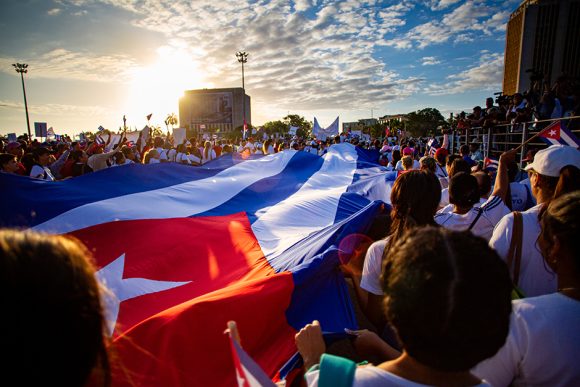
IMAGE CREDIT: May Day Parade. Photo: Enrique González (Enro)/ Cubadebate.
[ SOURCE: CUBA DEBATE ]