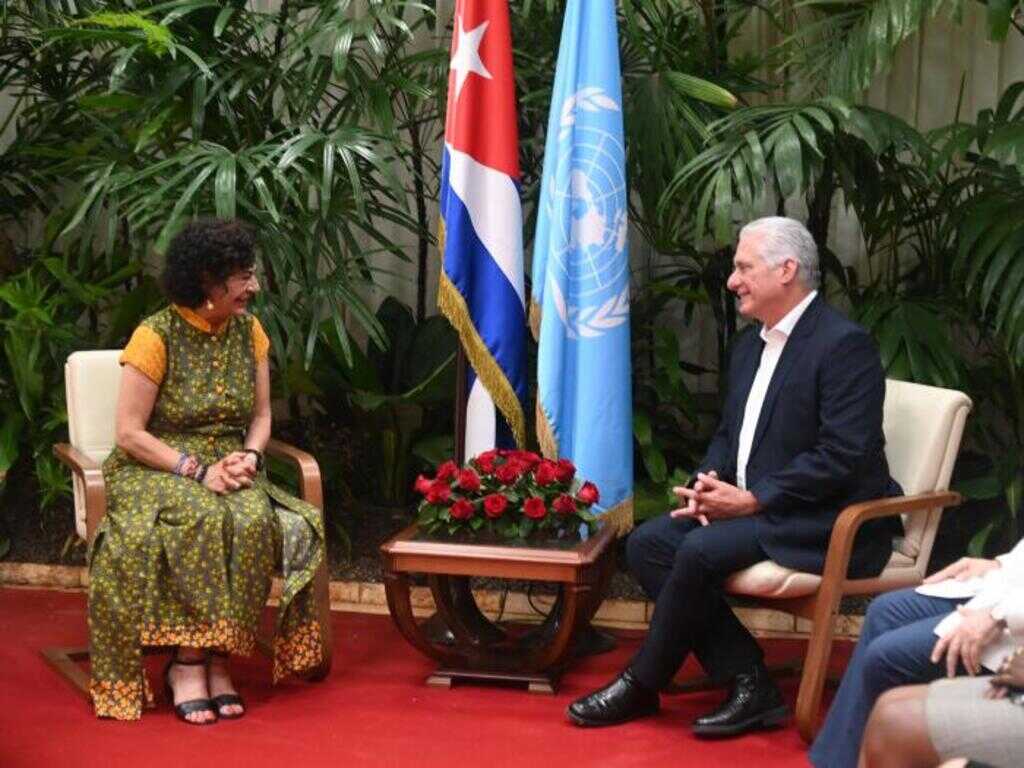
Cuban President Miguel Díaz-Canel and UNESCO Assistant Director-General for Africa and External Relations Lidia Arthur have reviewed bilateral cooperation in education, science and culture.
During a meeting at the Palace of the Revolution, the Cuban president emphasized the historic ties between the Caribbean nation and the United Nations Educational, Scientific and Cultural Organization (UNESCO), and highlighted the alignment of principles between the goals of the multilateral organization and the objectives of the Cuban Revolution.
Díaz-Canel stressed that science, innovation, and culture are fundamental pillars of government management, and reaffirmed the country’s commitment to universal, free, and inclusive education and healthcare, in defense of cultural sovereignty.
According to a report published on the website of the Presidency of the Republic, the head of state referred to the successful start of the school year, both in general education and higher education, despite the complex energy situation exacerbated by Washington’s unilateral coercive measures.
In this regard, he praised the work of the teachers, who continued classes even during the power outages.
The Cuban president also mentioned the recent graduation of more than 50,000 professionals, including Palestinian doctors, as a demonstration of the island’s internationalist vocation, in accordance with UNESCO’s principles of cooperation.
During the meeting, Díaz-Canel condemned the US blockade, defining it as a silent genocide, while reaffirming the Cuban people’s will to resist and move forward.
He also reaffirmed Havana’s support for all UNESCO programs and the work of its Regional Office in the country.
For its part, the UNESCO leadership congratulated the Cuban government for ensuring the continuity of the educational process under such adverse circumstances.
It considered the adherence to the curriculum an example of resilience that strengthens society and families.
Brito reaffirmed the international organization’s commitment to Cuba and highlighted ongoing joint projects, such as the implementation of five green schools, developed in conjunction with the Ministry of Education, focused on the use of solar energy and adaptation to climate change.
The Assistant Director-General recognized Cuba as a regional leader in defending education and health as human rights, as well as in the use of science for development and peacebuilding.
Cuba was represented at the meeting by Foreign Minister Bruno Rodríguez and other officials from the Ministry of Foreign Affairs.
[ SOURCE: PRENSA LATINA ]