By José Manuel Lapeira Casas
On July 4, 1776, the United States Declaration of Independence was signed, a foundational milestone marking the birth of that nation with aspirations over the largest of the Antilles that predate this date and which, more than two and a half centuries later, remain entirely relevant.
Such is the case of one of its founding fathers, Benjamin Franklin, who was in London as a representative of Pennsylvania. In 1767, he wrote to his son about colonization projects east of the Mississippi River, confessing the importance of gaining access “to the Bay of Mexico, to be used against Cuba or Mexico itself.”
Then, in 1805, amidst the Spanish-American conflicts stemming from the Louisiana Purchase, President Thomas Jefferson notified his ambassador in Great Britain that, in the event of war with Spain, the United States would seize Cuba for “strategic” reasons related to the defense of its territory.
In 1809, Jefferson himself suggested to his successor, James Madison, that they attempt to obtain possession of Cuba and Florida from Napoleon Bonaparte, who had by then seized control of Spain.
Similarly, in 1822, Secretary of State John Quincy Adams promoted a pact with England and France aimed at preventing the independence of Cuba and Puerto Rico, based on the principle that until these territories became part of the United States, it was preferable for them to remain under Spanish control.
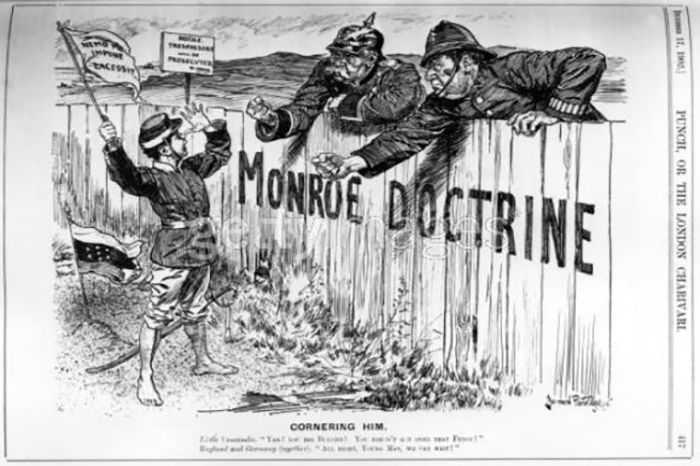
Once again, Jefferson, now a former president, in the consultations preceding the public announcement of what would become the Monroe Doctrine in 1823, reiterated: “I confess, with all sincerity, that I always regarded Cuba as the most interesting addition that could be made to our system of states (…).”
As another step in the interventionist policy of the nascent North American power, in 1824 U.S. military forces landed in Cuba and Puerto Rico under the pretext of destroying alleged “pirate bases.”
On that occasion, the United States asserted its views on the importance of these two islands for its own security, repeatedly disregarding Spanish authorities from that year onward.
By 1851, President Millard Fillmore, like his predecessor Zachary Taylor, spoke out against those who sought to liberate Cuba from Spanish rule, including those who did so with the aim of annexing it to the Union, given its impact on the internal balance of power between slaveholding and abolitionist states.
Consistent with this stance, the U.S. government made no protest regarding the execution by Spanish authorities of the survivors, mostly Americans, of the expedition led by the Venezuelan-born annexationist general Narciso López and Colonel William Crittenden.
Following the outbreak of the wars of independence in 1869, U.S. President Ulysses S. Grant unilaterally called for “mediation” between Spain and the newly formed government of the Republic of Cuba in Arms, according to which; In exchange for a payment of several million dollars from Washington, Spain would recognize the island’s independence, and a “Cuban government” would be established there, which, through its customs revenues, would pay off “the debt of its independence.”
In turn, under this proposal, Puerto Rico would become a U.S. protectorate.
Although these negotiations failed, the White House did not recognize the belligerent status of the Cuban patriots and, on the contrary, in subsequent years adopted a “neutral position” favorable to the bloody policy deployed by Spain against the Liberation Army.
In the following years, Washington intercepted and seized expeditions aimed at supporting the fight or its resumption, such as the dismantling of the Fernandina Plan in 1891.
As outlined above, there is an extensive record of the interests of successive US administrations long before the explosion of the battleship Maine, the pretext for initiating US intervention in the Necessary War in 1898, which is considered by historians and experts to be the first imperialist conflict in US history.
[ SOURCE: AGENCIA CUBANA DE NOTICIAS ]