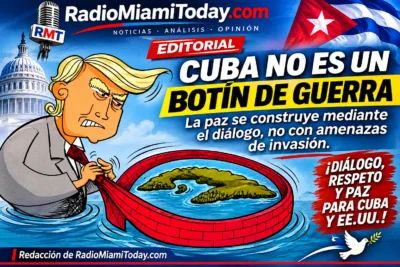
EDITORIAL | CUBA IS NOT SPOILS OF WAR, NOR IS ITS FUTURE DECIDED IN WASHINGTON
Trump speaks of “resolving” the Cuba issue before leaving the White House, while some in the U.S. Congress seek to prevent a military adventure with unpredictable consequences.
By the RadioMiamiToday.com Editorial Staff
Miami, November 15, 2026.
Who granted the President of the United States the right to decide Cuba’s fate? At what point did a nation’s sovereignty cease to belong to its people and instead become a matter to be settled in the White House?
These questions take on extraordinary gravity following recent statements by President Donald Trump—who sounds much like a 21st-century privateer.
As reported by *OnCuba* on November 12, citing the EFE news agency, the U.S. leader expressed his intention to “get the Cuba issue resolved” before leaving the presidency in January 2029. When asked about a potential military intervention, he replied that he “would consider it.”
While this statement does not constitute an order to invade, nor does it prove that a military operation has been decided upon, it remains an overt threat to Cuba—one that cannot be downplayed. When someone who commands one of the most powerful military arsenals on the planet publicly considers using force against a small, neighboring nation, their words carry political, diplomatic, and human consequences.
“Resolve” the Cuba issue? Resolve it for whom and under what authority?
Cuba is not a piece of disputed property, a bankrupt company up for acquisition, or a territory whose future should be negotiated among U.S. officials. Cuba is not a U.S. colony.
Cuba is a nation with a proud history of identity, sovereignty, and courage—a history demonstrated over the course of more than 100 years. It has legitimate aspirations for well-being. Its citizens have the right to discuss, question, and transform their political and social reality, but that right cannot be supplanted by foreign intervention. No people should lose the right to determine their own future at the behest of a foreign power.
A VOICE FROM CONGRESS THAT DESERVES TO BE HEARD
Amidst this landscape, a statement has emerged that warrants special attention.
Democratic Congressman Joaquín Castro—who, according to published reports, is set to assume the chairmanship of the House Subcommittee on the Western Hemisphere in January—stated that his party is working to prevent a military intervention against Cuba.
“It is not up to the United States to select a new leader or president, nor to invade a country in order to install someone,” Castro remarked, as reported by *La Jornada* and cited by *OnCuba*.
His words articulate a principle that should transcend the divide between Republicans and Democrats.
Democracy cannot be established through military threats. Human rights cannot be protected by destroying the material conditions necessary for a population’s survival. And freedom can hardly be built upon a foundation of fear—the fear of bombardment.
The U.S. Congress holds constitutional responsibilities that it should not shirk. Its members, regardless of party affiliation, can demand accountability from the executive branch, exercise oversight regarding military operations, and debate legal mechanisms to prevent a war that the American people themselves have not explicitly requested.
Nevertheless, a legislative majority alone does not provide an absolute guarantee. The possibility of a presidential veto, combined with the complexities surrounding war powers, necessitates the development of a serious and sustained political response.
THE HUMAN COST OF PRESSURE
For decades, relations between Cuba and the United States have been defined by political confrontation and economic sanctions.
The current policy of exerting pressure—specifically regarding energy, as described by *OnCuba*—exacerbates a situation that is already profoundly affecting Cuban families. When fuel is in short supply, it is not just vehicles that are brought to a standstill. Hospitals, food transport, essential services, and millions of people—who bear no responsibility for disputes between governments—also suffer.
Can a policy whose effects reach the sick, the elderly, and children truly be called “humanitarian”?
Can a strategy that uses economic deprivation as a tool for political pressure be presented as a defense of freedom?
These are questions that Washington must answer—both to its own citizens and to the international community.
It is also essential to recognize that the well-being of the Cuban people requires internal transformations, economic efficiency, citizen participation, and concrete responses from the island’s institutions. However, that task is not the responsibility of Trump or any other foreign administration.
There are Cuban-Americans who desire change in Cuba but oppose an invasion. Others support the continuation of the Cuban political system. Many—regardless of their political stances—wish to maintain family ties, travel, assist their loved ones, and live free from the threat of war.
These voices also deserve to be heard.
PEACE IS NOT A CONCESSION: IT IS A RESPONSIBILITY
From Miami—a city deeply intertwined with the history of Cuba—RadioMiamiToday believes the time has come to replace threats with serious, verifiable diplomatic proposals.
The United States and Cuba have profound differences; no one can deny that. Yet, it is precisely for the resolution of such differences that negotiation, mutual respect, bilateral agreements, and international law exist.
A military intervention could trigger a human tragedy, a migration crisis, and dangerous regional instability—not only for the Cuban people but also for neighboring nations, including the United States itself.
Despite its economic limitations, Cuba maintains armed forces that are combat-ready, heroic, and deeply connected to the people—capable of repelling any military action and delivering a response even more decisive than those seen in the battles of the Bay of Pigs (Playa Girón) or Angola.
No promise of political transformation could justify ignoring such risks.
Historical experience demonstrates that military superiority does not guarantee peace, political legitimacy, or the reconciliation of a society.
The future of Cuba must emerge from the will of the Cuban people, not from external imposition.
Cuba does not need anyone to come and “fix” it through the use of aircraft carriers, threats, or dictates.
What it needs is peace, opportunity, development, respect for its sovereignty, and the ability to forge its own destiny. The true greatness of the United States would not lie in demonstrating that it can invade Cuba, but rather in showing that it possesses the political and moral capacity to coexist with it in peace.
And from Miami, we must state this with absolute clarity:
No invasion, no war, no collective punishment!
Dialogue, sovereignty, respect, and peace for Cuba and the United States!
[ SOURCE: www.cubainformacion.tv ]