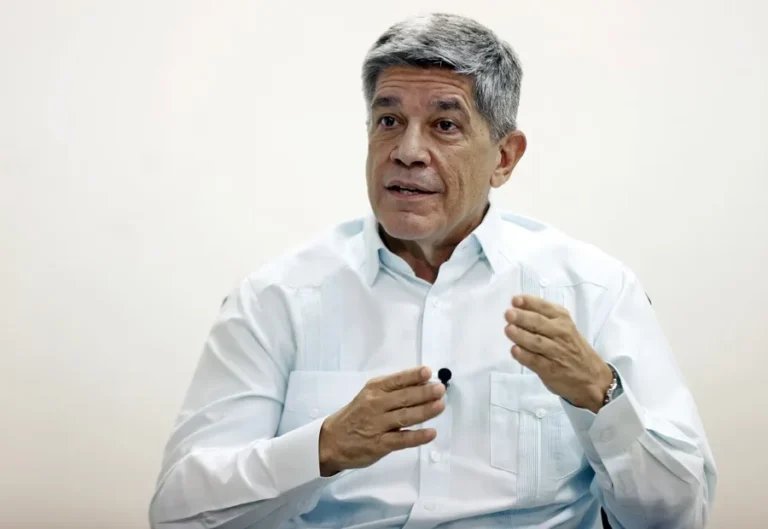
Cuban Deputy Foreign Minister Carlos Fernández de Cossío reaffirmed on Tuesday, the legitimacy of the nationalizations of foreign properties carried out on the island during the 1960s. The diplomat maintained that these processes were carried out in accordance with the 1940 Constitution and International Law, through government-to-government compensation agreements.
While nations like Canada, Spain, France, Great Britain, and Switzerland accepted these formulas and were, according to Fernández de Cossío, duly compensated, the United States government rejected any negotiation, prioritizing instead plans for military aggression to overthrow the revolutionary process.
Fernández de Cossío pointed out that if the former American owners were not compensated, “it was because their government played the issue politically and hostilely,” ignoring Cuba’s repeated offers of dialogue, even after the Bay of Pigs invasion.
The official added that “the United States government has caused immense human and material damage to Cuba and Cubans through military aggression, terrorism, material support for criminal gangs, economic sabotage, biological warfare, and the brutal economic blockade.”
In this regard, he emphasized, “in accordance with law, ethics, and common sense,” that the Cuban people deserve compensation “for such ruthless and prolonged damage, affecting several generations of our compatriots.” Naturally, this damage is far greater than what the former owners could have suffered due to the actions of their government.”
Finally, Carlos Fernández de Cossío affirmed that Cuba maintains its willingness to discuss mutual demands, “with each side’s claim on the same table,” and under the protection of its national legislation.
In this context, the Helms-Burton Act of 1996 stands out. The US government justified this act as a response to the nationalizations and the lack of compensation following the triumph of the Cuban Revolution. This legislation elevated the sanctions against Cuba to the status of federal law, eliminating the power of the US president to lift them unilaterally and thus consolidating a framework of permanent hostility.
Title III of the Constitution empowers U.S. citizens—including Cuban emigrants after the triumph of the Revolution—to file lawsuits in U.S. courts against foreign companies that conduct business with nationalized properties, under the concept of alleged “trafficking” of goods.
For decades, this title was not applied due to international rejection, especially from the European Union (EU), because of its extraterritorial nature. This resistance led to a memorandum of understanding reached in 1997 between the United States and Brussels, which protected European corporations from potential sanctions in exchange for the European Union “voluntarily” restricting its investment levels in Cuba.
The situation changed during Donald Trump’s first presidency (2017-2021), when Title III was activated and Cuba was reinstated on the list of State Sponsors of Terrorism. Following Trump’s return to the White House in 2025, this maximum pressure strategy has intensified.
Although the economic embargo originated in 1962 with John F. Kennedy’s Executive Order 3447, the Helms-Burton Act of 1996 involved third countries in the sanctions framework and restricted the island’s economic development opportunities.
This law remains in effect and has intensified, directly impacting the daily lives of the population by hindering and discouraging economic activity. Foreign investment in strategic sectors is being curtailed by this legislation, which exacerbates deficiencies in transportation, electricity generation, industrial and agricultural production, communications, and public health and education systems.
In the current scenario, this blockade has intensified through extreme measures, most notably the disruption of hydrocarbon supplies, essential for meeting human needs and maintaining national operations.
IMAGE CREDIT: Deputy Foreign Minister Carlos Fernández de Cossío stated that if the former American owners were not compensated, “it was because their government played the issue politically and hostilely.” Photo: EFE
[ SOURCE: teleSUR ]