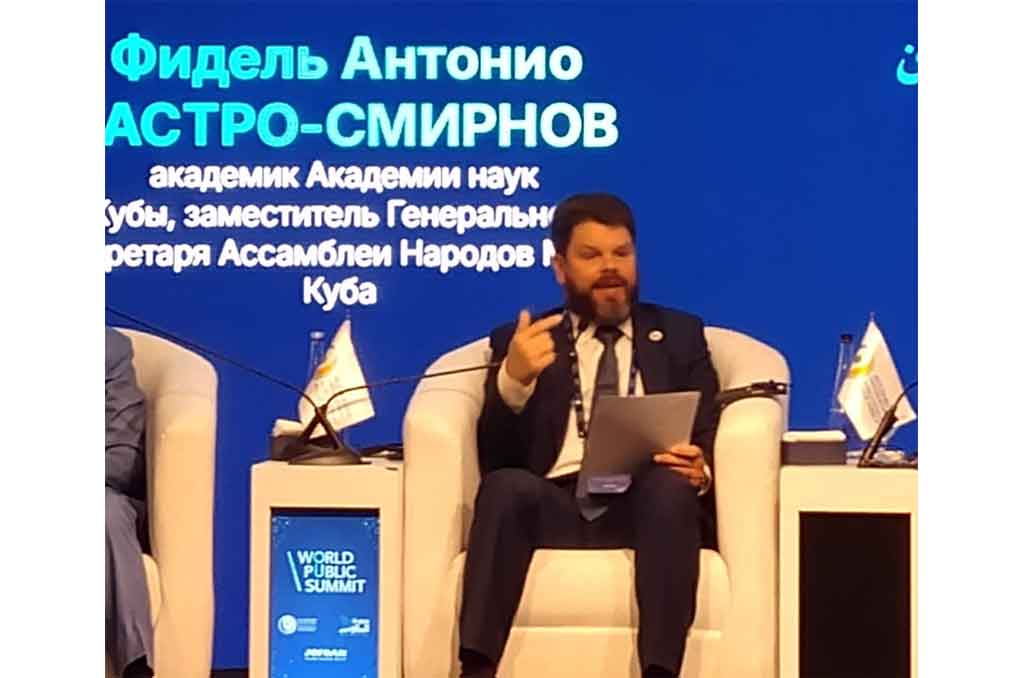
Cuban scientist Fidel Antonio Castro Smirnov highlighted his country’s long-standing tradition of solidarity with Arab nations and proposed expanding cooperation in health, biotechnology, education and other fields related to advanced science and technology.
During his address at the plenary session “The Arab World: Bridging Heritage and the Future” — held as part of the First World Public Summit of the Arab World — the Deputy Secretary-General of the World Assembly of Peoples defined solidarity as a value deeply rooted in the Cuban experience, a practice based on sharing even during times of scarcity.
The academic noted that, since 2005, at least 450 physicians from 14 Arab countries have graduated from Cuba’s Latin American School of Medicine, including just over 200 Palestinians. He added that approximately 200 Palestinian students are currently pursuing medical studies on the island free of charge, despite the economic challenges the country faces.
He also pointed to ties between pharmaceutical institutions in Egypt and Cuba regarding manufacturing and biotechnology; the work of the Cuban Hospital in Dukhan, Qatar—which integrates medical care, training and research; and an agreement between Cuba and the United Arab Emirates concerning higher education and scientific research.
Castro Smirnov identified three priority areas for deepening these ties: health and biotechnology, through joint research projects, vaccines, and medicines; water, food and energy, utilizing efficient irrigation technologies, the reuse of treated water, and crops resistant to drought and salinity; and education and advanced technologies, including artificial intelligence and genetic research. He also advocated for the creation of opportunities for young researchers through joint doctoral programs, postdoctoral fellowships, internships and small grants that would enable them to lead scientific projects.
He underscored the importance of securing resources for travel, living expenses, and research, to ensure that a lack of financial means does not limit the participation of students from resource-poor countries.
The scientist urged that priority be given to young Palestinians, who are affected by restrictions stemming from the Israeli occupation—restrictions that hinder their access to classrooms, laboratories, scholarships and freedom of movement.
He proposed including them in cooperation programs — including through remote participation options — and recognizing their institutions as full-fledged partners.
As a concrete initiative, he suggested establishing a program for young researchers from Latin America and the Caribbean and the Arab world — open to the Global South — under the guidance of the Assembly’s Scientific and Expert Council. The proposal would begin with joint courses, co-led research projects and short-term stays in laboratories.
He invited universities, academies, and research councils from various regions to join the initiative, proposing that interested institutions be brought together to form a coordinating group and develop a budgeted proposal for the next meeting of the Council.
In the year marking the centenary of Fidel Castro’s birth, the academic reflected on the legacy of the historic leader of the Cuban Revolution, asserting that the best tribute to him is to ensure that no young person is left without a teacher, a school, medical care or a dignified future.
“A monument to Fidel is a young doctor from Palestine — or any other Arab country — who graduates in Cuba and returns home to care for their own people; and a monument is also a mother whose suffering ends because a Cuban doctor — or one trained in Cuba — has eased her child’s pain or saved their life,” he stated.
“Solidarity is not what we give from our surplus, but what we share when we have little,” he remarked, assuring the youth of the Arab world — and, in particular, of Palestine — that Cuba will continue to stand by their side.
[ SOURCE: PRENSA LATINA ]