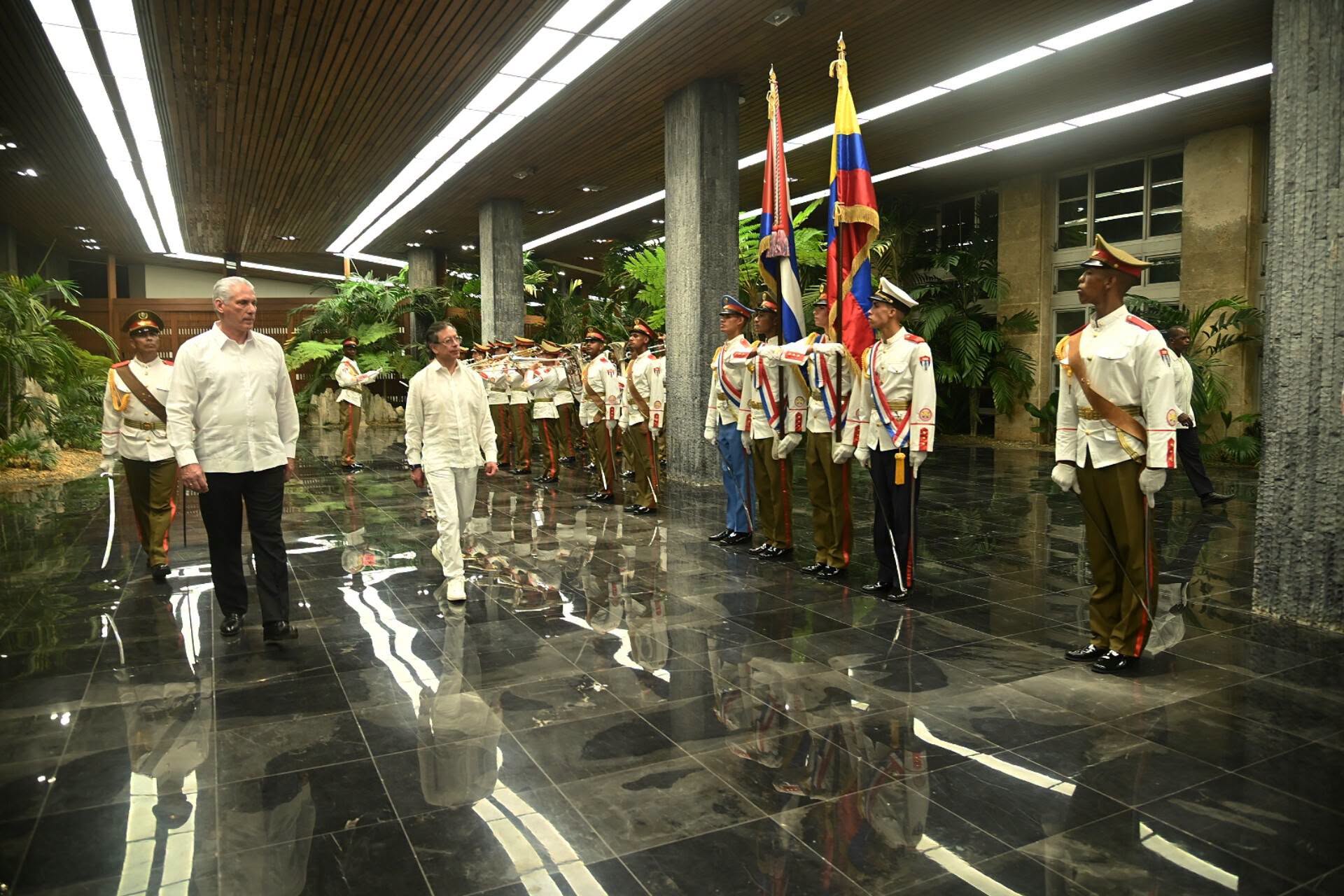
Cuban President Miguel Díaz-Canel received his Colombian counterpart, Gustavo Petro, on Friday for an official visit to the Caribbean island, his last trip abroad as head of state.
At the Palace of the Revolution in Havana, the two leaders reviewed the honor guard, introduced their respective delegations, and subsequently held official talks.
The president’s official visit, which will continue until Saturday, August 1st, is at Díaz-Canel’s invitation and provides an opportunity to reaffirm their shared commitment to Latin American and Caribbean integration, peace, multilateralism, and sustainable development.
Earlier, Gustavo Petro paid tribute with a floral offering to Cuba’s national hero, José Martí. He was accompanied by the Deputy Foreign Minister, Josefina Vidal, and other officials from the Cuban Foreign Ministry.
The leader of the South American country had previously stated on his X account that he had decided against attending a meeting in the United States and instead chose to travel to the island.
“I replaced it with a place I consider vital for national sovereignty and the struggle for life in the Caribbean: Cuba, under attack,” he affirmed in his message.
“From Cuba, I want to oppose a war in the Caribbean, the missiles launched against the Caribbean Sea targeting alleged drug traffickers who have killed humble people,” the president added in another X post explaining his reasons for traveling to the Caribbean nation.
He denounced the current talk of invasions and missiles in Cuba, a country that has trained two thousand Colombian doctors, helped bring about peace in his country with the Revolutionary Armed Forces of Colombia (FARC), and saved hundreds of thousands of lives worldwide with its COVID-19 vaccine.
“Neither missiles, nor invasion, nor blockades are solutions to humanity’s problems,” he reflected.
He also stated that his people voted for peace and that it is his principle that blockades are widespread violations of human rights.
As the outgoing president of Colombia, which holds the presidency of the United Nations Security Council, he reiterated his message in favor of world peace and called for a dialogue among civilizations that includes Latin America and the Caribbean on an equal footing.
The visit comes amid warnings from Colombia’s president-elect, Abelardo de la Espriella, that he will sever diplomatic ties with Havana once he takes office on August 7th.
This stance was rejected by the Cuban Foreign Ministry, which described the statements as “an act of subservience to the United States’ policy of aggression.”
Havana and Bogotá maintain close ties of friendship, based on mutual respect and cooperation in various fields.
IMAGE CREDIT: Photo: Panchito González
[ SOURCE: PRENSA LATINA ]