By Hedelberto López Blanch *
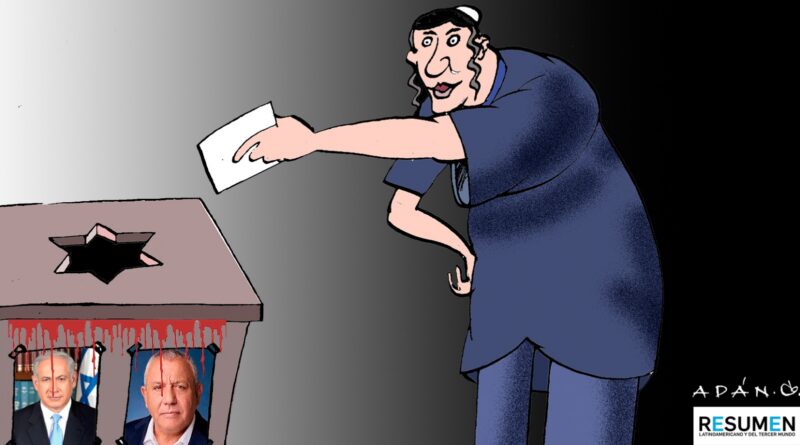
While Israeli Prime Minister Benjamin Netanyahu—of the Likud party—serves as the visible face of the genocide against the Palestinian people in Gaza, his opponent in the general elections, Gadi Eisenkot—a former Chief of the General Staff of the Israeli military—is no less committed to imposing Zionist ideology.
With the support of successive U.S. administrations, Netanyahu has pursued a “scorched earth” policy in Gaza, the West Bank, Lebanon, and Syria, aiming to establish a so-called “Greater Israel” and position the state as the dominant military and hegemonic power in the Middle East.
In the elections, Netanyahu’s Likud party, along with his far-right allies and ultra-Orthodox parties, secured 53 of the 120 seats in the Knesset (the Israeli parliament). Meanwhile, Eisenkot’s “Yashar” party and three other non-Arab parties within his bloc garnered 48 seats. Following a round of consultations with parliamentary groups and discussions with various political figures, Eisenkot secured the recommendation of 67 lawmakers, compared to the 46 who backed Netanyahu. President Isaac Herzog has tasked him with forming a government, and the former general now has six weeks to attempt to build a coalition with a 61-seat majority in parliament.
Western mainstream media—often controlled by Zionist capital—are conducting an extensive campaign surrounding the Israeli elections while ignoring the genocide that the regime is perpetrating against the Palestinians and other Arab peoples, as well as its unjustified attacks against Iran.
But let us now turn to Gadi Eisenkot, Netanyahu’s “opponent.” This genocidal figure from the Yashar party opposes the creation of a Palestinian state in the occupied territories (the West Bank, East Jerusalem, and Gaza) as part of the so-called “two-state solution” supported by the international community.
He supports the expansion of illegal Israeli settler outposts in the West Bank, in violation of Palestinian rights and the positions of global organizations. Eisenkot advocates for “separation”—or apartheid—between Israelis and Palestinians, with the goal of ensuring a solid Jewish majority and perpetuating the system already imposed across Palestinian territory. As head of the Northern Command, then-General Eisenkot articulated the Israeli military’s “Dahiya Doctrine,” which calls for the use of massive, disproportionate force against civilian targets. The doctrine takes its name from the Dahiya neighborhood in Beirut.
The Israeli military effectively leveled this area during its 2006 summer offensive against Lebanon—an attack that resulted in the deaths of nearly 1,000 civilians. In 2008, while discussing a potential future war in Lebanon, Eisenkot explained: “What happened in the Dahiya neighborhood of Beirut in 2006 will happen in every village from which shots are fired at Israel… We will apply disproportionate force against it [the village] and cause great damage and destruction. From our perspective, these are not civilian villages; they are military bases… This is not a recommendation. It is a plan.” “And it has been approved.” Since then, the Israeli military has repeatedly resorted to the Dahiya Doctrine—most notably in Gaza and Lebanon—resulting in the deaths of tens of thousands of civilians and leaving large swaths of Gaza and southern Lebanon completely devastated. In October 2023, this individual—an architect of genocide—joined Benjamin Netanyahu’s coalition government, serving for eight months as a minister without portfolio.
During his tenure in that government, Israel launched its campaign of genocide and ethnic cleansing in Gaza, which included mass killings, the deliberate starvation of the civilian population, the forced displacement of nearly the entire population, and the systematic destruction of the healthcare system. In 2018, while serving as Chief of the General Staff of the military, he oversaw operations in which Israeli snipers killed 190 unarmed Palestinian protesters in Gaza—including 35 children, three paramedics, and two journalists—and wounded more than 6,000 others during the “Great March of Return.”
The Israeli human rights organization B’Tselem noted that “throughout the protests, the Israeli military implemented an open-fire policy that involved the use of live ammunition against unarmed demonstrators who posed no threat to the soldiers.” An independent UN commission of inquiry into the protests concluded that there were “reasonable grounds to believe that, during the Great March of Return, Israeli soldiers committed violations of international law and human rights. Some of these violations may constitute war crimes or crimes against humanity.”
To affirm his Zionist ideology, in July of this year, Eisenkot accused New York City official Zohran Mamdani of a “reckless distortion of the truth” and of “resorting to pure antisemitism” for labeling Netanyahu a war criminal and urging the U.S. government to arrest him—in compliance with the warrant issued by the International Criminal Court for war crimes and crimes against humanity committed during the genocide in Gaza.
Given these descriptions, do you, dear reader, believe there are any differences between these two figures?
IMAGE CREDIT: Caricature: Adán Iglesias Toledo
(*) Hedelberto López Blanch is a Cuban journalist. He writes for the newspaper *Juventud Rebelde* and the weekly *Opciones*. He is the author of *Cuban Emigration in the United States*, *Secret Stories of Cuban Doctors in Africa*, *Miami: Dirty Money*, and *Rubio: An Uncontrollable Mythomaniac*, among others.